Copyright infringement remains a serious problem in Vietnam. A common practice today is for publishers to arbitrarily take other people's works and publish them in books. If no one finds out, it's usually fine, but if someone discovers it, the publisher only pays royalties as a token gesture.
As reported by SGGP newspaper, the publication "Large Print Book - Poems for Children Learning to Read" (published by An Phuoc Books Vietnam Co., Ltd. in collaboration with Vietnam Women's Publishing House) used poems by several authors such as Khuc Hong Thien, Dinh Ha, Ho Huy Son, etc., without permission. When author Khuc Hong Thien spoke out, the publisher announced they would send 10 complimentary copies of the book and a royalties of 140,000 VND for two poems. However, after nearly 20 days, author Khuc Hong Thien has only received the complimentary copies, and the royalties have yet to be paid.
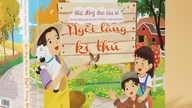


The poem "The Cow Looking in the Mirror" by author Huu Vi was published in the book "Nursery Rhymes - Poems - Stories for Babies Learning to Speak" (Dai Mai Books and Vietnam Women's Publishing House), and later appeared in another book, "Poems for Babies Learning to Speak" (Dai Mai Books and Vietnam Women's Publishing House). Huu Vi was unaware of both instances of the poem being published in books. He stated: "It wasn't until 2022, when I accidentally discovered that the book 'Nursery Rhymes - Poems - Stories for Babies Learning to Speak' contained my poem, that I complained on my personal page. An old acquaintance contacted me and offered 300,000 VND in royalties. Out of politeness, I let it go. However, recently I discovered that the poem was again published in the book 'Poems for Babies Learning to Speak' without any contact. As an author, I feel upset because I haven't been respected."
In 2004, Vietnam joined the Berne Convention on the Protection of Intellectual Property and Copyright, and it has been 20 years since then. We also have the Intellectual Property Law and the Publishing Law, the most fundamental principle being that any use of a work without the author's permission constitutes copyright infringement. In such cases, the parties involved will have to compensate the author for damages, rather than only paying royalties after the infringement is discovered, treating it as a favor.
All justifications are very weak, while in principle, no individual or organization is allowed to use a work without the author's consent. Not to mention, in this day and age, finding information about an author is not difficult at all. The important thing is whether these entities want to live and work within the law!



QUYNH YEN
Source