

According to Live Science, a report recently presented at the American Astronomical Society conference shows that asteroid Dimorphos has been continuously tumbling in its old orbit around its parent asteroid Didymos and has been steadily decelerating for at least a month after its collision with NASA's DART spacecraft.
Dimorphos was a much-talked-about name in 2022, when NASA conducted a groundbreaking Earth defense experiment.
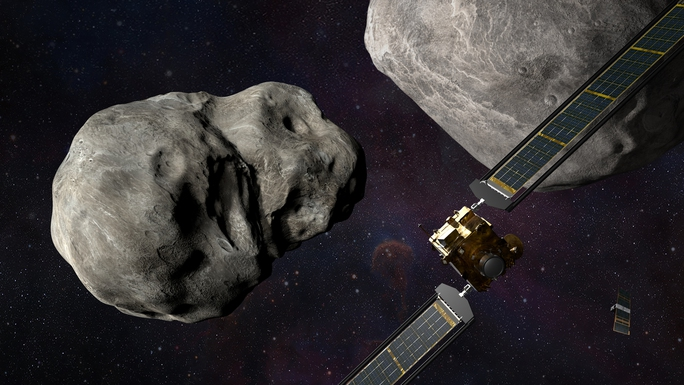
NASA's DART spacecraft on a straight course towards Dimorphos (left). (Graphic image: NASA)
NASA's Binary Asteroid Redirection Test (DART) includes a suicide lander of the same name tasked with targeting the smaller of the near-Earth asteroids Dimorphos and Didymos.
In this pair, Dimorphos acts as a smaller moon orbiting Didymos. Predictive models don't suggest either will pose a threat to Earth in the near future, but its position is a perfect choice for a test.
In a hypothetical scenario where Dimorphos posed a threat, NASA's DART spacecraft—in a suicide mission—crashed directly into the asteroid with the goal of knocking it out of its original orbit.
The experiment was initially successful, and the asteroid began to change its orbit and speed immediately after impact. However, it did not change in the way predicted.
The new discovery was made by high school teacher Jonathan Swift and his students. The research also shows that the asteroid appears to have slowed down by up to 1 minute in its orbit just a month after impact, then seemingly rebalanced itself.
Its slowdown was also inconsistent. According to Swift, this may have been due to the "cloud" of debris created by the impact, which NASA had previously stated was very large, continuously causing small collisions with the asteroid throughout the first month.
Meanwhile, NASA's DART team calculated that the asteroid had slowed down by just 15 seconds, with preliminary results published fairly soon after the experiment.
Since then, Dimorphos and its parent asteroid, as well as the debris cloud, have been closely monitored by the space agency. The DART team plans to release its own report next week.
However, to get a full answer about the impact of the attack, we will have to wait until 2026, when the European Space Agency's (ESA) Hera spacecraft approaches Dimorphos for a direct investigation, in a mission in collaboration with NASA.
(Source: Nguoi Lao Dong Newspaper)
Source
![[Photo] Closing Ceremony of the 10th Session of the 15th National Assembly](/_next/image?url=https%3A%2F%2Fvphoto.vietnam.vn%2Fthumb%2F1200x675%2Fvietnam%2Fresource%2FIMAGE%2F2025%2F12%2F11%2F1765448959967_image-1437-jpg.webp&w=3840&q=75)

















































![[OFFICIAL] MISA GROUP ANNOUNCES ITS PIONEERING BRAND POSITIONING IN BUILDING AGENTIC AI FOR BUSINESSES, HOUSEHOLDS, AND THE GOVERNMENT](https://vphoto.vietnam.vn/thumb/402x226/vietnam/resource/IMAGE/2025/12/11/1765444754256_agentic-ai_postfb-scaled.png)















































Comment (0)