

Along with Ho Chi Minh City, provinces in the Southeast region have also planned to develop the space along the Dong Nai River. Many modern, eco-friendly urban development projects are gradually taking shape.
The formation of many new urban areas.
The Dong Nai River (known as the Cai River) flows through Dong Nai province for 200km, passing through Tan Phu, Dinh Quan, Vinh Cuu districts, Bien Hoa City, and Nhon Trach and Long Thanh districts. Of this, the section bordering Dong Nai and Ho Chi Minh City is over 50km long, making it favorable for developing an economic corridor and exploiting the landscape. Dong Nai province is implementing many urban beautification projects along the main riverside route through Bien Hoa City to improve urban transportation infrastructure and create a scenic riverside environment.
Several districts in the province with rivers running through them have also planned to exploit the riverside landscape and develop new urban areas. A prime example is the construction of two riverside roads with a total investment of 5,200 billion VND, spanning from Vinh Cuu district - Bien Hoa city - Long Thanh - Nhon Trach, linked with the organization of diverse and appropriate recreational activities in the riverside area, while simultaneously restoring cultural and historical resources along the river.
This also serves as a foundation for the development of Vinh Cuu and Nhon Trach districts, which have many projects but have not yet fully realized their urban potential. In particular, the riverside road helps Nhon Trach district connect with Route 319, the Ho Chi Minh City - Long Thanh - Dau Giay Expressway, and the Ben Luc - Long Thanh Expressway. Furthermore, Dong Nai province plans to develop Pho Island (Hiep Hoa Ward, Bien Hoa City) into the core of Bien Hoa urban area, functioning as a regional center for history, culture, commerce, finance, and ecology, covering an area of 293 hectares with an estimated population of 31,600 people.
The project, with an investment capital of over 72,200 billion VND, will be implemented over 12 years (from 2023-2035), aiming to create a new urban area and service complex with low construction density, modern design, and harmony with the natural landscape. It will focus on sustainable tourism development, diversify housing types, and integrate with public commercial and service centers. In addition, along the Dong Nai River section passing through Bien Hoa City and the districts of Long Thanh and Nhon Trach, many new urban area projects, entertainment areas, and tourist destinations are being developed, such as Tan Van Island, Ba Xe Island, Buu Long Tourist Area, Aqua City Novaland residential area (1,085ha), Waterfront Nam Long (170ha) (Bien Hoa City), Dai Phuoc ecological urban area (550ha) and SwanBay (200ha) (Nhon Trach district)...
Developing ecotourism along the river
In Binh Duong province, the Dong Nai River flows through Tan Uyen City and Di An City. To capitalize on the riverside advantages, Binh Duong province is pursuing the development of eco-tourism areas and low-density urban areas along the river. Numerous surveys and assessments of eco-tourism potential have been conducted in coordination with the People's Committee of Tan Uyen City (an area with many regions surrounded by the Dong Nai River), and efforts are gradually underway to develop eco-tourism routes and scenic spots to attract domestic and international tourists.
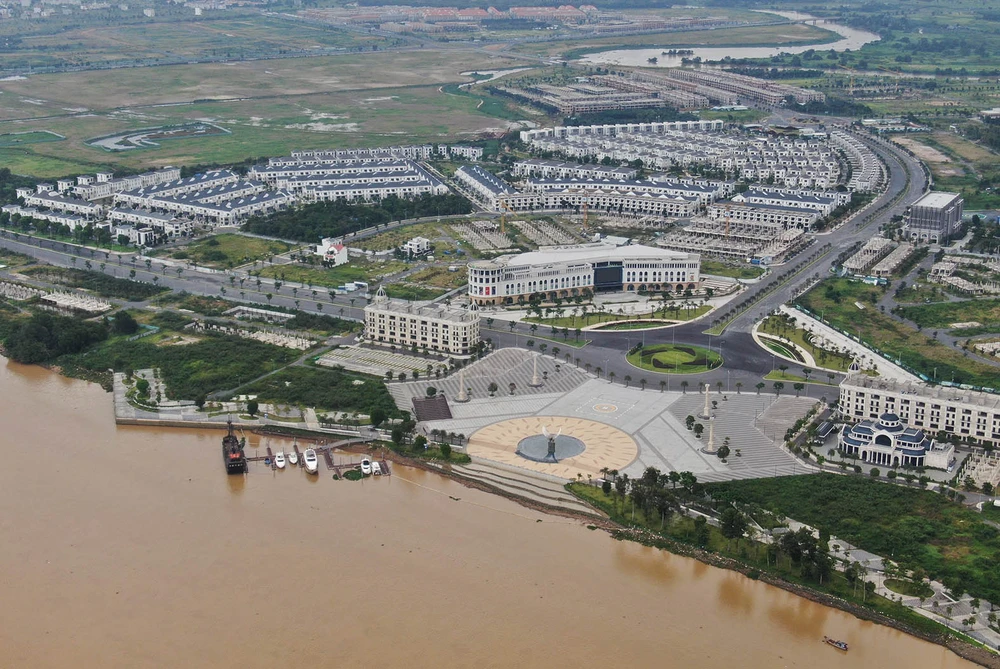
Tan Uyen City has six communes located along the Dong Nai River, and Binh Duong province has already planned for infrastructure development with riverside roads, low-density housing, and concentrated riverside eco-tourism areas in Bach Dang and Thanh Hoi communes. In these areas, Binh Duong province will not develop high-density industrial or urban areas, preserving high-tech agricultural zones and historical sites associated with the region's formation. According to Mr. Vo Hoang Ngan, Director of the Binh Duong Department of Construction, the province is currently developing 27 new urban areas along the province's main arterial roads and along the Saigon and Dong Nai rivers. The province has worked with and reached agreements with neighboring provinces and cities to create harmonious plans for developing green, modern, and livable new urban areas that better serve the material and spiritual lives of the people.
Regarding the planning of the economic corridor along the Dong Nai River, Dong Nai province is divided into three sub-regions for development. Specifically, the southwestern region includes Bien Hoa City, Long Thanh, Nhon Trach, Trang Bom districts, and part of Vinh Cuu district; the eastern region includes Long Khanh City, Thong Nhat, Xuan Loc, and Cam My districts; and the northern region includes Dinh Quan, Tan Phu districts, and part of Vinh Cuu district.
The zoning plan aims to synchronously integrate and exploit the advantages of the riverside landscape between Dong Nai and neighboring provinces and cities in the construction and implementation of the Southeast region planning task according to Decision No. 463/QD-TTg dated April 15, 2022, of the Prime Minister approving the task of preparing the Southeast region planning for the period 2021-2030, with a vision to 2050. Currently, in the mid-term report of the Dong Nai Provincial Planning for the period 2031-2030, with a vision to 2050, relevant agencies are studying the development of ecological landscape tourism along the Dong Nai River, forest landscapes, urban agriculture with ecological urban areas, green parks and entertainment service centers…
HOANG BAC - XUAN TRUNG
Source


![[Photo series] Watching the sunset at Long Thanh Airport construction site](https://vphoto.vietnam.vn/thumb/402x226/vietnam/resource/IMAGE/2025/11/27/1764254151573_anh_5_20251127205055_20251127212613.jpeg)













![[Photo] Prime Minister Pham Minh Chinh holds a phone call with the CEO of Russia's Rosatom Corporation.](/_next/image?url=https%3A%2F%2Fvphoto.vietnam.vn%2Fthumb%2F1200x675%2Fvietnam%2Fresource%2FIMAGE%2F2025%2F12%2F11%2F1765464552365_dsc-5295-jpg.webp&w=3840&q=75)











































Comment (0)