

Currently, many households in Quang Tri province have successfully developed their economy through oyster mushroom cultivation. Low investment, early harvest, high profits, and an expanding market are favorable conditions for the development of oyster mushroom farming. The family of Ms. Le Thi Thuy, in Don Que village, Hai Que commune, Hai Lang district, is one of those who earn a relatively high income from growing oyster mushrooms on sawdust.
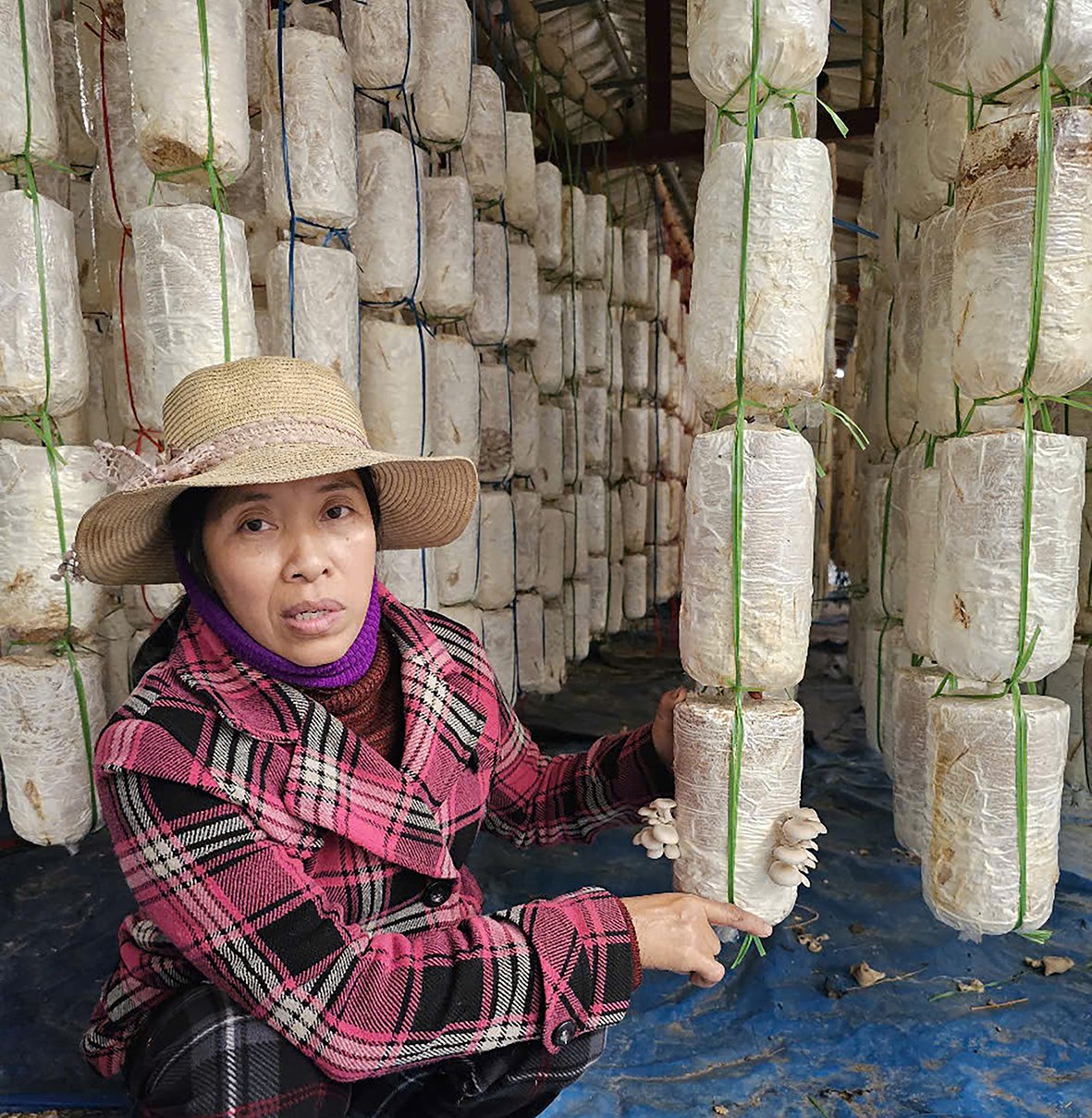
Ms. Le Thi Thuy, from Don Que village, Hai Que commune, is tending to oyster mushrooms - Photo: MT
Leading us on a tour of her mushroom farm, Ms. Le Thi Thuy happily shared her story of 10 years in the profession: “Previously, my family was classified as a poor household, and I was ill, so I couldn't do strenuous work. We tried many ways but couldn't escape poverty. Finally, we chose to grow snow oyster mushrooms and purple oyster mushrooms because they require little capital investment and provide a stable income quickly, suitable for our family's circumstances. However, in the beginning, due to lack of experience, we failed many times. Undeterred, my family learned from our mistakes and researched more information channels about mushroom spawn incubation and preservation techniques, which led to our success.”
Currently, her family's mushroom farm has a total of over 4,000 bags ready for harvest. After deducting expenses, the family earns approximately 50 million VND per year. Investing in mushroom cultivation isn't very expensive. The price of 1 kg of mushroom spawn is about 15,000 VND. Meanwhile, the raw materials for oyster mushroom production are abundant and can be easily sourced from nature, such as sawdust and straw. Typically, 100 kg of sawdust can produce hundreds of mushroom bags. On average, each bag yields 600 grams of edible mushrooms. At the same time, the market price of 1 kg of oyster mushrooms is currently 30,000 VND. Therefore, with proper investment, the income from oyster mushroom cultivation is quite high.
However, the first step in cultivating oyster mushrooms is ensuring the quality of the raw materials. Thuy's family chose sawdust as their main ingredient. Before use, the sawdust must be dried and sifted. This must be done immediately because if left for too long, mold will consume the beneficial parts of the sawdust. The next step is to treat the spores and microorganisms with hot steam or lime water. After treatment, the sawdust is removed, mixed with some powders, and then sealed. The sawdust mixture is then tightly packed into plastic bags. At the same time, oyster mushroom spawn is sprinkled into the bags, usually 3-4 layers per bag. After inoculation, the plastic bags are tightly tied and hung in bunches on a rack. After about 1-2 days, the mycelium will spread throughout each bag. When the bag of mushrooms turns completely white like cotton, it's time to make 3-4 cuts around the bag with a knife, each cut 3-4 cm long. Mushrooms will grow from these cuts in a few days.
Growing and caring for mushrooms doesn't require complex techniques, but it does require strict adherence to procedures, regular monitoring, and hygiene. First, the mushroom farm must be sturdy, well-ventilated, and protected from direct drafts. The mushroom bags should be hung in rows, maintaining appropriate spacing for easy watering and timely detection of pests and diseases. In areas with high temperatures and low humidity, watering should be done at least 4-6 times a day. Watering can be reduced during the rainy season. Most importantly, all stages of growing and caring for oyster mushrooms must maintain absolute hygiene.
Experience shows that the cleaner the water used for watering, the better the mushrooms grow. In particular, the use of pesticides during cultivation and care can be very harmful to mushrooms, so farmers avoid using any chemicals. This is why oyster mushrooms can be considered a clean food. Therefore, this food is becoming increasingly popular in the market. Ms. Thuy said: “Previously, my family had to take oyster mushrooms to the market to sell every day, but now many traders come to our house to buy them. Many people order mushrooms in large quantities and inquire about how to grow and care for them.”
Chairman of Hai Que Commune People's Committee, Hoang Tan Thong, said: "The mushroom farming model of Ms. Le Thi Thuy's family is one of the effective models in the commune. These models have increased people's income and contributed to poverty reduction in the area. In 2023, the poverty rate in the commune was 4.73%, and by 2024 it had decreased to 3.78%."
Minh Tri
Source: https://baoquangtri.vn/trong-nam-so-cho-loi-nhuan-cao-190626.htm




































































Comment (0)