

Ukraine's Deputy Defense Minister accused Russia of destroying the Kakhovka dam in Kherson province to prevent Kyiv's forces from counterattacking in the south.
"The explosion at the Kakhovka hydroelectric dam appears to have been carried out to prevent Ukrainian forces from launching an offensive in Kherson," Ukrainian Deputy Defense Minister Hanna Maliar said on Telegram on June 11.
According to Maliar, the collapse of the Kakhovka dam, which caused water to escape from the reservoir and flood the downstream Dnieper River, allowed Russia to deploy reserve forces to the Zaporizhzhia and Bakhmut regions. Meanwhile, Ukrainian forces had to use part of their strength and resources to respond to the disaster, preventing Kyiv from advancing to the eastern bank of the Dnieper River, where Russia is in control.
Russian officials have not commented on the information.
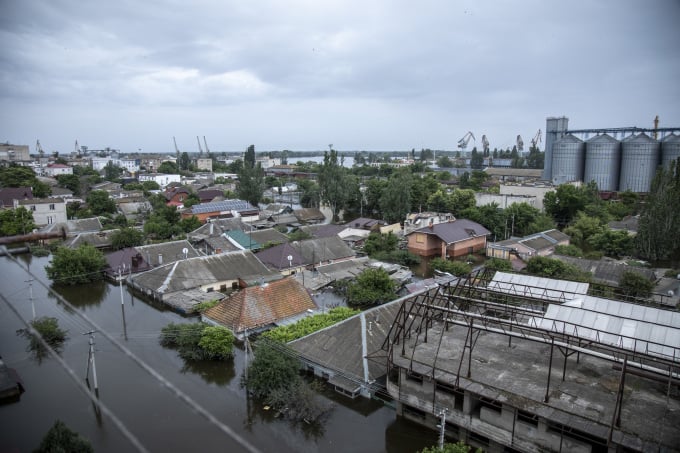
An area in Kherson was flooded on June 10 following the collapse of the Kakhovka dam. Photo: AFP
Ukraine has said in recent months that it plans to launch a major counteroffensive to retake Russian-controlled areas in the south and east. However, Ukraine has not confirmed that it has begun the main operation.
The Kakhovka hydroelectric dam on the Dnieper River, in the Russian-controlled Kherson province, burst on June 6, causing water from the reservoir to flood downstream, submerging many residential areas, villages, and some urban areas along the river. Both Russia and Ukraine consider this a deliberate attack and blame each other.
Lake Kakhovka has a capacity of approximately 18 billion cubic meters and provides cooling water for the Zaporizhzhia nuclear power plant and the Crimean Canal. The Kakhovka Dam was built by the Soviet Union between 1950 and 1956.

Residents of Kherson recount their evacuation experiences. Video : AFP
Ukrainian officials said the dam collapse flooded about 600 square kilometers in Kherson, warning that the disaster could leave hundreds of thousands without drinking water and turn at least 500,000 hectares of land into "desert" due to insufficient irrigation water for months to come.
Vladimir Saldo, the Russian-appointed leader of Kherson province, said on June 10 that water levels in Nova Kakhovka, a city near the Kakhovka dam downstream, had dropped 3 meters from their peak on June 6.
"The process of pumping water out of the streets and collecting debris has begun," Saldo said. Late on June 10, he said the flow of the Dnieper River was expected to return to normal by June 16.
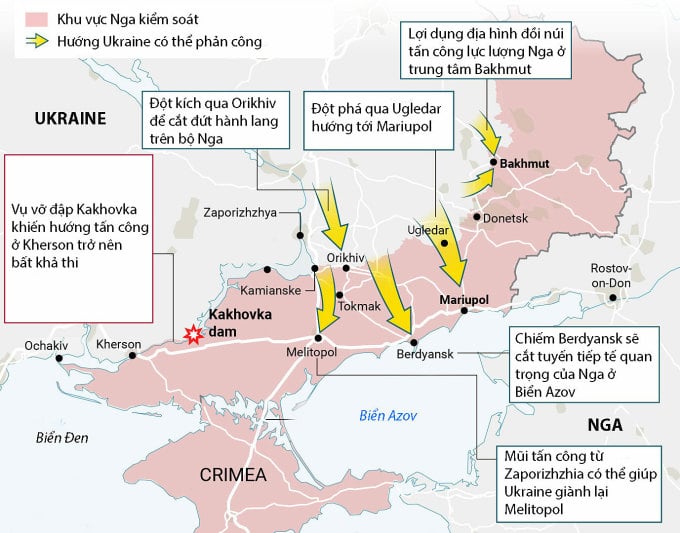
Potential counterattack routes for Ukraine. Graphic: Times
By Như Tâm (According to Reuters, Ukrinform )
Source link


























































































Comment (0)