

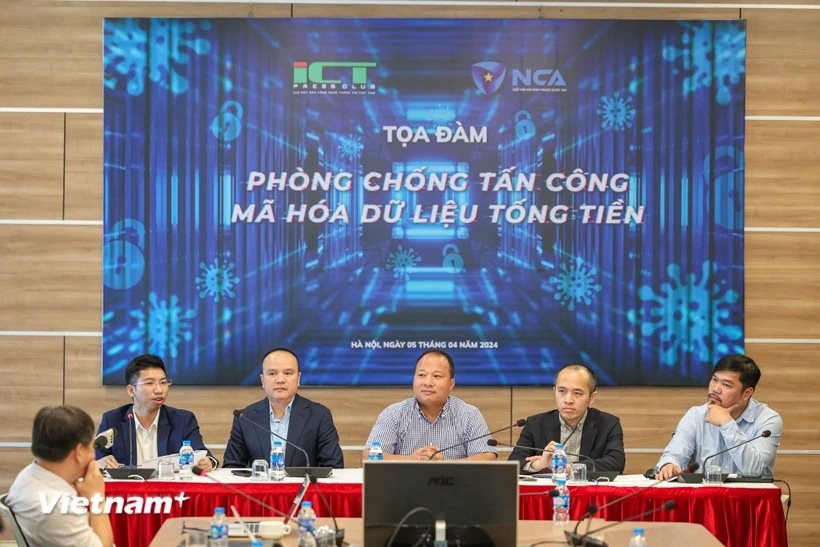
Since the beginning of 2023, there have been more than 13,750 cyberattacks on information systems in Vietnam, causing incidents. Of these, 2,323 cyberattacks on information systems in Vietnam occurred in the first three months of this year alone.
In particular, recently, many Vietnamese businesses such as VNDIRECT, VPOIL, etc., have been subjected to data encryption attacks.
According to the National Cyber Security Association, in response to this issue, the Cyber Security and High-Tech Crime Prevention Department of the Ministry of Public Security has proactively taken the lead, coordinating with the Information Security Department of the Ministry of Information and Communications (MIC) and other relevant agencies to investigate and guide agencies and businesses to promptly rectify the situation, quickly restore information systems to normal operation, and minimize damage to agencies and businesses.
The National Cybersecurity Association predicts that in the coming period, hacker groups will increase cyberattacks using ransomware, targeting critical agencies, economic , financial, and energy organizations. The situation will continue to be complex, and it is possible that ransomware attacks have been deeply embedded within information systems.
According to Lieutenant Colonel Le Xuan Thuy, Director of the National Cyber Security Center, Department of Cyber Security and High-Tech Crime Prevention, Ministry of Public Security: The fact that Vietnamese organizations and businesses have repeatedly faced ransomware attacks recently shows that 24/7 information security monitoring is generally not being implemented regularly by organizations and businesses. Even large organizations and businesses are still negligent, significant IT assets are being neglected, critical IT systems are not being invested in synchronously, and there are technical weaknesses, security vulnerabilities, and a lack of timely patch updates... suddenly becoming a "launching pad" for hackers to attack.
Regarding the issue of whether organizations and units should pay ransom to hacker groups when they encrypt data for ransomware attacks, Lieutenant Colonel Le Xuan Thuy stated that the National Cyber Security Center participates in an initiative to combat ransomware attacks with over 50 participating countries, and most opinions emphasize not transferring ransom money to hacker groups. According to Lieutenant Colonel Thuy, transferring ransom money to hackers would set a bad precedent, encouraging further cyberattacks against us. "If we resolutely resist these attacks, it will reduce the motivation of hacker groups," Lieutenant Colonel Le Xuan Thuy argued.
Meanwhile, Mr. Vu Ngoc Son - Technical Director of the National Cyber Security Technology Joint Stock Company (NCS), and Head of the Technology Research Committee of the National Cyber Security Association, stated that the hackers' attack methods in the recent incidents were similar, all involving a period of infiltration followed by data encryption for ransom. However, the attack techniques differed, suggesting that these were likely attacks by different cybercrime groups. While there is no evidence to suggest this was an organized campaign, this possibility cannot be ruled out given the consecutive incidents within a relatively short period.
Mr. Pham Thai Son, Deputy Director of the National Cybersecurity Monitoring Center, Information Security Department, Ministry of Information and Communications, predicted that data encryption attacks will remain a common attack trend in the future. In response to this, the Information Security Department has requested agencies, organizations, and businesses to focus on implementing several other tasks such as: reviewing and organizing information security implementation according to security levels; effectively, substantively, regularly, and continuously implementing information security measures based on the four-layer model; developing incident response plans for information systems under their management; and implementing a plan for periodic backup of critical systems and data to ensure timely recovery in the event of data encryption attacks…
According to statistics from the Information Security Agency, Vietnam currently meets over 90% of the requirements for cybersecurity solutions domestically. Vietnam is also one of the few countries that can independently develop cybersecurity solutions… However, Vietnamese cybersecurity solutions still face many difficulties in competing with foreign solutions, such as a lack of human resources and insufficient investment capital… Therefore, synchronization and coordination among domestic and international agencies, organizations, and businesses are needed to improve the quality and effectiveness of Vietnam's cybersecurity solutions.
Source














































































Comment (0)