


Science and technology are important pillars of the comprehensive strategic partnership .
Right alongside the official program of the Forum, the delegation from the Vietnam Academy of Science and Technology (VAST) held a private meeting with Russian Deputy Prime Minister Dmitry Chernyshenko, Chairman of the Russian Section of the Russian-Vietnamese Intergovernmental Commission, and First Vice Chairman of the Federation Council of Russia Andrei Yatskin. Despite the short working time, the high-ranking Russian leaders extended a warm welcome, affirming VAST's special position in the Vietnam-Russia science and technology cooperation system over the past decades.
During the exchange, the two senior Russian leaders expressed their support for further deepening relations between VAST and the Russian Academy of Sciences (RAS), promoting the development of joint research groups in key scientific fields, expanding cooperation in training young generations, and collaborating on the implementation of strategic research programs of mutual interest to both countries.
At the opening session of the forum, Russian Deputy Prime Minister Dmitry Chernyshenko and First Deputy Chairman of the Federation Council Andrei Yatskin highly appreciated the long-standing tradition of cooperation between Vietnam and the Russian Federation in the fields of science and education. The Russian leaders affirmed that science and technology are important pillars of the comprehensive strategic partnership and expressed their readiness to support Vietnam in training high-level human resources, basic research, technology development, and expanding new cooperation programs, as well as strengthening Russian language training at the Pushkin Institute branch in Hanoi , Vietnam.
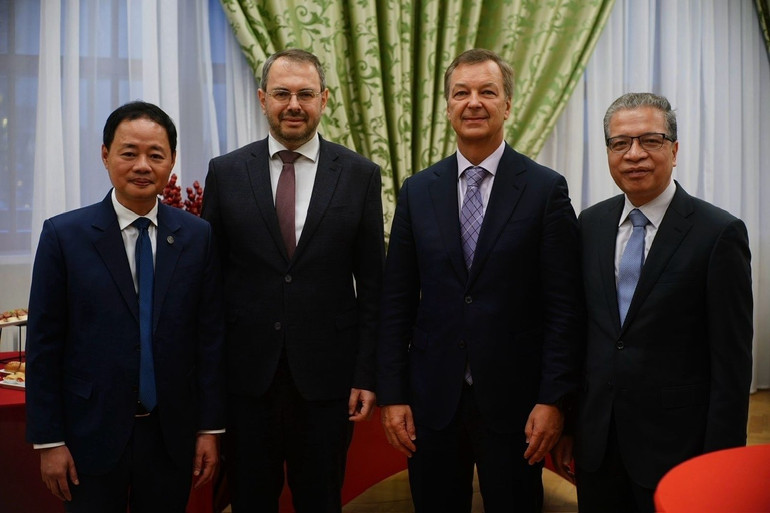
On the Vietnamese side, Deputy Prime Minister Tran Hong Ha, Chairman of the Vietnamese delegation at the Vietnam-Russia Intergovernmental Committee, emphasized the role of science and technology in the country's development strategy, especially in the context of digital transformation, innovation, and the need to build endogenous capacity.
The Deputy Prime Minister affirmed the three pillars of strategic cooperation: basic research and development of core technologies, training of high-quality human resources, and technology transfer for sustainable development; and highly appreciated the contributions of VAST as a core force in the substantive implementation of scientific cooperation between the two countries.
Continuing to play a core role in Vietnam-Russia scientific and technological cooperation.
Contributing to shaping the forum's message, VAST Standing Vice President Tran Hong Thai delivered the opening remarks, emphasizing that 75 years of Vietnam-Russia cooperation is a special journey, leaving behind an invaluable asset: a strong friendship and a large number of Vietnamese intellectuals trained in major Russian scientific schools. From historically significant collaborations such as the Intercosmos flight of Hero Pham Tuan to modern fields such as mathematics, physics, chemistry, biology, biotechnology, materials science, and marine science, cooperation between the two countries has contributed to the formation of Vietnam's important scientific strength.
The Standing Vice President of VAST emphasized that scientific and technological cooperation is not only external support but also a strategic leverage for Vietnam to unleash its internal potential and develop endogenous scientific capabilities. He also pointed out that Vietnam-Russia cooperation is developing in a direction that links academic research with solving practical development problems, with many joint research groups having been formed and yielding clear results in fields such as: marine technology, energy, materials, biotechnology, pharmaceutical chemistry, and Earth observation satellites.
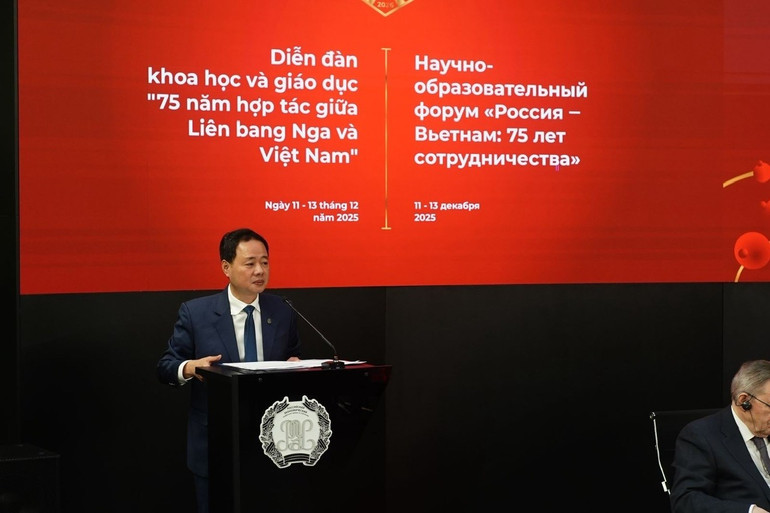
At the plenary session on "Strategic Partnership between Russia and Vietnam: Prospects for Vietnam-Russia Cooperation," VAST Standing Vice President Tran Hong Thai shared the journey of research and training cooperation between VAST and RAS, as well as other Russian research institutes and universities, emphasizing the supportive role of Russian friends throughout VAST's 50 years of development.
He affirmed that VAST has always considered cooperation with Russia as one of its most important strategic relationships, not only in basic research but also in marine research, materials technology, energy, digital technology, climate, environment, and many emerging research areas.
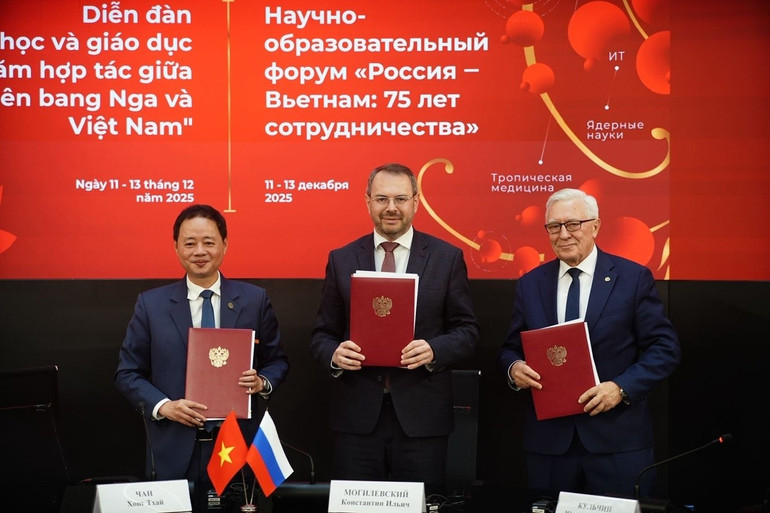
On this occasion, the Vietnam Academy of Science and Technology, the Russian Academy of Sciences - Far Eastern Branch, and the Russian Ministry of Science and Higher Education signed the Roadmap for Marine Research Cooperation 2026-2035, demonstrating a strong commitment to continuing to jointly implement the key research areas that the two Academies have focused on over the past 50 years.
At the thematic sessions, VAST presented many outstanding research results on Vietnam-Russia cooperation in basic research, strategic technology development orientation; nuclear physics research and applications within the framework of the Joint Institute for Nuclear Research in Dubna; deep-ocean surveys on the Academician Oparin and Academician Lavrentiev vessels; research on marine biodiversity and biochemistry; and research on materials, climate, emerging pollution, and genetic diseases using modern molecular tools. VAST's reports attracted significant attention from the Russian scientific community, contributing to showcasing Vietnam's multidisciplinary research capabilities and its development in recent years.
2025 also marks the 50th anniversary of VAST's founding – half a century of development closely linked to the immense support of research institutes and universities in the former Soviet Union and present-day Russia. The results achieved by VAST in maritime cooperation, basic research, doctoral training, and the implementation of joint projects over the past 75 years are vivid evidence of the effectiveness of Vietnam-Russia scientific cooperation.
With a spirit of continuing tradition and looking towards the future, VAST affirms its commitment to maintaining its core role in scientific and technological cooperation between the two countries, prioritizing the development of core and strategic technologies, expanding joint research groups, and strengthening the training of young human resources, contributing to deepening the traditional friendship and comprehensive strategic partnership between Vietnam and the Russian Federation in the new development phase.
Source: https://nhandan.vn/vien-han-lam-khoa-hoc-va-cong-nghe-viet-nam-khang-dinh-vai-role-nong-cot-trong-hop-tac-khoa-hoc-viet-nga-post929873.html










![[Video] Hue and Quang Ninh mark strong tourism growth](https://vphoto.vietnam.vn/thumb/402x226/vietnam/resource/IMAGE/2025/12/12/1765555481742_dung00-22-16-02still007-jpg.webp)















































Comment (0)