

 |
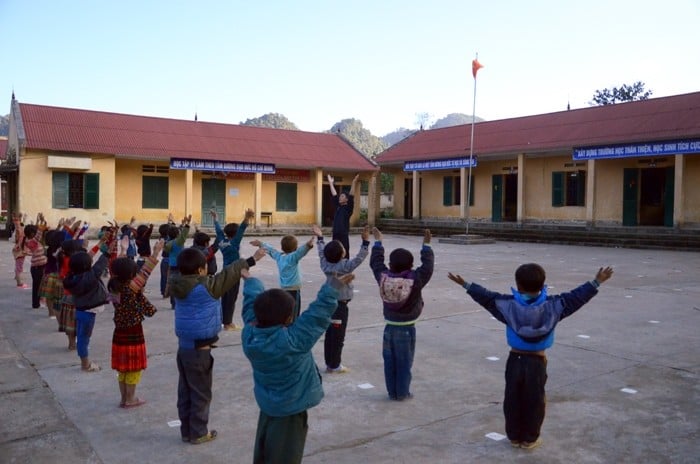
| There are very few ethnic minority students in physical education class. (Source: CPV) |
In May 2017, when the Government issued Decree No. 57/ND-CP stipulating preferential policies for enrollment and learning support for preschool children, students, and university students from ethnic minority groups with very small populations, 16 ethnic groups in Vietnam were identified as eligible beneficiaries, including: Cong, Mang, Pu Peo, Si La, Co Lao, Bo Y, La Ha, Ngai, Chut, O Du, Brau, Ro Mam, Lo Lo, Lu, Pa Then, and La Hu.
These are ethnic minorities with populations under 10,000 people, accounting for 0.08% of the national population and 0.55% of the total ethnic minority population. They reside in disadvantaged areas, often in the "poverty core" of the country, and therefore consistently lag behind other ethnic minorities and the majority ethnic group in accessing resources, public services, and development opportunities.
Due to difficult socio -economic conditions, the need to study far from home, and partly influenced by outdated perceptions that human resources are needed for productive labor to ensure daily sustenance, or even that "higher education is pointless," a small number of ethnic minority groups still have lower-than-targeted primary school enrollment rates, such as the Brâu ethnic group.
The Brau ethnic group has the highest rate of out-of-school children (35.4%); the rate of children not attending lower secondary school is three times higher than the average for all 53 ethnic minority groups.
Among ethnic minorities with populations under 10,000, the lowest rate of trained workforce is among the Brau ethnic group (2.2%), while the highest is the Pu Peo ethnic group, which only reaches 29%. Nine very small ethnic minority groups have a lower rate of trained workforce than the average of all 53 ethnic minority groups, i.e., lower by 10.3%...
Some figures from the results of the second survey of 53 ethnic minority groups in 2019 show that ethnic minorities in Vietnam still face many difficulties in accessing education and consequently suffer disadvantages in accessing opportunities for vocational and technical training to create their own jobs or find higher-paying jobs than purely agricultural work in their hometowns, leading to a high poverty rate among these ethnic minorities.
Decree No. 57/ND-CP was issued to contribute to creating conditions for children of ethnic minority groups with very small populations to have access to education, ensuring the expansion of career choices; protecting and promoting vulnerable groups to exercise their right to education and training, their right to full and equal development with other ethnic groups, meeting human development needs and improving the quality of life.
In accordance with Decree No. 57/ND-CP, during the period 2017-2022, 100% of children from ethnic minority groups with very small populations who wished to attend public preschools and kindergartens were able to do so; 100% of students from ethnic minority groups with very small populations were able to attend all levels of general education at ethnic boarding schools and public general schools.
Upon graduating from middle school and high school, students are placed in higher education programs that align with their personal aspirations and academic abilities.
In addition, nearly 710 billion VND has been spent to implement policies supporting education for students from very small ethnic minority groups.
Tao Thi Dien, a member of the Lu ethnic group, is studying at the Central Ethnic Minority University Preparatory School and receives a monthly financial support allowance equivalent to 100% of the basic salary per person, as stipulated in Decree No. 57/ND-CP. This support, paid directly monthly, has helped her family alleviate some of the financial burden of monthly living and tuition expenses, and has motivated her to study hard to gain admission to her dream university.
According to the assessment of the Department of Ethnic Education (Ministry of Education and Training), the policies stipulated in Decree 57/ND-CP not only facilitate enrollment but, thanks to financial support, have provided students with better learning conditions, thereby maintaining attendance rates, reducing dropout rates, and making a significant contribution to implementing and consolidating universal preschool, primary, and lower secondary education, gradually improving the quality of education.
For example, in Bao Lac district, Cao Bang province, the implementation of the preferential enrollment policy has helped increase the percentage of Lo Lo ethnic minority students completing primary school and attending ethnic minority boarding schools. In the 2018-2019 school year, this rate was 17.24%, but by the 2019-2020 school year, it had increased to 53.13%.
However, according to Mr. Le Nhu Xuyen, Deputy Director of the Department of Ethnic Education, Ministry of Education and Training, the implementation of Decree 57/ND-CP is currently facing some shortcomings. For example, the learning support policy only applies to preschool children aged 3 and above; nursery children do not receive any support, while the percentage of poor and near-poor households among many ethnic minority groups is very high, reaching up to 80%, leading to difficulties in mobilizing nursery children to attend school.
Furthermore, the population of ethnic minorities with very small numbers has also changed. The La Hủ and La Ha ethnic groups now have populations exceeding 10,000 people, and are no longer eligible for benefits under Decree No. 57/ND-CP. In fact, according to Decision No. 1227/QD-TTg dated July 14, 2021, of the Prime Minister approving the list of ethnic groups still facing many difficulties and specific difficulties in the 2021-2025 period, there are only 14 ethnic groups remaining: Cống, Mảng, Pu Péo, Si La, Cờ Lao, Bố Y, Ngái, Chứt, Ơ Đu, Brâu, Rơ Măm, Lô Lô, Lự, and Pà Thẻn.
According to Deputy Minister of Education and Training Ngo Thi Minh, the implementation of support policies for children, students, and university students from ethnic minority groups with very small populations has affirmed the humanity, superiority, and concern of the Party and the State for these ethnic minority communities.
This is also a solution implemented by Vietnam to realize human rights in general, and the rights of ethnic minorities in particular, to access educational opportunities, aiming to narrow the development gap in education and training with other ethnic minorities and with the majority ethnic group.
In the coming period, along with prioritizing the allocation of resources to seriously and fully implement the preferential policies on enrollment and learning support for preschool children, students, and university students from ethnic minority groups with very small populations as stipulated in Decree No. 57/ND-CP, the Ministry of Education and Training will coordinate with ministries, sectors, and localities to continue reviewing and perfecting mechanisms and policies suitable to the practical situation in order to create the best conditions for the development of education and training for ethnic minority groups with very small populations.
Review and refine policies and mechanisms to suit practical realities, aiming to create the best conditions for the development of education and training for ethnic minority groups with very small populations.
Strengthen inspection and supervision, and promote the role of mass organizations, village elders, community leaders, and influential people in ethnic minority areas in disseminating information and mobilizing support to promote communication on the implementation of Decree 57/2017/ND-CP and other policies in the field of education and training in ethnic minority and mountainous regions.
The Ministry of Education and Training also requested the People's Committees of provinces and cities to strengthen inspection and supervision, promptly detect, prevent, and handle cases of violations of the law regarding Decree 57/2017/ND-CP during its implementation.
Source



















































































Comment (0)