

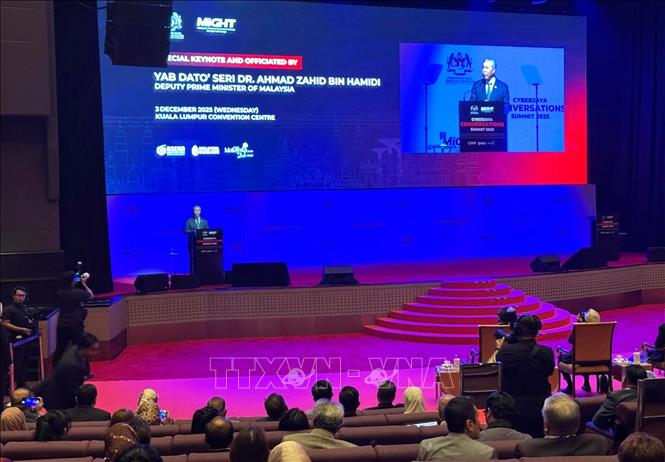
At the Cyberjaya 2025 Summit held in Kuala Lumpur on December 3, speakers discussed ASEAN's sustainable competitiveness and expressed their impression of Vietnam's economic growth, not only in terms of its competitiveness in attracting investment but also in terms of innovation capacity.
Speaking at the event, ASEAN Secretary-General Dr. Kao Kim Hourn said the ASEAN region has made significant progress in the Global Innovation Index (GII). The World Intellectual Property Organization (WIPO) has ranked six ASEAN member states among the world's top 60 innovators. He noted that Vietnam and Indonesia are "exceeding expectations" in the WIPO GII rankings. Accordingly, the ASEAN community has attracted about 230 billion USD in foreign direct investment (FDI) by 2024, with Singapore, Indonesia and Vietnam leading the way.
Speaking to VNA reporters at the conference, Senior Advisor of the Pacific Research Center, Mr. Ei Sun OH, said that Vietnam is currently considered the most prominent country in Southeast Asia, attracting a lot of foreign investment and having a very high economic growth rate. Meanwhile, Chairman and CEO of the technology advisory agency for the Malaysian government - MIGHT, Mr. Rushdi Abdul Rahim, affirmed that Vietnam is one of the leading countries in ASEAN in the field of high technology, besides Malaysia and Singapore.
However, experts stressed that ASEAN needs to ensure the quality of investment. Expert OH stated that the top priority is to ensure that investments in Vietnam must be of high quality and high technology to create new jobs and bring high incomes to the people. He said that Vietnam, together with Malaysia, is trying to become "part of the global electronics supply chain". He also suggested that lessons learned from the development of Malaysia's electronics industry will be "very useful for Vietnam".
The conference – designed to generate ideas and forecast challenges that ASEAN will face in the next 10-15 years – brought together government, industry and academic leaders from nine member states in the region.
In his opening remarks, Malaysian Deputy Prime Minister Ahmad Zahid Hamidi highlighted innovation as a core element to enhance competitiveness, a foundation for economic resilience and an engine of regional growth. Meanwhile, Malaysian Minister of Science, Technology and Innovation Chang Lih Kang outlined a vision to boost regional competitiveness, including the ability to “design chips, build satellites, invent Artificial Intelligence (AI) models” and pioneer sustainable energy solutions. Accordingly, to achieve the goal of becoming the world’s fourth largest economy by 2030, ASEAN must move from being technology adaptors to “technology innovators”.
Leaders and experts also agreed that accelerating digital transformation and AI adoption is necessary. Syed Mohamed Tahir, chairman of technology company Dagang NeXchange Berhad, stressed that AI adoption needs to be accompanied by providing “the right legal, policy and regulatory framework.”
In terms of regional cooperation, experts point out that ASEAN’s competitiveness will not be maintained if countries work alone. In addition, “science diplomacy” is considered a strategic necessity.
According to Mr. Syed Mohamed Tahir, ASEAN needs to move from economic competition to economic complementarity. To promote this cooperation, he pointed out three important factors, including quality human resources, the ability of highly skilled workers to move freely within the region “without worrying about visas,” and investment in the regional innovation ecosystem, especially for small and medium enterprises (SMEs) and startups.
Dr. Kao Kim Hourn concluded that ASEAN needs to work together to build sustainable competitiveness to be able to implement the Science, Technology and Innovation Action Plan 2026–2035 and the ASEAN Community Vision 2045.
Source: https://baotintuc.vn/kinh-te/viet-nam-tao-an-tuong-ve-suc-hut-dau-tu-va-doi-moi-trong-asean-20251204060534072.htm

![[Photo] Cat Ba - Green island paradise](/_next/image?url=https%3A%2F%2Fvphoto.vietnam.vn%2Fthumb%2F1200x675%2Fvietnam%2Fresource%2FIMAGE%2F2025%2F12%2F04%2F1764821844074_ndo_br_1-dcbthienduongxanh638-jpg.webp&w=3840&q=75)











![[Infographic] Cross-calculated exchange rates to determine taxable value from December 4-10](https://vphoto.vietnam.vn/thumb/402x226/vietnam/resource/IMAGE/2025/12/04/1764832340841_infographic-ty-gia-tinh-cheo-de-xac-dinh-tri-gia-tinh-thue-tu-4-1012-20251204120447.jpeg)


























![[VIMC 40 days of lightning speed] Da Nang Port: Unity - Lightning speed - Breakthrough to the finish line](https://vphoto.vietnam.vn/thumb/402x226/vietnam/resource/IMAGE/2025/12/04/1764833540882_cdn_4-12-25.jpeg)


































Comment (0)