

The reporter had a conversation with Labor Hero Thai Huong - Founder and Chairwoman of the Strategic Council of TH Group , who for many years has persistently pursued the mission "For the stature of Vietnam," about school nutrition as an indispensable foundation for realizing the aspiration for national development.
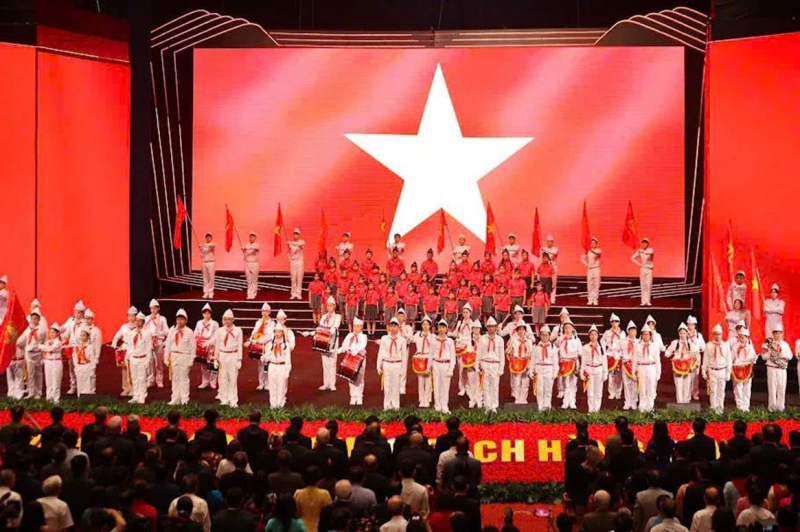
Outstanding students from Nguyen Sieu School, TH School, Amsterdam School, and Dich Vong School performed a cultural show to celebrate the 80th anniversary of the education sector's tradition and the opening of the 2025-2026 school year.
PV: What thoughts did the three goals emphasized by General Secretary To Lam in his opening speech for the new school year evoke in you, especially from the perspective of school nutrition?
Ms. Thai Huong, a Hero of Labor: As the Chairwoman of the Strategic Council of TH Group, I have always persistently pursued nutrition for Vietnamese people, especially nutrition during the "golden age." At the opening ceremony of the 2025-2026 school year, General Secretary To Lam emphasized: "No child should be left behind...", with special priority given to school nutrition. That message is like a rallying cry from the leader and the will of the entire political system. This is a golden moment for the whole society to listen, communicate, and act. It touches my heart because I understand clearly: if children are not properly cared for during this golden period, their lifelong development opportunities will be missed.
Many people think of nutrition as simply meals, of satiety, but in reality, it directly determines the intellectual, physical, and even personality development of future generations. Consider the statistics: according to the 2023 National Nutrition Survey, up to 18.2% of Vietnamese children under 5 years old suffer from stunting; in some mountainous regions, this rate exceeds 30%. This means millions of children are entering life with an "unequal start" in terms of stature. Meanwhile, in urban areas, children face overweight and obesity rates exceeding 20% at the primary school level. This is a "double burden" that, if not addressed at its root, will cost us dearly in the future.
I have always emphasized that every day of delay in implementing school meals is a day of missed opportunities for children. School nutrition is the fairest shield, ensuring that every Vietnamese child – from the capital to the remote mountains, from coastal villages to the highlands – has a fair starting point on their journey to adulthood. Only when a generation is adequately nourished will Vietnam truly have a solid workforce to go far and sustainably.
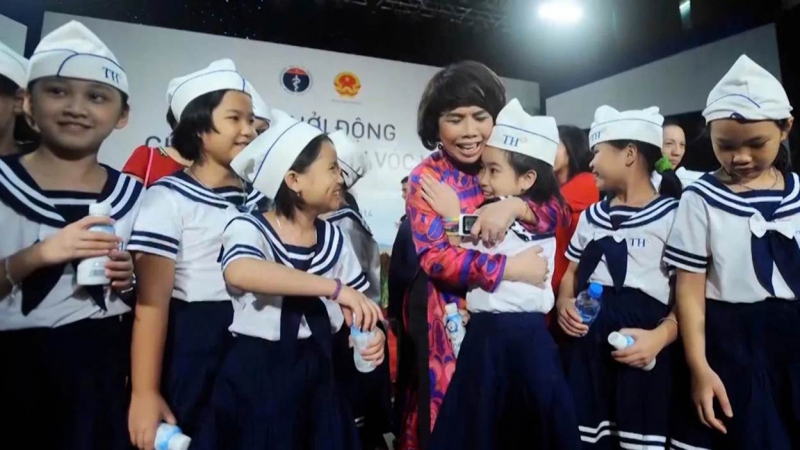
Heroine Thai Huong encouraged students at the launching ceremony of the "Joining Hands for the Stature of Vietnam" program on September 4, 2014.
PV: From a school nutrition perspective, what connection do you see between a meal, a glass of milk, and the formation of a generation that is "both intelligent, compassionate, and resilient"?
Labor Hero Thai Huong: Comprehensive education cannot be separated from nutrition. A child who is hungry, lacking energy, or conversely overweight or obese will find it difficult to absorb knowledge and develop harmoniously. Therefore, school meals, including school milk, must be considered the "first lesson" in physical, intellectual, and character development. Science has shown that 86% of maximum height and 80% of brain development are completed before the age of 12. This is the golden age that determines a person's physical and intellectual abilities. If we miss this opportunity, all subsequent efforts will only be "firefighting" and will never be able to recover. Therefore, investing in proper nutrition for this age group is a sustainable investment in the future.
Looking at the world, we can see that Japan, after the end of the war in 1946, experimented with and enacted the School Lunch Law in 1954, so that 70 years later, the term "short Japanese" no longer exists.
Based on that vision, TH Group initiated and collaborated with the Ministry of Education and Training, the Ministry of Health, and independent experts both domestically and internationally, consulting with experts from Japan and France to implement the "Model of school meals ensuring balanced nutrition combined with enhanced physical activity for children, students, and university students," piloting it in the 2020-2021 school year in 10 provinces and cities, representing 5 major ecological regions across the country.
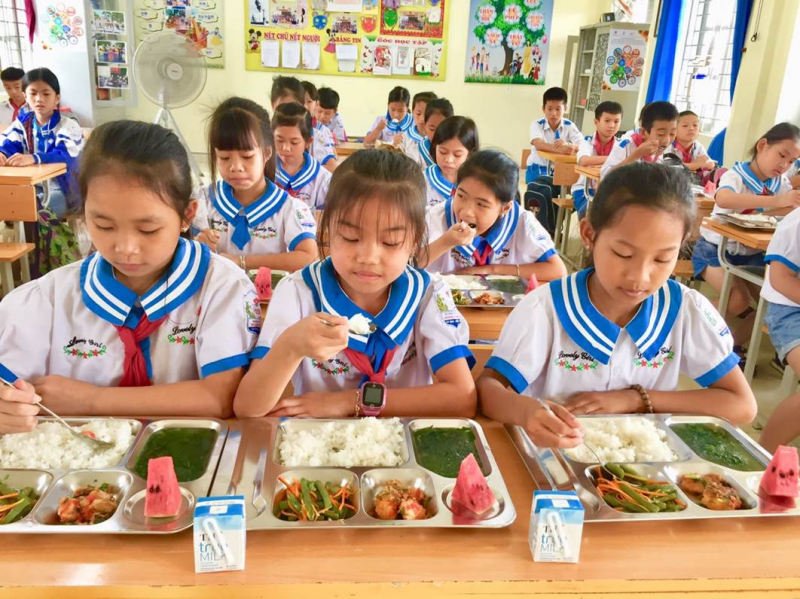
School meals ensure adequate nutrition.
In the pilot model, school meals are approached using entirely natural foods, based on the agricultural advantages of the region; fresh, whole milk is scientifically incorporated into the meal composition: a glass of fresh, whole milk is provided five days a week, along with a set of 400 menus; and students are encouraged to exercise for at least 60 minutes each day. After one year of implementation, the pilot model has yielded outstanding results compared to the initial targets: the results show not only improved physical health, reduced malnutrition and overweight, but also enhanced concentration, discipline, and self-confidence. The model is considered a comprehensive, revolutionary solution for improving the stature of Vietnamese people. This is the scientific basis for us to build school nutrition policies linked to holistic education.
But the significance of school nutrition lies not only in physical health. When children have access to a standardized, transparent, and safe meal, they learn to respect their own health, appreciate nature, and share kindness. This is a way of educating character through very simple things. A balanced meal or a glass of clean milk every day is a seed sown in the soul, to form a generation of Vietnamese people who are "both talented, compassionate, and resilient," as the country's leaders have aspired to.
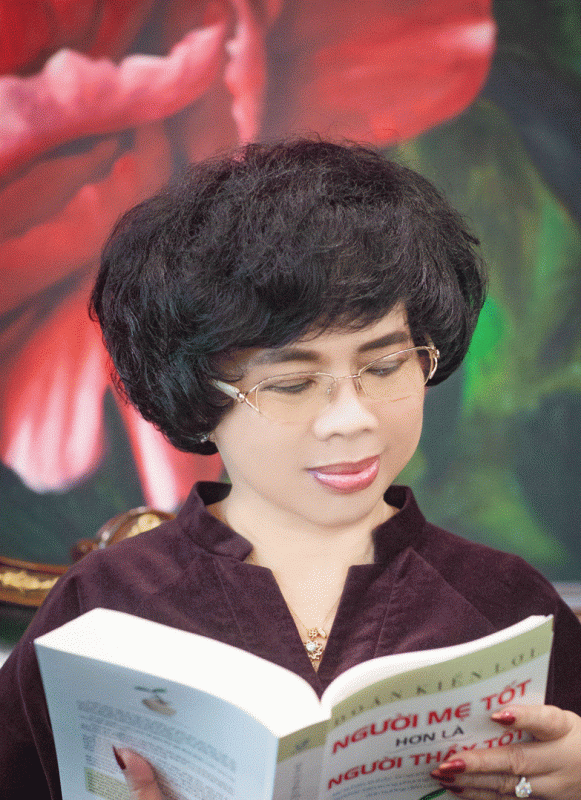
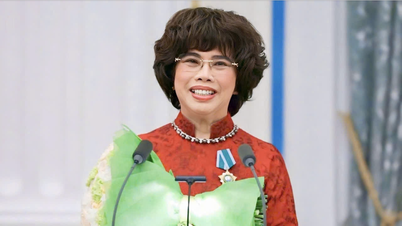
Hero of Labor Thai Huong.
PV: Regional disparities remain a challenge: in mountainous areas, the rate of stunting is double that of the lowlands, and many children lack access to milk. In your opinion, what solutions can ensure nutritional equity in schools, so that all children – whether in urban or island areas – have equal opportunities for development?
Hero of Labor Thai Huong: That's right, the regional gap is a "silent wound" on the future of the country. According to the National Institute of Nutrition, the rate of stunting among ethnic minority children is currently over 30%, double the national average. This means that from the very beginning, children in mountainous and remote areas are at a disadvantage compared to their peers in urban areas – not only physically but also in terms of educational and development opportunities.
To address this, we must first consider school nutrition as a universal right, without distinction between rich and poor, mountainous or lowland areas. In Vietnam, there are approximately 13.8 million children in preschool and primary school, and the national multidimensional poverty rate is only 1.9%. However, in remote mountainous areas, nearly 30% of children come from extremely disadvantaged families, 20% are poor or near-poor, and the remaining 50% are mothers who can afford to buy milk for their children five days a week without needing assistance. Therefore, I believe a stratified mechanism for school meal policies in general is needed.
• For particularly disadvantaged areas and regions where mothers cannot afford meals: The State must fully subsidize school meals. The school meal program, when implemented as a pilot project, already has established standards and regulations. These menus need to be digitized immediately and made publicly available for the entire society to monitor. And in phase 1, a glass of milk should be provided so that 100% of children receive the national school milk program.
• For other localities: A co-payment model involving the budget, parents, and businesses can be applied.
In addition to government mechanisms and policies, businesses in the food industry must shoulder a mission and responsibility to stand alongside the nation.
When we achieve such transparency and fairness, the promise of "leaving no child behind" will truly become a reality. More importantly, we will not only nurture children in disadvantaged areas, but also foster belief in social justice – the foundation of a strong nation.
PV: She initiated TH School – a place that integrates knowledge, character, physical development, and international integration. According to her, what does this model demonstrate about the feasibility of realizing a vision for comprehensive educational innovation, and what lessons can be replicated throughout the entire system?
Labor Hero Thai Huong: When I founded TH School, I didn't just want to build a school, but to experiment with a comprehensive educational model that combines "world-class advancements + the essence of Vietnamese studies," where knowledge, character, physical development, and international integration develop harmoniously. Students learn according to Cambridge international standards, but without straying from their roots: they still study culture, history, and traditional music. In the school, the school lunch program is designed as part of the education curriculum with a scientifically balanced menu, linked to daily physical activity.
Most importantly, we focus on character education and life skills: from manners, discipline, community spirit to environmental responsibility. A TH School student is not only academically excellent and physically healthy, but also knows how to share and love. This is the spirit of "being both intelligent, compassionate, and resilient" that society expects.
From this experience, I've drawn three lessons that can be replicated:
1. Nutrition and physical fitness should be considered the cornerstone, not the secondary, of education.
2. International integration must go hand in hand with preserving Vietnamese identity, so that students can confidently navigate the global world without losing their roots.
3. Character education must go hand in hand with knowledge, to train citizens who know how to be good people before they can work.
TH School proves that Vietnam can absolutely create a modern, comprehensive educational environment right here in its own country. With determination and the right mechanisms, these principles can be widely applied in both public and private schools, ensuring a balanced and sustainable development for an entire generation of young Vietnamese people.
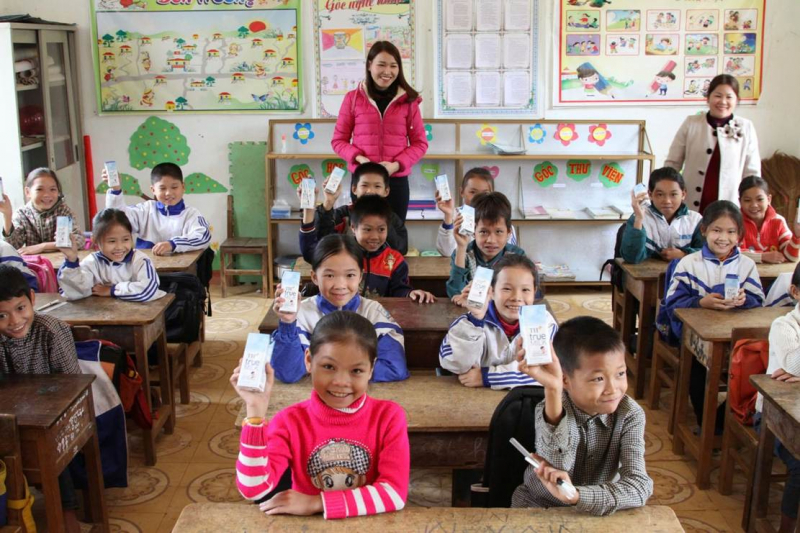
School nutrition supplementation.
PV: Recently, the Politburo issued Resolution No. 71 on breakthroughs in education and training development. Resolution 71 sets the aspiration for Vietnam to be among the top 20 education systems in the world by 2045. According to you, to achieve that stature, how should school nutrition policies and new educational models be positioned within the long-term strategy?
Hero of Labor Thai Huong: For Vietnam to become one of the top 20 education systems in the world by 2045, we cannot just talk about the curriculum, textbooks, or digital technology. The most fundamental thing is that our people – our students – must be healthy and have a solid physical foundation. If their physical health is weak, their intellectual potential cannot be developed, and then all educational reforms will be difficult to achieve their goals.
Therefore, I believe that school nutrition should be positioned as the nation's soft infrastructure, on par with schools, teachers, or digital infrastructure. To have a generation of intellectuals on par with international standards, we must first have a generation of young people of international stature. School nutrition policy needs to be built on three long-term pillars:
1. Standardize school meals nationwide, with a mandatory set of nutritional standards, to ensure that students in any province or city receive a minimum level of energy and micronutrients.
2. Integrate nutrition with physical education and life skills, so that children are healthy, disciplined, civic-minded, and aware of the importance of maintaining their health.
3. Combine with a holistic education model like TH School – where knowledge, character, physical development, and integration all flourish – to cultivate a generation of global citizens who still retain a strong Vietnamese identity.
A nation that aspires to be a leader cannot simply teach literacy; it must also teach moral values and nurture its people. I believe that when school nutrition is given its proper place in the long-term education strategy, the 2045 goal will not be a distant dream.
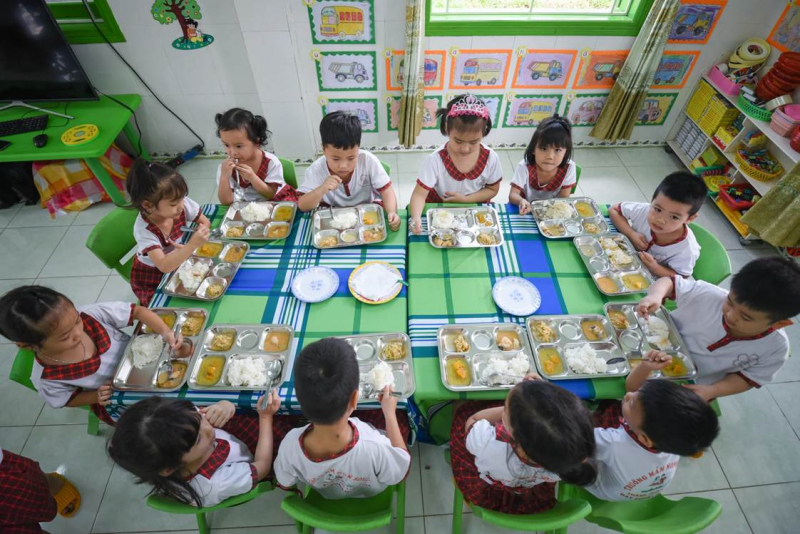
School meals.
PV: In the context of digital transformation, technology and artificial intelligence are strongly penetrating education. Regarding school nutrition, how do you expect technology to help monitor and personalize students' meals to ensure transparency and effectiveness?
Hero of Labor Thai Huong: Technology has the potential to revolutionize school nutrition. I envision that in the near future, every student will have an electronic nutritional profile, updated with height, weight, BMI, and micronutrient status. From there, artificial intelligence (AI) will analyze the data of millions of students to provide recommendations for optimal meal plans for each age group and location. This will help us detect early risks of malnutrition or overweight so that timely intervention measures can be taken.
Technology can also support awareness education: students have access to online nutrition apps, can self-assess their knowledge about meals, and are encouraged to engage in at least 60 minutes of physical activity per day as recommended by the WHO. Thus, technology not only monitors but also becomes a tool for fostering healthy lifestyle habits in the younger generation.
Transparency and personalization – these are two key elements that digital transformation and AI can bring to school nutrition. And once we gain trust, we will have the strong support of parents and society as a whole.
PV: If you were to send a message to society after this special opening ceremony, what would you like to call on parents, teachers, businesses, and the community to do together to turn school nutrition into a national movement?
Hero of Labor Thai Huong: I want to say something very simple: act like a mother. A mother's heart and love for her child are always the most boundless. For nine months and ten days, the child grows in the mother's body; in the early years, the sweet milk of the mother nourishes the child. But there are also times when a mother unintentionally misses a golden opportunity for her child – the first ten years of life, which determine the stature and intelligence of a lifetime. If, at that age, the child lacks calcium, zinc, iron, or other nutrients, the opportunity for development can never be regained.
Research indicates that a glass of fresh, clean school milk each day can meet up to 30% of a child's daily zinc and iron requirements. The FAO has affirmed that fresh milk is the most complete food for growing children. School meals and school milk are a shield, a strong fortress protecting the physical and intellectual future of the Vietnamese generation. Every day of delay in implementation is a day of missed opportunity for our children.
With the sincere wishes from the heart of a mother, I hope that all of us, in our own individual roles, will treat children today with a mother's heart, and contribute to providing them with a School Meal, a shield, a strong fortress to protect them.
Interviewer: Thank you very much, Madam!
Source: https://cand.com.vn/doi-song/anh-hung-lao-dong-thai-huong-dinh-duong-hoc-duong-phai-duoc-coi-la-ha-tang-mem-cua-quoc-gia-i780907/
































































Comment (0)