

According to Mr. Mai Van Khiem, Director of the National Center for Hydro-Meteorological Forecasting, at 7:00 a.m. on July 19, storm Wipha entered the northeastern sea area of the North East Sea, becoming storm number 3. The storm moved northwest with the strongest wind speed of level 9 (75-88 km/h), gusting to level 12.
According to forecasts, after entering the East Sea, storm Wipha will continue to move rapidly in the West-Northwest direction and is likely to strengthen.
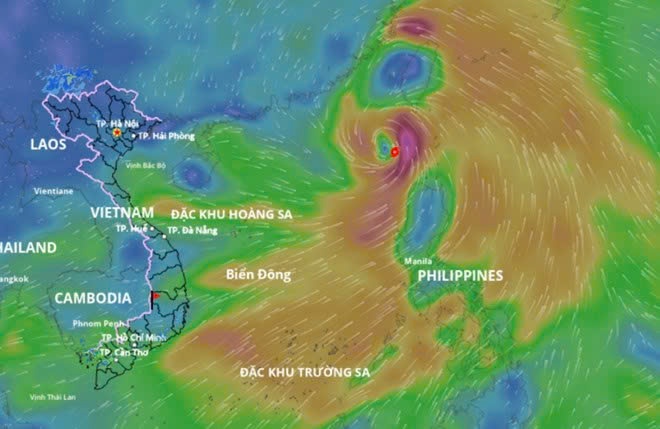
At 1:00 a.m. on July 20, the center of storm Wipha was in the northeastern sea of the North East Sea, about 760 km east of Leizhou Peninsula (China). The storm's intensity was currently at level 10, gusting to level 12. Experts said that at 1:00 a.m. on July 21, the center of storm Wipha was about 210 km east-northeast of Leizhou Peninsula (China), the storm's intensity was now at level 11-12, gusting to level 14.
At 1:00 a.m. on July 22, the center of storm Wipha was in the Gulf of Tonkin, the storm's intensity weakened to level 9-10, gusting to level 13. During the day and night of July 22, the storm moved mainly in the West-Southwest direction, entering the mainland of the coastal provinces and cities of the North and gradually weakening.
Due to the influence of the storm, in the eastern sea area of the North East Sea, the wind will gradually increase to level 6-7, near the eye of the storm, it will be level 8-10, gusting to level 12, with waves 3-5m high. The sea will be very rough.
Ships operating in the above-mentioned dangerous areas are likely to be affected by storms, whirlwinds, strong winds, and large waves. According to Mr. Khiem, due to the impact of the storm, from July 21 to 24, the Northern and North Central provinces are likely to have widespread heavy rain with rainfall of 200-350mm, in some places over 600mm.
In response to storm No. 3, this afternoon, the Ministry of Agriculture and Environment (MARD) issued a telegram to the People's Committees of provinces and cities in the Northern region and coastal areas from Quang Ninh to Dak Lak on responding to storms in the East Sea.
To proactively respond to storms and the risk of heavy rain, floods, inundation, flash floods, and landslides, the Ministry of Agriculture and Environment recommends that provinces and cities from Quang Ninh to Dak Lak closely monitor the storm's developments; strictly manage vessels going out to sea; organize counting and notify owners of vessels and captains of ships and boats operating at sea of the location, direction of movement and developments of the storm so that they can proactively avoid, escape, not move into dangerous areas or return to safe shelters.
Provinces and cities must deploy work to ensure safety for people, vehicles, and property, especially for tourist sites, aquaculture, fishing, and constructions at sea, on islands, and in coastal areas; based on specific situations, proactively decide to ban fishing boats, transport ships, and tourist boats from going to sea and evacuate people from cages, watchtowers for aquaculture along the coast, at sea, and on islands to ensure safety; be ready with forces and means for rescue when required.
For the delta regions of the North and North Central regions, focus on reviewing and being ready to evacuate people from unsafe houses, areas at risk of deep flooding, river mouths, and coastal areas; direct the work of ensuring the safety of sea dykes and river dykes, especially at vulnerable locations or those under construction; proactively drain buffer water, prevent flooding, and protect agricultural production, urban areas, and industrial zones at risk of flooding.
The mountainous areas of the North and North Central regions deploy shock forces to inspect and review residential areas along rivers, streams, low-lying areas, and areas at risk of flooding, flash floods, and landslides to proactively clear the flow of blocked and obstructed areas; organize the relocation and evacuation of people to safe places; direct commune-level authorities to notify each household living in areas at risk of landslides and flash floods to inspect and review the area around their residence to promptly detect unusual and dangerous signs and proactively evacuate them from dangerous areas.
Source: https://cand.com.vn/Xa-hoi/bao-wipha-vao-bien-dong-canh-bao-mua-lon-dien-rong-phu-18-tinh-thanh-i775280/
![[Photo] National Assembly Chairman Tran Thanh Man attends the VinFuture 2025 Award Ceremony](/_next/image?url=https%3A%2F%2Fvphoto.vietnam.vn%2Fthumb%2F1200x675%2Fvietnam%2Fresource%2FIMAGE%2F2025%2F12%2F05%2F1764951162416_2628509768338816493-6995-jpg.webp&w=3840&q=75)

![[Photo] 60th Anniversary of the Founding of the Vietnam Association of Photographic Artists](/_next/image?url=https%3A%2F%2Fvphoto.vietnam.vn%2Fthumb%2F1200x675%2Fvietnam%2Fresource%2FIMAGE%2F2025%2F12%2F05%2F1764935864512_a1-bnd-0841-9740-jpg.webp&w=3840&q=75)

















































































Comment (0)