

 |
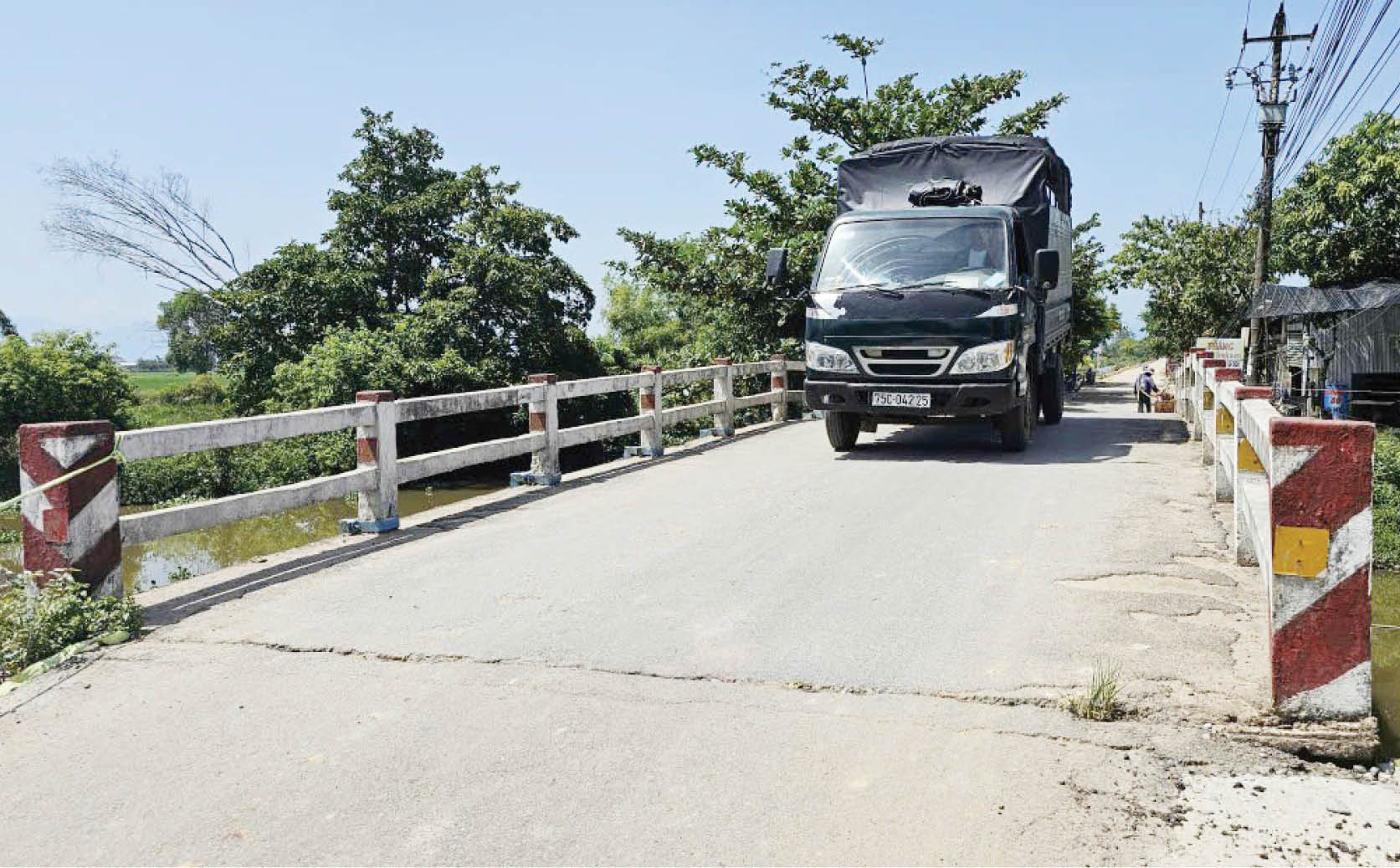
| The bridge is weak, but it always has to handle a large volume of car traffic. |
Safety risks
According to our observations, the TL3 route is approximately 10km long, starting at the intersection with National Highway 1 in Thanh Thuy ward and ending at Quang Xuyen village, Phu Ho commune. This route experiences a high volume of daily traffic, especially small trucks, passenger buses, and vehicles used for agricultural production. However, due to the narrowness of the road and the damaged surface and potholes in many sections, traffic flow is difficult, especially when two vehicles are trying to pass each other.
On National Highway 3, there are currently three bridges: Loi Nong, Nhu Y, and Trung Chanh, all of which have been in operation for many years without significant investment in upgrading. Among them, the Loi Nong bridge (Thanh Thuy ward) has a weak structure, with many parts severely degraded, including damaged bridge railings, peeling bridge deck, rusted bridge girders, and cracked bridge abutments. The maintenance unit has had to temporarily reinforce the bridge and install a 5-ton weight limit sign to prevent heavy trucks from crossing and to avoid accidents.
The Nhu Y Bridge (Phu Ho commune), approximately 20m long and 5m wide, has numerous cracks and peeling concrete on both bridge abutments, posing a risk of subsidence. The Trung Chanh Bridge (Phu Ho commune), smaller in scale at 10m long and 5m wide, also has weak abutments and a deteriorating bridge surface.
Mr. Bui Quang Do from Trung Chanh village said: "I have lived here for a long time and have clearly seen the bridge deteriorating year after year. We earnestly hope that the authorities will soon invest in a new bridge or upgrade it so that we can travel safely, especially during the rainy season."
Upgrade soon
Residents living along National Highway 3 (TL3) have stated that the upgrading and expansion of three weak bridges and the entire TL3 route have been repeatedly requested during meetings with constituents. However, to date, the relevant authorities and local government have not implemented the upgrades and expansions. This not only affects daily travel but also impacts the transportation of goods, trade, and safety during the rainy season and floods.
Mr. Nguyen Van Chinh, Chairman of the People's Committee of Phu Ho commune, informed: The TL3 road section passing through the commune is approximately 7km long, including the Nhu Y and Trung Chanh bridges, which are severely degraded. The local authorities have repeatedly reported and proposed that the city allocate funds soon to upgrade, repair, and expand the bridge and road surfaces, ensuring uniformity along the entire route. Based on feedback from voters, Hue City has also issued a directive to include the TL3 road section in the city's public investment plan for the coming period. Once approved by the Hue City People's Council, the renovation, repair, or new construction of bridges and roads will be implemented.
Regarding these three bridges, the Department of Transport (now the Department of Construction) had previously conducted a review and inspection of the local bridge system. The inspection revealed that these three bridges were dilapidated and weak, so the department proposed that the Provincial People's Committee (now the Hue City People's Committee) consider the early renovation of Loi Nong Bridge (Km2+100), Nhu Y Bridge (Km2+900), and Trung Chanh Bridge (Km3+250) on National Highway 3.
To thoroughly address the deterioration of the three weak bridges on National Highway 3, a comprehensive set of solutions is needed. In particular, Hue City should prioritize the upgrading of National Highway 3 and the three weak bridges in its medium-term public investment plan for the 2025-2030 period. This will ensure stable funding and avoid temporary, fragmented repairs.
In addition, a thorough survey of the current situation is necessary to select a suitable upgrade or new construction plan, ensuring technical aspects, load capacity, aesthetics, and resilience to natural disasters. The bridge deck should be widened, and the road surfaces at both ends of the bridge should be improved to ensure traffic safety. Bridge repairs should be linked to upgrading the entire TL3 road surface, thoroughly addressing damaged areas and potholes, widening narrow sections of the road, and installing traffic signs and speed bumps in densely populated areas.
Before any new investment project is undertaken, relevant departments need to maintain regular inspections and temporarily reinforce severely degraded sections; at the same time, restrict load and speed limits on the bridge to ensure safety. In addition to the city budget, funding can be mobilized from the central government, national target programs, socialized capital, or public-private partnerships to accelerate implementation.
The TL3 route not only serves the transportation needs of people in Thanh Thuy and Phu Ho communes and wards but also connects production and trade areas with National Highway 1 and other main traffic routes of Hue City. Upgrading the three weak bridges and the entire route will contribute to reducing traffic congestion, shortening goods transportation time, improving production and business efficiency, and ensuring traffic safety, especially during the rainy season.
Source: https://huengaynay.vn/kinh-te/xay-dung-giao-thong/can-som-nang-cap-sua-chua-ba-cay-cau-yeu-บน-tuyen-tinh-lo-3-156858.html


















![[Photo] Prime Minister Pham Minh Chinh holds a phone call with the CEO of Russia's Rosatom Corporation.](/_next/image?url=https%3A%2F%2Fvphoto.vietnam.vn%2Fthumb%2F1200x675%2Fvietnam%2Fresource%2FIMAGE%2F2025%2F12%2F11%2F1765464552365_dsc-5295-jpg.webp&w=3840&q=75)













































Comment (0)