

Transportation - a major source of emissions
In Hanoi , exhaust fumes from gasoline-powered vehicles and road dust billowing during rush hour have become a familiar sight. Along with construction, industry, traditional crafts, and daily life activities, transportation is among the four biggest causes of air pollution in the city.
 |
| Traffic has been identified as a major source of air pollution. |
According to the Department of Environment ( Ministry of Agriculture and Environment ), emissions from vehicles contribute about 15% of PM2.5 particulate matter, and road dust accounts for about 23%. Total emissions from traffic activities account for about 38% in Hanoi during severe pollution episodes in winter. A study conducted by the World Bank also showed that traffic accounts for about 12%, while secondary particulate matter formed from precursor gases (such as NOx) emitted by traffic accounts for about 18%. Road dust stirred up from traffic, construction, and cement production accounts for about 17%.
These figures show that transportation remains a major contributor to air pollution in Hanoi, especially during the winter when meteorological conditions limit the dispersion of pollutants. Therefore, controlling this emission source continues to be a key task in the coming period to address the problem of air pollution in large cities.
Supporting the transition to clean transportation.
Currently, the Ministry of Agriculture and Environment is drafting regulations on the roadmap for applying national technical standards on exhaust emissions from motorcycles and mopeds participating in traffic in Vietnam, and simultaneously issuing national technical standards on exhaust emissions from motorcycles and mopeds circulating in Vietnam, and national technical standards for exhaust emissions from automobiles participating in road traffic.
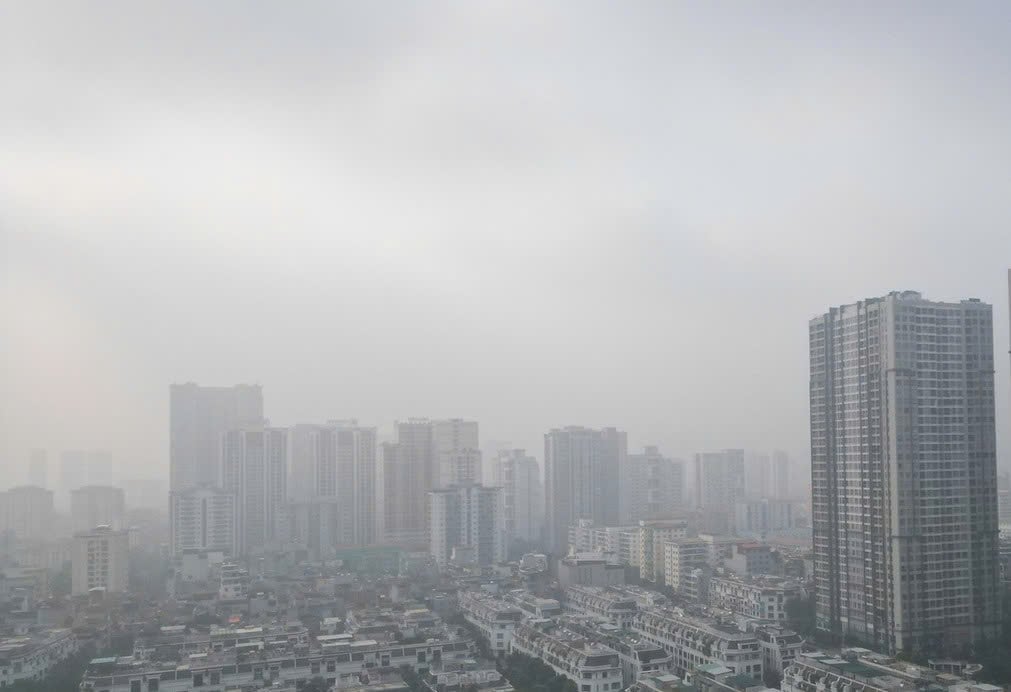 |
| Air pollution is a frequent occurrence during the winter months in Hanoi and many northern provinces. |
The latest draft proposes a roadmap to eliminate fossil fuel-powered motorcycles and scooters from the Ring Road 1 by July 1, 2026; eliminate motorcycles and scooters, and restrict the circulation of fossil fuel-powered private cars on Ring Road 1 and Ring Road 2 by January 1, 2028; and expand implementation to Ring Road 3 in Hanoi from 2030 onwards. The draft also outlines the development of a vehicle emissions testing system, connecting data for emission inventory and management.
In addition, a Decision stipulating the roadmap for applying national technical standards on vehicle emissions for road traffic has also been issued. Accordingly, vehicles manufactured before 1999 will apply Level 1 standards from the effective date of this Decision (November 28, 2025).
For automobiles manufactured from 1999 to the end of 2016, Level 2 will apply from the effective date of this Decision. For automobiles manufactured from 2017 to the end of 2021, Level 3 will apply from the effective date of this Decision.
For cars manufactured between 2017 and the end of 2021 that are used in traffic in Hanoi and Ho Chi Minh City, Level 4 will apply from January 1, 2027.
Motor vehicles manufactured from 2022 onwards will be subject to Level 4 from the effective date of this Decision, and Level 5 from January 1, 2032. For motor vehicles manufactured from 2022 onwards participating in traffic in Hanoi and Ho Chi Minh City, Level 5 will be applied from January 1, 2028.
Furthermore, from January 1st, 2029, vehicles participating in traffic in Hanoi and Ho Chi Minh City must meet emission standards of Level 2 or higher.
Besides controlling emissions from motorcycles, motorbikes, and cars currently in circulation, experts from the project "Integrating Climate Change Resilience and Environmental Protection for the Development of Green Cities," led by the Department of Environment, Ministry of Agriculture and Environment, propose studying the limitation of the number of newly registered motorcycles and moving towards ceasing the registration of fossil fuel-powered motorcycles in Hanoi and Ho Chi Minh City according to a suitable roadmap. This is considered a measure with a significant impact on the public, therefore supporting policies will need to be prepared in parallel.
Experts also proposed developing preferential policies and social mobilization to encourage people and businesses to convert old motorcycles and scooters to clean, green, and environmentally friendly vehicles; applying preferential policies and support to waive or reduce fees for students using public transportation; and developing a public bicycle service system (mobilizing social participation through preferential policies and support).
In particular, it is necessary to improve, upgrade, and expand public transport infrastructure; develop an investment roadmap; convert public transport vehicles using fossil fuels to buses using clean, green, and environmentally friendly energy; and complete urban railway (metro) lines and build infrastructure.
Electric vehicle charging stations and battery swapping cabinets suitable for multi-purpose use. Develop plans to encourage the conversion of vehicles to clean, green, and environmentally friendly energy for intercity bus passenger transport routes and fixed passenger transport routes.
Source: https://huengaynay.vn/kinh-te/giao-thong-and-bai-toan-o-nhiem-khong-khi-do-thi-160868.html














![[Photo] Prime Minister Pham Minh Chinh holds a phone call with the CEO of Russia's Rosatom Corporation.](/_next/image?url=https%3A%2F%2Fvphoto.vietnam.vn%2Fthumb%2F1200x675%2Fvietnam%2Fresource%2FIMAGE%2F2025%2F12%2F11%2F1765464552365_dsc-5295-jpg.webp&w=3840&q=75)











































Comment (0)