

Vietnam's English Proficiency Index (EPI) in 2024 decreased compared to 2023, leading to a drop in the rankings.

An English enrichment lesson for students at Ho Van Hue Primary School (Phu Nhuan District, Ho Chi Minh City) - Photo: NHU HUNG
On November 13th, Education First officially announced the English Proficiency Index 2024 (EPI 2024).
The survey has been conducted annually since 2011 and is currently the world's largest survey of English language skills by country and region.
The 2024 EPI index is analyzed from the test results of 2.1 million non-native English speakers aged 18 and over in 116 countries and regions.
Based on the EPI index results, countries are divided into English proficiency groups: Very High (above 600 points), High (550 - 599 points), Medium (500 - 549 points), Low (450 - 499 points), Very Low (below 450 points).
In 2024, Vietnam's English proficiency index reached 498 points, placing it in the low group. A year earlier, in 2023, Vietnam scored 505 points, placing it in the medium group.
In this year's global ranking, Vietnam is ranked 63rd out of 116 countries and regions.
Thus, Vietnam's ranking in 2024 dropped 5 places compared to the previous year, from 58 to 63, ceding this position to Guatemala, a Spanish-speaking country in Central America.
This ranking is also quite far from the best ranking Vietnam achieved in 2019, which was 52nd.
In Asia, Vietnam ranks 8th in English proficiency, after Singapore, the Philippines, Malaysia, Hong Kong, South Korea, Nepal, and Bangladesh.
Compared to 2023, Vietnam dropped one place from 7th to 8th. Bangladesh took the 7th position from Vietnam, whereas last year it was ranked 8th.
Vietnam ranks above some countries in the region such as Indonesia (80), China (91) and Japan (92) in the EPI 2024 index.
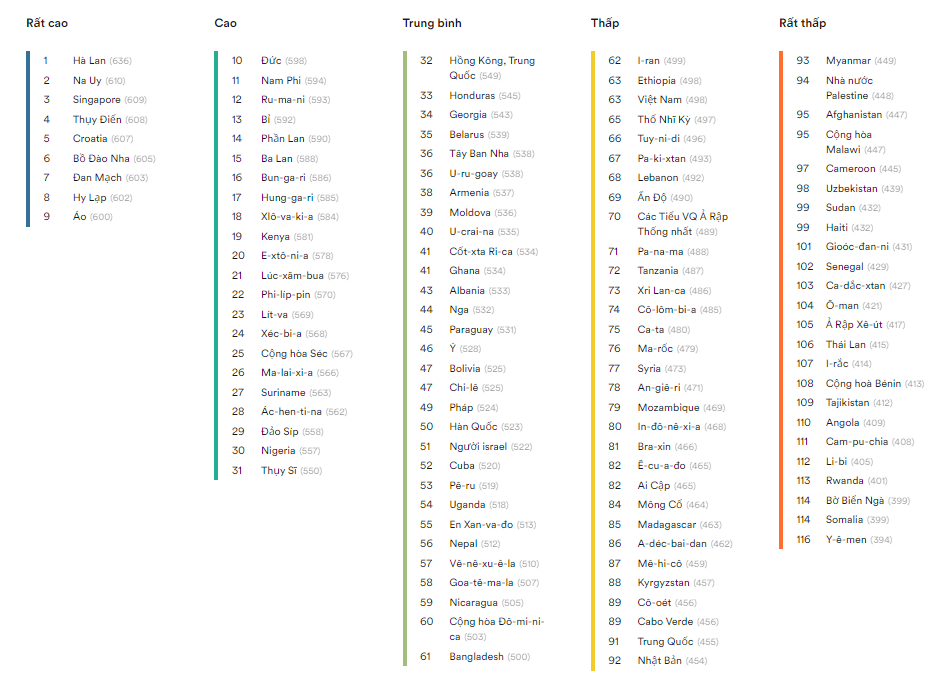
According to the 2024 EPI rankings, the Netherlands continues to lead - Photo: EF
Mark Do, director of EF Education First in Vietnam, said that EF's analysis shows a decline in global English proficiency. This is the fourth consecutive year that global English proficiency has decreased, with 60% of countries in the ranking having lower scores than last year.
However, a bright spot is that the 18-20 age group has halted its prolonged decline, increasing by 5 points compared to 2023 after having decreased by 89 points since 2015.
Asia saw the largest decline in English proficiency compared to last year, largely due to India and partly due to China. In Europe, English proficiency also declined slightly.
In Latin America, English proficiency remained stable after years of increases, but some countries such as Brazil, El Salvador, and Cuba saw a drop of more than 10 points.
Another analysis by EF found that there are still 40 countries where men significantly outperform women, by more than 20 points, similar to 2023.
Notably, Africa is the only continent where women consistently outperform men in English, and this is also the region where women show the most significant improvement.
How is the English Proficiency Index (EPI) calculated?
The national EF EPI score is calculated as the average of three consecutive years. First, EF calculates the average EF SET score of all test-takers in a country during the previous calendar year.
This score is then averaged with the published EF EPI scores from the two previous years (Y-1 and Y-2). This method helps to stabilize the index and minimize volatility due to changes in the sample from year to year.
After calculating the national EF EPI scores, EF uses these scores to calculate composite scores for regions around the world (such as Europe, Asia) and a global score.
These scores are calculated based on the population weight of each country. For example, India's score will have a higher weight than Thailand's when calculating the Asian regional score.
This methodology applies to all scores at the supranational level (global and regional scores, along with analyses by gender and age group).
Scores for subgroups within a country are not weighted by population but are calculated as a three-year average, adjusted against the national score to ensure consistency.
Based on threshold scores, EF ranks countries, regions, and cities into proficiency groups, helping to identify clusters with similar English skill levels and allowing for comparisons within and across regions.
Source: https://tuoitre.vn/chi-so-thong-thao-tieng-anh-viet-nam-dung-thu-63-trong-116-quoc-gia-khao-sat-20241113071558073.htm











































































Comment (0)