

Many experts believe that this draft will create unfairness in the admissions process, making the enrollment process more complicated, increasing the number of "phantom" candidates, and causing candidates to wait longer even though they may have met all the criteria for early admission... In response to these concerns, Deputy Minister of Education and Training Hoang Minh Son stated that when universities conduct early admissions, they do so independently, and the problem of "phantom" candidates only arises when the Ministry conducts a unified admissions process.
Mr. Son argued that it is impossible to predict the percentage of "ghost" applications (applications from students who don't enroll in a specific program or major), leading to schools wanting to conduct early admissions to meet their quotas or secure as many early admission slots as possible. This results in uncertain determination of admission quotas and cut-off scores.
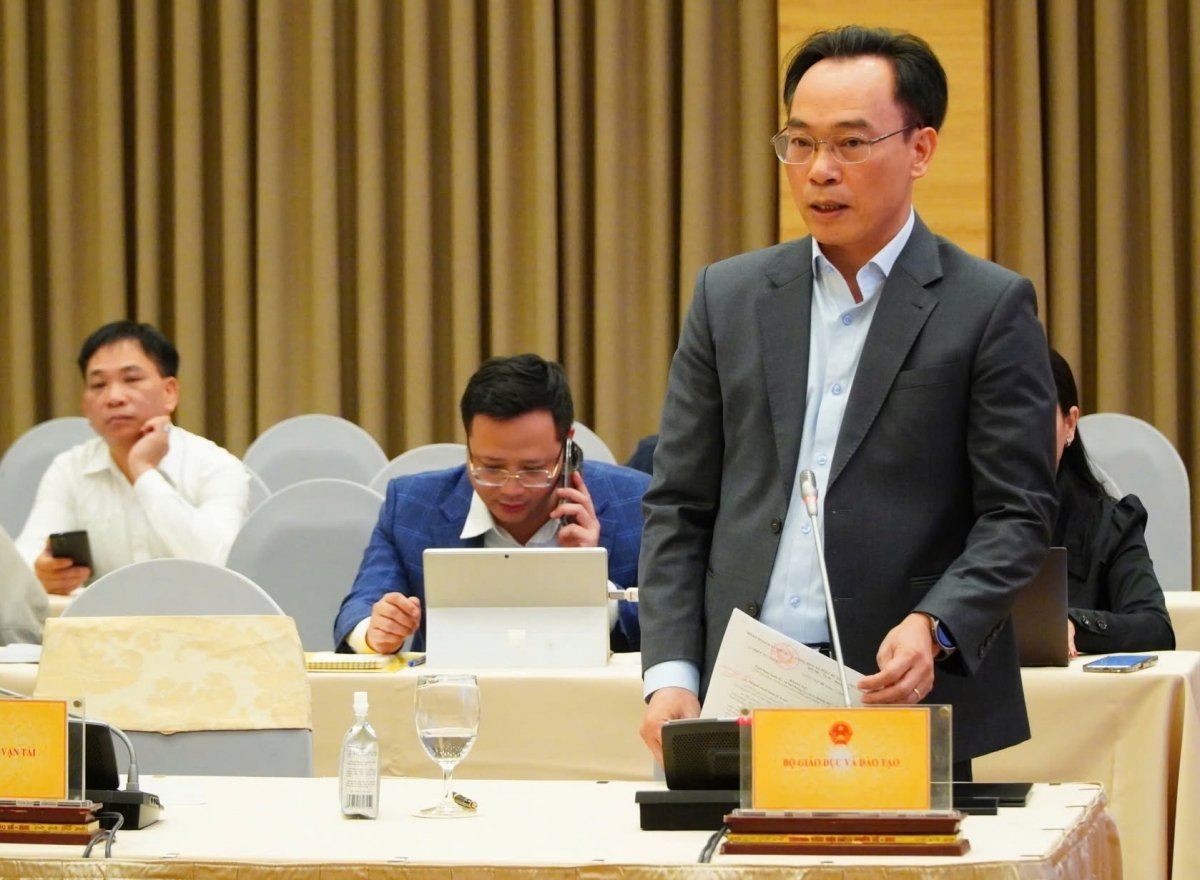
According to Mr. Son, the Ministry of Education and Training, like other ministries and agencies, bases its revisions of legal documents on both legal grounds and practical realities. Throughout the years of implementing the admissions regulations, the Ministry has monitored and listened to the opinions of experts and those involved to directly carry out the admissions process with schools and Departments of Education and Training that directly manage secondary education .
The Deputy Minister of Education and Training affirmed that the most important rule in education is fairness and quality. In addition, it is important to improve efficiency and create favorable conditions for candidates: "Specifically, yesterday (December 6th) we also organized a frank and open seminar with the participation of about 50 experts who are directly involved in admissions and training at higher education institutions. The experts' opinions were in complete agreement with the Ministry's draft."
Further explaining the draft, Deputy Minister Hoang Minh Son said that the practice of early university admissions originated 6-7 years ago. Prior to that, all universities conducted centralized admissions after students received their high school graduation exam results. Since 2017, some educational institutions have begun early admissions based on academic transcripts or other achievements.
According to Mr. Son, when one educational institution organizes early admissions, other institutions also race to gain a competitive advantage: "When everyone is competing, everyone struggles. Educational institutions have to prepare from the beginning of the year for the recruitment process, collecting application forms, and high school students in their final year have to rush to take certification exams to complete their applications. Everyone struggles, but the results are not very effective. Out of 8 successful early admission applications, only 1 will actually enroll; or out of 2 successful early admission applications, only 1 will enroll later."
The Deputy Minister further explained that the cutoff scores are usually lowered to recruit more students; therefore, the acceptance rate is unpredictable, and the rate of "ghost" applications (those who apply but don't actually enroll) is very high. The Deputy Minister also cited examples from recent years, where the cutoff scores for some majors in the general recruitment round have skyrocketed.
"There was a candidate who scored 25 points and was admitted to this major, but the final admission cutoff score was 26 points. Meanwhile, if they had applied early, they would have been admitted. This unfairness leads to compromised quality," Mr. Son said.
Leaders of the Ministry of Education and Training also stated that because of the early admission process, students who have not yet completed the high school graduation program are being considered for admission, which creates unfairness. While some students have the means to study early and complete the first semester's curriculum, most students only finish in May. Therefore, the admission scores based on their academic results are uneven, also creating injustice.
Deputy Minister Hoang Minh Son stated that a major negative impact on secondary education is that many students, having already been admitted to universities, no longer care about their studies and simply sit around in class. Many students entering specialized high schools feel almost secure about their admission and do not focus on comprehensive learning or studying subjects truly necessary for future training. Therefore, the quality of secondary education is negatively affected, leading to a decline in the quality of university education later on, as students lack a solid foundation.
"We could consider abolishing early admissions. Based on years of experience and feedback from those involved, the Ministry of Education and Training has made adjustments to address these shortcomings. By reducing the percentage of early admissions, only truly outstanding students will be admitted directly. Students will focus on the general admissions process, ensuring fairness, quality, efficiency, and convenience," the Deputy Minister said, adding that they will consider whether to keep the early admissions rate at 20% or abolish it altogether and merge it into the general admissions process.
At the same time, the Ministry of Education and Training has also prepared a complete database of academic transcripts, high school graduation exam scores, aptitude test scores, and thinking skills assessment scores of schools. Schools will then only need to consider these scores, and students can confidently complete their 12th grade studies and choose their desired majors and schools through the system. This will create convenience and efficiency for everyone, aiming towards a transparent, fair, high-quality, effective, and convenient education system.
Source: https://vov.vn/xa-hoi/co-the-can-nhac-viec-bo-xet-tuyen-dai-hoc-som-post1140573.vov


![[Photo] Prime Minister Pham Minh Chinh holds a phone call with the CEO of Russia's Rosatom Corporation.](/_next/image?url=https%3A%2F%2Fvphoto.vietnam.vn%2Fthumb%2F1200x675%2Fvietnam%2Fresource%2FIMAGE%2F2025%2F12%2F11%2F1765464552365_dsc-5295-jpg.webp&w=3840&q=75)
![[Photo] Closing Ceremony of the 10th Session of the 15th National Assembly](/_next/image?url=https%3A%2F%2Fvphoto.vietnam.vn%2Fthumb%2F1200x675%2Fvietnam%2Fresource%2FIMAGE%2F2025%2F12%2F11%2F1765448959967_image-1437-jpg.webp&w=3840&q=75)








































![[OFFICIAL] MISA GROUP ANNOUNCES ITS PIONEERING BRAND POSITIONING IN BUILDING AGENTIC AI FOR BUSINESSES, HOUSEHOLDS, AND THE GOVERNMENT](https://vphoto.vietnam.vn/thumb/402x226/vietnam/resource/IMAGE/2025/12/11/1765444754256_agentic-ai_postfb-scaled.png)













































Comment (0)