


Candidates taking the 2025 Ho Chi Minh City National University's capacity assessment exam - Photo: TRAN HUYNH
Data from the Ho Chi Minh City National University's aptitude test recently announced by the university shows that after 7 years of organization, the scale of the test has continuously increased.
The average score fluctuates around 640-665
During the 2023-2025 period, the number of candidates taking the competency assessment exam increased steadily over the years, especially in 2025, which recorded a rapid increase with more than 152,000 candidates, nearly one and a half times compared to 2023 and 2024.
Dr. Nguyen Quoc Chinh - Director of the Center for Testing and Assessment of Training Quality of Ho Chi Minh City National University - said: "Despite the sharp increase in the number of candidates, the exam results still maintained statistical stability: the average score fluctuated around 640-665 and the median score was stable at 629 to 654 points (on a scale of 1,200 points). This shows that the test-taking ability of the majority of candidates has not fluctuated much over the years."
The increase in the number of candidates widened the score range, as shown by the increase in standard deviation from 123.8 to 159.8.
Along with the increase in the number of candidates taking the exam, the differentiation of diverse ability levels of candidates is also shown more clearly through the slight "leftward shift" in the low-score area and the slight "rightward shift" in the high-score area at the two ends of the score distribution.
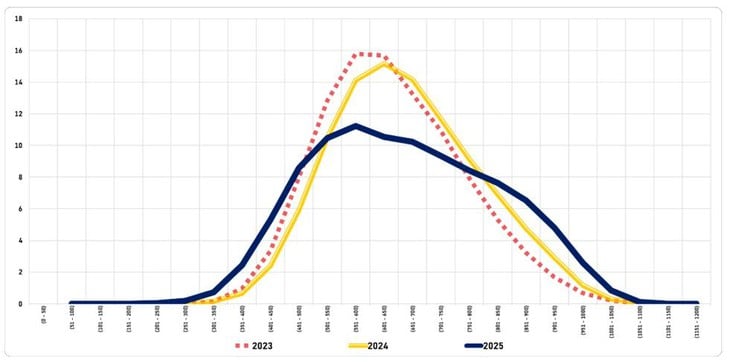
Distribution of scores for the Ho Chi Minh City National University's aptitude test in 2023, 2024, 2025
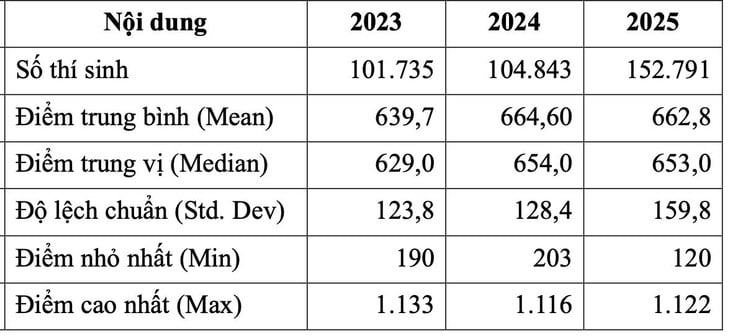
Statistics of characteristics of the competency assessment test results in 2023, 2024, 2025
Why are the second round of competency assessment test scores often higher than the first round?
Analyzing the exam results of candidates who took the 2025 exam, Mr. Chinh said that the score distribution in each round was close to the standard distribution, the width of the score distribution showed that the exam had a good level of differentiation suitable for university admission goals.
The score distribution of wave 2 tends to be "right-skewed" and more spread out than wave 1, reflecting a higher average score and greater dispersion.
According to Mr. Chinh, this could be due to the following reasons:
Firstly, of the total number of candidates taking the second round, more than 65,000 candidates (71.27%) had taken the first round. Analysis of the results showed that this group of candidates had higher test scores than the average, indicating that they were of good ability or above. The fact that this group of candidates continued to take the second round contributed to shifting the score distribution to the right.
Second, the second round takes place about two months after the first round, giving candidates more time to review and consolidate their knowledge. At the same time, thanks to the experience in the first round, candidates gain more experience in the structure of the test, time management skills, exam psychology and how to avoid previous mistakes, thereby improving their test results.
Third, the second round often attracts highly motivated candidates with clear goals in improving or optimizing their scores for admission. Meanwhile, many candidates with poor academic performance or who do not really invest in the exam tend not to register or not participate in the second round. This changes the candidate structure, increases the proportion of candidates with good and excellent academic performance, thereby contributing to raising the average exam score.
"Analysis of the results shows that this group of candidates has higher test scores than the average, showing that they are in the group with good or above average ability. The fact that this group of candidates continues to take the exam in the second round contributes to shifting the score distribution to the right," said Mr. Chinh.
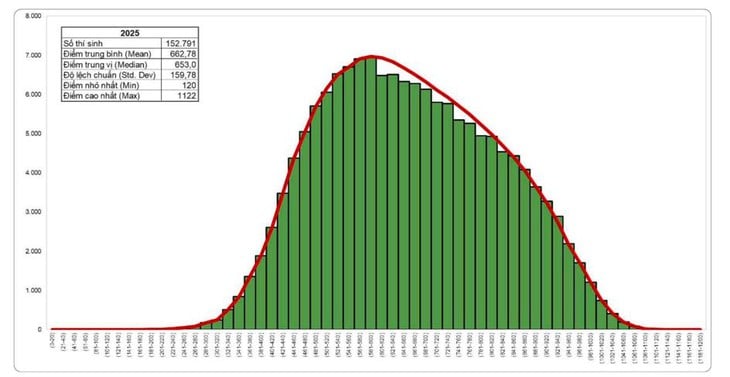
Distribution of competency assessment test scores in 2025
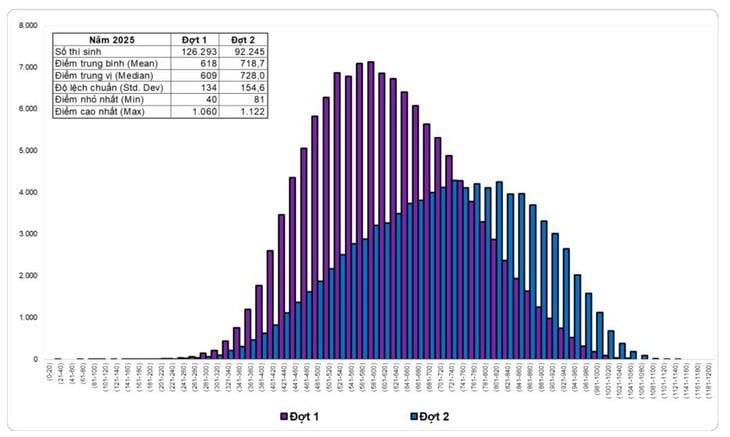
Distribution of test scores for the first and second rounds of capacity assessment in 2025
Source: https://tuoitre.vn/thi-sinh-thi-danh-gia-nang-luc-dh-quoc-gia-tphcm-lien-tuc-tang-diem-thi-co-bien-dong-20251208110112325.htm





































































































Comment (0)