

After decades of building narrow, tube-shaped houses, it's very difficult to deal with the situation.
On the morning of June 20th, continuing the program of the 7th Session, the National Assembly held a plenary discussion on the Hanoi Capital City Planning for the period 2021-2030, with a vision to 2050; and the overall adjustment project of the Hanoi Capital City Master Plan until 2045, with a vision to 2065.
Speaking at the session, delegate Nguyen Anh Tri (Hanoi) expressed his concern about the development of the Red River axis so that the Red River truly becomes the center of development for the capital city, with a harmonious distribution of ecological, cultural, historical, and modern urban spaces.
Regarding the renovation of old apartment buildings, delegates believe this is a very positive development, especially given the increasingly serious fire incidents. Therefore, this is an urgent and pressing issue that needs to be addressed.
According to the Hanoi delegation, the urban replanning process must prioritize ensuring "wide roads for easy access," and clear, unobstructed routes to prevent accidents such as fires, explosions, or other serious incidents. The delegates emphasized that every effort must be made to achieve this.
In addition, Representative Tri also raised the issue of how to eliminate tube houses in Hanoi, emphasizing that this matter needs to be discussed with the people and achieve a high level of consensus.
"We've gone through decades of narrow, tube-shaped houses, and now it's very difficult to deal with and rectify the situation. This time, we should gradually limit the construction of new tube-shaped houses and re-plan to make changes," the representative emphasized.
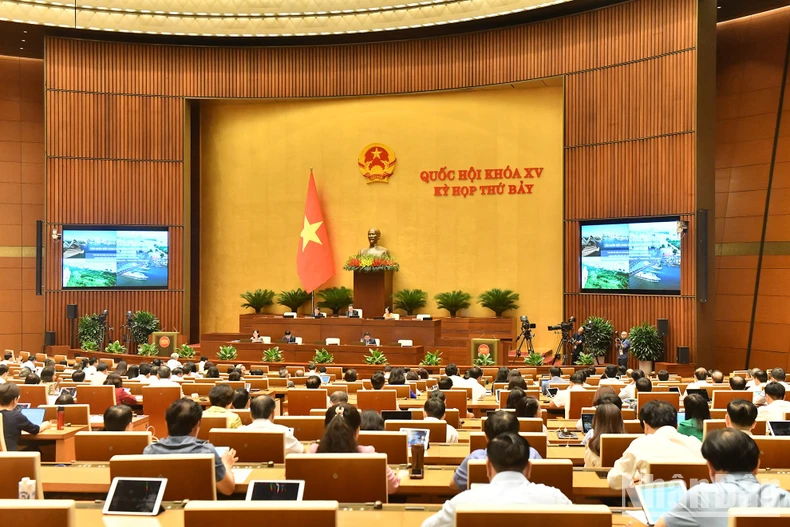 |
Members of Parliament watch a video clip about the development plan for the capital city. (Photo: DANG KHOA) |
Regarding elevated roads, delegates suggested that they should only be developed in suburban areas, while in densely populated urban areas, such as the Old Quarter or streets with many modern high-rise buildings, they should be minimized. Building elevated roads would completely obstruct the view and detract from the appearance of the street.
Regarding the planning of the capital's healthcare system, delegate Tri emphasized that this is a plan not only for the people of the capital but also for the entire region, and even the whole nation.
According to the delegates, most of the major, leading hospitals are concentrated in Hanoi. Therefore, large hospitals, especially specialized ones, should concentrate their resources, and perhaps even establish medical centers or specialized institutes for coordination.
The urban planning of the capital city must incorporate elements that converge and represent the development of the entire country.
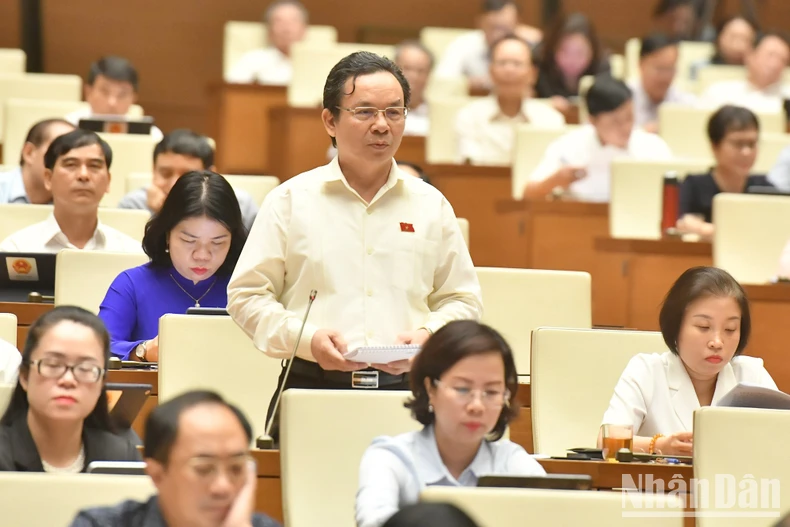 |
Delegate Hoang Van Cuong (Hanoi) delivers a speech. (Photo: DANG KHOA) |
Commenting on the planning content, delegate Hoang Van Cuong (Hanoi) stated that the Hanoi Capital City plan is a provincial plan, but unlike the plans of other provinces which only cover one locality, the Hanoi Capital City plan is a plan for the entire country. Therefore, it must incorporate elements that converge and represent the development of the whole nation.
According to the delegates, Hanoi needs to focus on solving the biggest bottleneck, which is traffic, by investing in the construction of 14 inner-city railway lines and establishing a sufficient railway network to alleviate traffic congestion.
According to Mr. Cuong, when the railway network is connected, it will help to decentralize the population, especially connecting provinces in the Hanoi region such as Bac Ninh, Hung Yen, Ha Nam, etc., and build satellite urban areas.
"The connectivity aspect needs to be prioritized first; then people will automatically move out of old apartment buildings and low-rise housing areas to high-rise housing areas in the suburbs," Mr. Cuong said.
According to the delegates, it is necessary to plan residential areas in conjunction with commercial and service areas and underground spaces, connecting them to the railway network and public transportation.
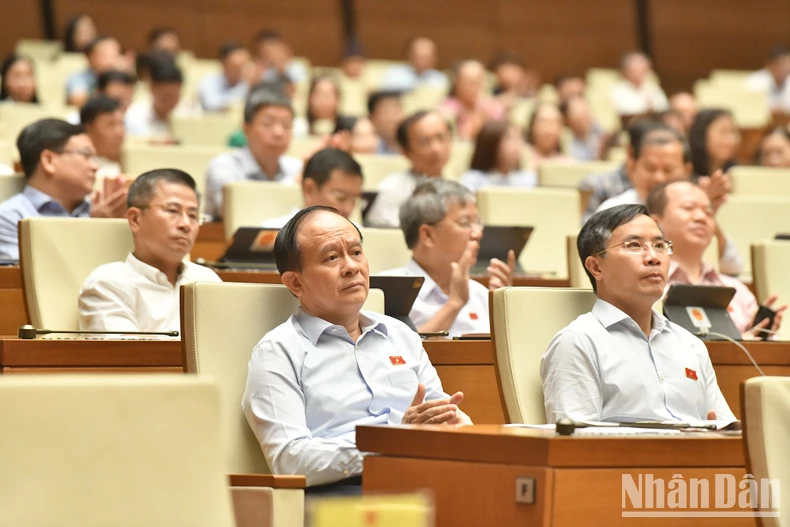 |
Members of Parliament working in the assembly hall. (Photo: DANG KHOA) |
Regarding the Red River landscape axis in the planning project, Representative Cuong stated that: Hanoi uses the Red River as a landscape space and a future spatial axis, so it is necessary to build a heritage road along the Red River to connect urban areas and urban chains.
Mr. Cuong also noted that Hanoi needs a policy to support residents of the Old Quarter in relocating to the outskirts of the city, with the view that their houses should not be confiscated, their assets should still be preserved, and the government should only support the joint development of commercial services between the state and the people.
"Investors should be encouraged to renovate old neighborhoods and historical streets to transform these areas into centers for accommodation and nighttime economic development. Currently, we are only developing the area around Hoan Kiem Lake; we need to expand this nighttime economic model to all 36 streets and wards," Representative Cuong proposed.
Without a breakthrough mechanism, when will Hanoi ever complete its 14 railway lines?
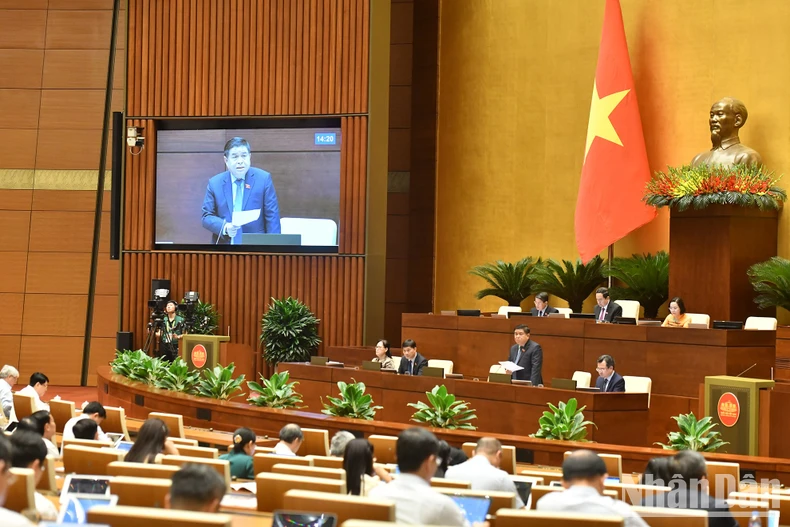 |
Minister of Planning and Investment Nguyen Chi Dung delivers a speech. (Photo: DANG KHOA) |
Commenting on the revised master plan for Hanoi, Minister of Planning and Investment Nguyen Chi Dung affirmed that Hanoi needs a mechanism to complete the 14 railway projects and lines.
The minister stated that currently, it takes the city 12-15 years to complete a railway project, while according to the plan, 14 urban railway lines must be completed by 2035, thus posing a risk of not being able to implement the project.
“Hanoi has a plan for 14 urban railway lines, requiring approximately 40 billion USD in capital, and these lines must be completed before 2035, which is 11 years away. However, currently, it takes us an average of 12-15 years to complete a railway project. Without a breakthrough mechanism, when will we ever complete them?”, Mr. Nguyen Chi Dung expressed his concern.
The Minister stated that Hanoi needs to develop clear policies and mechanisms to prioritize tasks, determining what to do first and what to do later, in order to complete the railway construction plan assigned by the Politburo.
"Hanoi must develop the most feasible plan, including accompanying mechanisms and priorities, in order to have the future Hanoi that we desire," said the Minister of Planning and Investment.
The Minister also commented that the plan has oriented the spatial development of the Red River into an ecological, cultural, and economic space, showcasing the development symbols of the Capital, with the Red River axis becoming the central convergence point, the face and important highlight of the Capital region, and the urbanized Red River Delta region.
Nevertheless, the study also needs to resolve conflicts in the planning scheme for the Red River axis to ensure compatibility with other plans, such as those on flood control and dike construction, which have been approved by the Prime Minister.
To ensure that planning is truly meaningful and highly feasible, the Minister emphasized the importance of reviewing and assessing the consistency and uniformity between plans to avoid conflicts and contradictions that would otherwise have to be costly or require significant adjustments.
Establishing dynamic and specific mechanisms for the Capital City.
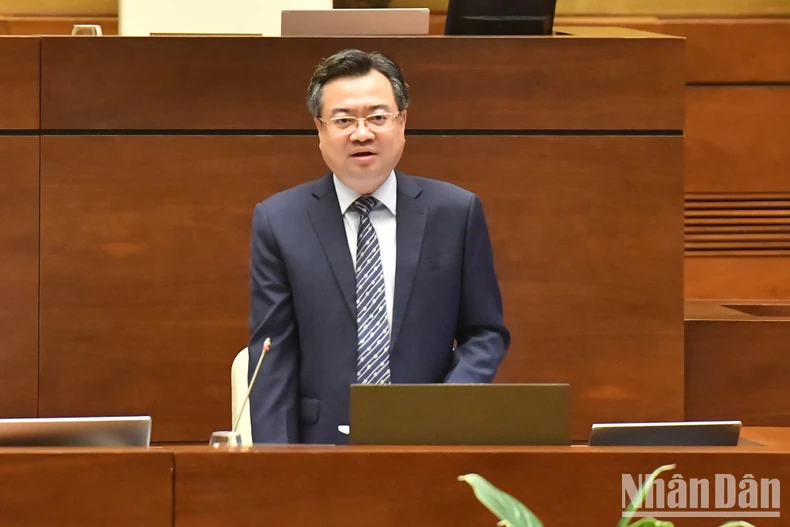 |
Minister of Construction Nguyen Thanh Nghi delivers a speech. (Photo: DANG KHOA) |
Speaking at the session, Minister of Construction Nguyen Thanh Nghi stated that this revised plan is aligned with development strategies such as cooperation and linkages, cultural heritage development, green development, establishing a livable environment, smart and sustainable cities, as well as establishing dynamic and specific mechanisms for the capital city.
According to the Minister, the new aspects of this project stem from the realities of development and, through review and assessment, adjustments to the development forecast for the capital city to align with the Capital City Master Plan.
Furthermore, the project also inherits and adjusts the scale of the urban structure, with an urban structure that is a multi-polar, multi-centered cluster of cities with 5 urban areas: the central urban area, the eastern urban area, the northern urban area, the western urban area, and the southern urban area. These urban areas are separated by green corridors and linked by a system of ring roads and radial roads.
Fourth, this project addresses the issue of controlling urban and rural spatial development. This project has established a distinctive architectural planning model for Hanoi in both urban and rural areas, and also requires strict control over building height and construction density in each area, especially in the inner city, as suggested by National Assembly representatives.
According to the Minister of Construction, the selection of land use indicators, spatial utilization, technical infrastructure, and development requirements in the special functional area is also clarified in this project.
Furthermore, the project also adjusts and supplements planning solutions for green and smart technical infrastructure systems to align with the development orientation of the Capital City, as well as to conform to the development orientations in national sectoral plans for each stage, ensuring regional infrastructure connectivity, developing smart public transportation, and developing other technical infrastructure.
The Minister also clarified that urban development based on the TOD model is a new and focused aspect in this planning phase, aimed at urban renovation and reconstruction, concentrating on urban construction, urban beautification, and the exploitation of public transportation infrastructure.
Accordingly, investment will be focused, planning will be oriented, and the Red River will be identified as the spatial axis and symbol of the capital's development.
"This is the highlight of our planning this time, and the details have been reviewed by National Assembly deputies in the documents and video clips, applying the model of a city within the capital. This has been clearly reported to the National Assembly deputies in the documents," the Minister stated.
Regarding infrastructure to meet the development requirements of the Capital, the plan has identified the development of a second airport in the capital region, as well as the development of transportation and technical infrastructure systems to meet the development requirements of the Capital in the coming period.
Regarding underground space planning, the Minister stated that while the Urban Planning Law stipulates this, currently only Hanoi is implementing underground space planning for certain urban areas.
However, to meet the development requirements of the new phase and to effectively utilize space and land resources, underground space planning for the capital will continue to be a focus of investment and will be specifically implemented in this planning document.
Source: https://www.vietnam.vn/dai-bieu-quoc-hoi-de-xuat-cap-thiet-cai-tao-chung-cu-cu-tai-ha-noi/


![[Image] Close-up of the newly discovered "sacred road" at My Son Sanctuary](/_next/image?url=https%3A%2F%2Fvphoto.vietnam.vn%2Fthumb%2F1200x675%2Fvietnam%2Fresource%2FIMAGE%2F2025%2F12%2F13%2F1765587881240_ndo_br_ms5-jpg.webp&w=3840&q=75)



































































Comment (0)