

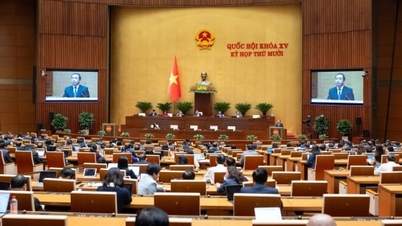
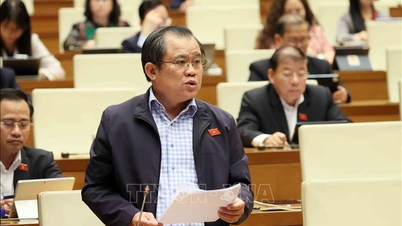
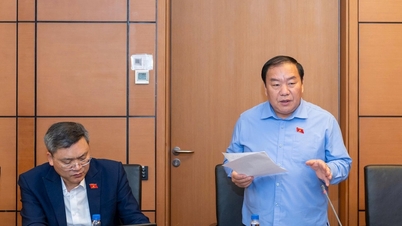
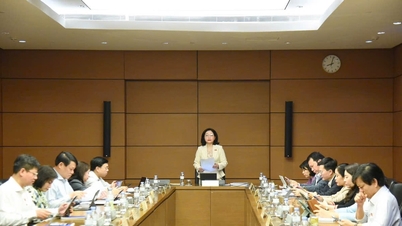
On the afternoon of June 20th, during a group discussion on the Law on Geology and Minerals, Representative Sung A Lenh, Deputy Head of the National Assembly Delegation of Lao Cai province, suggested that Article 9, which stipulates "Rights and responsibilities of localities, communities, households, and individuals where geological and mineral resources are exploited," should be supplemented with the provision "The people need to be informed about geological and mineral surveys."
In reality, in many localities, people living near mining sites are not informed about the organizations and businesses involved in mining activities. This easily leads to the consequence that people are caught off guard and surprised, with many reacting negatively and disagreeing with the mining activities of these organizations and businesses. Therefore, people need to be informed about geological and mineral surveys.
The content of "Mineral Planning" is clearly stated in Article 13, in which point d, clause 2 stipulates " Areas for registering the exploitation of Group IV minerals" . According to the regulations, Group IV minerals include clay, hill soil, mixed soil, rocks, sand, gravel, etc. This group is only suitable for purposes such as foundations and leveling materials, and the demand usually arises during the construction process.

Delegate Sung A Lenh analyzed that most construction investment projects have short timelines, so including Group IV minerals in the planning process requires more careful consideration and assessment of their practical suitability.
Regarding the regulation on "Areas prohibited from mineral exploitation, areas temporarily prohibited from mineral exploitation" (Article 29), delegate Sung A Lenh suggested that the determination of areas prohibited from mineral exploitation should be more specific and detailed based on "the results of geological surveys on minerals".

Also in Article 29, at point d, clause 1, the representative proposed adding the phrase "belief" and amending it to the full content as follows: Religious and belief-related land. According to point g, clause 3, Article 9 of the 2024 Land Law: Land used for religious activities (hereinafter referred to as religious land); land used for belief-related activities (hereinafter referred to as belief-related land). These are types of land used for constructing facilities, headquarters, and religious structures; therefore, consideration should be given to adding them to the areas prohibited from mining activities.
Representative Sùng A Lềnh also suggested considering and researching the expansion of areas where mining activities are prohibited or temporarily banned, such as areas with high biodiversity or ecological value; and areas at risk of groundwater pollution. These are areas that have a significant impact on biological organisms as well as the human living environment.

Regarding the regulation on "Rights and obligations of organizations and individuals exploiting minerals" (Article 62), specifically point l, clause 1, which stipulates that organizations and individuals exploiting minerals have the right to "mortgage or contribute capital to mineral exploitation rights," Representative Sung A Lenh pointed out that in some cases, organizations and individuals have mortgaged or contributed capital to register mineral exploitation rights, but then violated regulations during exploitation to the point where the license had to be revoked. In such cases, disputes and their resolution become quite complex and difficult to address.
Mineral extraction is a unique activity, and the estimated mineral reserves can change due to various reasons. In case of risk, if the extracted reserves are not as predicted, no agency will be held responsible to the bank or credit institution. Therefore, the representative suggested that the drafting agency research and consider additional regulations to ensure they are appropriate and rigorous.
Delegate Sùng A Lềnh also participated in drafting Article 64 on "Mining Design," including Clause 1. The regulation includes two points: point a: "For mineral mining projects of a scale conforming to the regulations on one-step and two-step design, the mine design is the construction drawing design" and point b: "For mineral mining projects of a scale conforming to the regulations on three-step design, the mine design includes technical design and construction drawing design."

According to delegate Sung A Lenh, the above regulation is inconsistent with the provisions of the 2014 Construction Law and the Law amending and supplementing some articles of the Construction Law in 2020. Specifically, this Law stipulates that "one-step design includes construction drawings; two-step design includes basic design and construction drawings; three-step design includes basic design, technical design, and construction drawings."
Source













































































Comment (0)