

Not long ago, at a seminar on modernizing and upgrading higher education , Associate Professor Dr. Do Phu Tran Tinh, Director of the Institute for Policy Development - Vietnam National University Ho Chi Minh City, argued that the fact that a university with 40,000 or 4,000 students only has a maximum of 3 vice rectors is a shortcoming in governance.
According to Mr. Tinh, although the Party's guidelines and policies and the law affirm that university autonomy is a legal right, coupled with accountability, in reality, the units are still bound by many general regulations, causing difficulties in organizing and carrying out their tasks.
For example, according to regulations, in addition to having a maximum of 3 vice rectors, a university can only establish departments and offices when it has at least 2 working areas and a minimum of 7 staff. Member universities of Ho Chi Minh City National University have a large training scale, need more vice rectors to take on and share the workload, contributing to improving the efficiency of administration and operations, but are limited by this regulation.
Many other public universities also have a very large training scale, with tens of thousands of students, hundreds of lecturers, affiliated units and training programs. These include Ho Chi Minh City University of Industry and Trade, Ho Chi Minh City University of Technical Education, Ho Chi Minh City University of Industry, Ho Chi Minh City University of Technology, Ho Chi Minh City University of Social Sciences and Humanities, Ho Chi Minh City University of Medicine and Pharmacy, University of Finance - Marketing... The limitation of the number of vice presidents puts great pressure on the administrative apparatus of many schools in assigning, operating and supervising. Some schools have not yet appointed enough 3 vice presidents due to personnel problems.
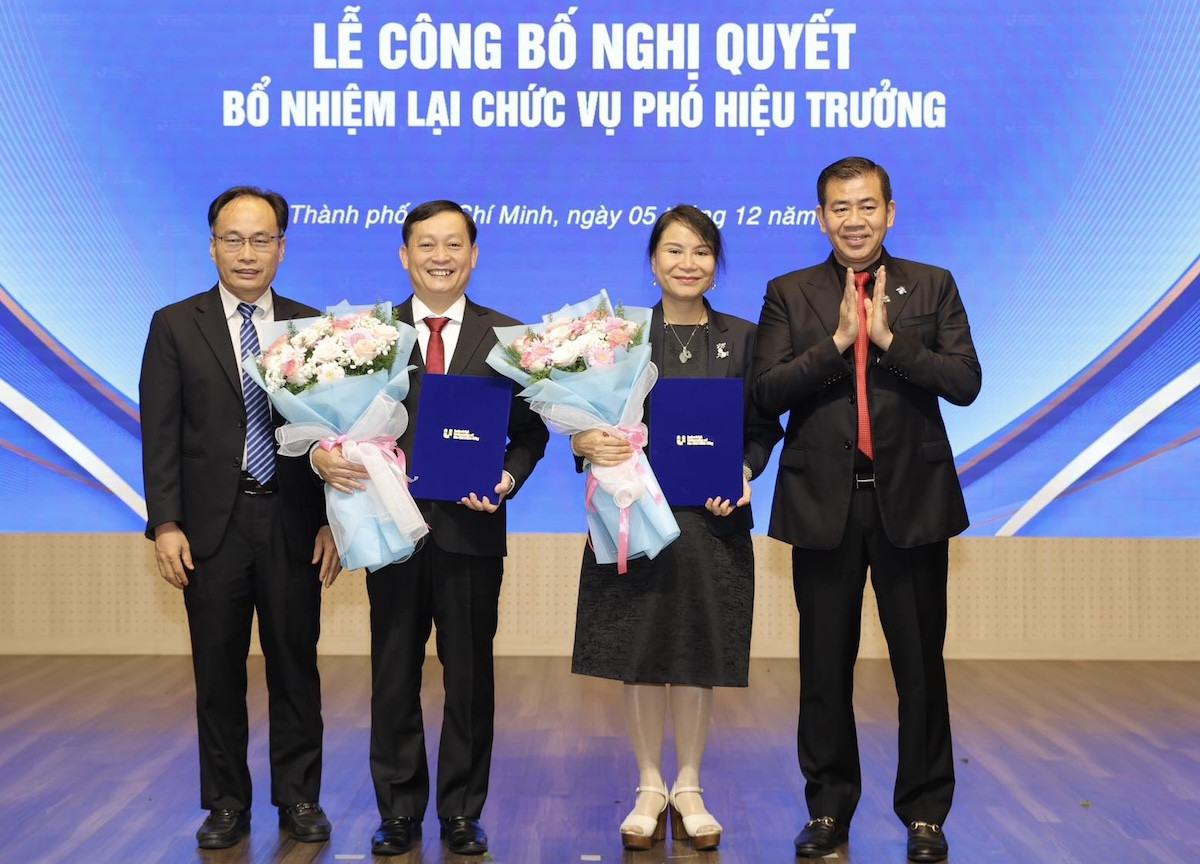
Schools should be given autonomy in appointing vice principals.
At Ho Chi Minh City University of Industry and Trade, Associate Professor Dr. Nguyen Xuan Hoan, the university's rector, said that the university has only appointed two vice rectors so far, leaving one position vacant, which is expected to be filled in the near future.
Mr. Hoan analyzed that with a large student population, an expanding training program system and increasingly complex administrative requirements, the school needs four vice principals to handle the workload, ensure operational quality and meet development requirements. The school has proposed to add one more vice principal.
According to Mr. Hoan, when universities have entered a period of comprehensive autonomy, especially in organizational structure and personnel, it is necessary to allow schools to decide on the number of vice rectors. “Schools differ in size, training fields and operating models. Therefore, setting a fixed number of vice rectors according to general regulations will be difficult to implement. It is necessary to let schools determine their own personnel based on actual operational requirements,” Mr. Hoan stated his opinion.
A university leader believes that the delegation of personnel autonomy should be approached in a hierarchical manner, based on the level of financial autonomy of each higher education institution. For financially autonomous schools of group 2 and above, units that are capable of ensuring their own regular expenses, it is necessary to let the school proactively decide the number of vice-rectors and leadership personnel.
According to him, only when the apparatus is designed to suit the student size, the number of training majors, the linkages and the actual workload, can the school operate effectively, flexibly and be directly responsible for the results of its operations. On the contrary, for financially autonomous schools in groups 3 and 4 - still dependent on the state budget for salary payments, allowances and some State regimes - it is necessary to continue to control and closely monitor the number of management personnel. This is to ensure effective use of the public budget, avoid cumbersome apparatus or unnecessary costs while the payment part is still subsidized by the budget.
"Autonomy is not only a right, but also a responsibility. In establishments with sufficient financial capacity, delegating the right to decide the number of vice principals is reasonable, reflecting the spirit of autonomy and self-responsibility. But in units that are not yet autonomous, controlling human resources is not only a matter of organizational structure, but also a requirement of budget discipline and financial responsibility," he said.
Source: https://vietnamnet.vn/dai-hoc-4-000-hay-40-000-sinh-vien-deu-chi-toi-da-3-pho-hieu-truong-co-bat-cap-2470906.html


![[Photo] Explore the US Navy's USS Robert Smalls warship](/_next/image?url=https%3A%2F%2Fvphoto.vietnam.vn%2Fthumb%2F1200x675%2Fvietnam%2Fresource%2FIMAGE%2F2025%2F12%2F10%2F1765341533272_11212121-8303-jpg.webp&w=3840&q=75)






























































































Comment (0)