

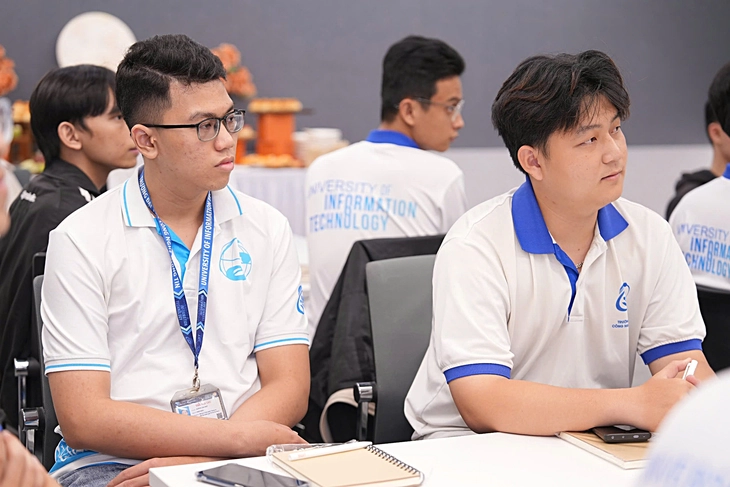
Students from the University of Information Technology (Vietnam National University Ho Chi Minh City) studying at a company - Photo: VAN TOAN
Many universities are simultaneously proposing reforms to their training programs and strengthening the "three-party" collaboration model (State - university - business). This aims to improve teaching quality and create a substantial transformation for higher education in the new era.
The key to bridging the gap.
Resolution 71 sets out the requirement to improve the quality of human resources for the new development phase. This reality poses the challenge for universities to innovate their training programs to align with practical needs, and to promote the "three-party" linkage to create a sustainable ecosystem of education, research, and innovation.
Associate Professor Tran Le Quan - Rector of the University of Science (Vietnam National University Ho Chi Minh City) - believes that Vietnamese higher education is entering a period of strong model transformation, from a semester-based training system to a competency-based training system that meets social needs. This shift from knowledge transmission to the development of creative abilities can only succeed if a genuine link is built between the "three stakeholders" (government, businesses, scientists, and the government).
As knowledge creators and facilitators, universities need to design open programs, inviting businesses to participate in providing feedback and evaluating course modules. Similarly, they should develop business collaboration centers and joint laboratories, make practical project-based courses mandatory, and increase the proportion of faculty with practical experience.
The university will become a hub for research, training, and technology transfer, maintaining its academic identity while meeting the needs of the labor market.
According to Mr. Quan, in the new era of development with the advancement of digital transformation and globalization, the linkage between the "three stakeholders" (government, businesses, scientists, and scientists) has become a strategic pillar for the development of human resources, science, and technology.
"The State needs to issue national framework regulations on 'three-party' cooperation, build a national interconnected database connecting human resource needs - training - research, as well as mechanisms for businesses to co-fund courses, co-supervise, cooperate in R&D and commercialize research results," Mr. Quan suggested.
Change the way internships are organized.
From a different perspective, Associate Professor Phan Hong Hai, Rector of Ho Chi Minh City University of Industry, suggests changing the internship organization from a one-time end-of-course model to a phased internship model. Students would have short internship periods interspersed between semesters, partly in the university's labs and partly at businesses.
This model helps students gain early exposure to real-world situations, while businesses can screen potential personnel from an early stage. To overcome difficulties related to scheduling and resources, Mr. Hai said that schools and businesses need to sign long-term cooperation agreements and make internships a mandatory credit-bearing course component.
Another model considered effective is a graduation thesis that solves a practical problem commissioned by a business.
Students conduct their research under the joint guidance of faculty and experts from the company. The only issue is the need for information security and intellectual property protection, requiring clear research collaboration regulations from the outset.
"We need to promote the model of shared lab investment, where businesses and schools jointly build and operate modern laboratories. This approach helps schools access advanced facilities without bearing the entire cost, while creating a rich research and practice environment for students," Mr. Hai said.
Comprehensive restructuring
Dr. Lam Duc Khai - Head of Training Department at the University of Information Technology (Vietnam National University Ho Chi Minh City) - said that the university has identified innovation in training program content and the development of the "three-party" linkage as strategic directions, aiming to build a model of an autonomous, innovative, and internationally integrated university.
Mr. Khai said that reforming training programs is not just about updating knowledge, but a comprehensive restructuring of all aspects of training towards interdisciplinary, applied, and creative approaches.
"The goal is to have a workforce of graduates who possess self-learning abilities, creativity, digital thinking skills, and high adaptability in the era of digital transformation and artificial intelligence," Mr. Khai emphasized.
Accordingly, the training program is designed based on learning outcomes, ensuring students achieve core competencies in professional skills and ethical qualities. Assessment will be based on practical skills and feedback from businesses. The method of testing and evaluation will shift from theoretical knowledge to assessing practical application skills and real-world products through graduation projects completed at businesses.
The school has implemented an online training system that personalizes learning and connects lecturers, students, and businesses, building a smart, convenient, and optimal learning environment for learners.
Combined with a model of instructors from businesses and graduation projects within businesses, this will create a closed-loop applied training chain. Businesses participate in teaching, providing feedback, guidance, project topics, and personnel recruitment throughout the training process.
"The State needs to improve financial mechanisms and incentives for cooperation, establish a fund to support program innovation, provide tax incentives for businesses participating in training, create a mechanism for ordering strategic human resource training, simplify linkage procedures, and protect intellectual property... Promote entrepreneurship and technology transfer through seed investment funds, incubators, and national incubation programs," Mr. Khai suggested.
Program design tailored to the specific needs of the business.
Dr. Quách Thanh Hải, Vice Rector of Ho Chi Minh City University of Technology and Education, stated that for many years the university has placed businesses at the center of its curriculum development and innovation. The university currently collaborates with over 1,600 domestic and international businesses and multinational corporations.
The school's training programs are updated every four years and adjusted annually. This includes input and feedback from a panel of experts and business leaders, and many programs are even designed entirely based on practical requests from businesses.
Source: https://tuoitre.vn/dai-hoc-doi-moi-manh-lien-ket-ba-nha-de-sinh-vien-hoc-toi-dau-dung-duoc-toi-do-20251210100330472.htm
![[Photo] The captivating scenery of the fragrant maple forest in Quang Tri](/_next/image?url=https%3A%2F%2Fvphoto.vietnam.vn%2Fthumb%2F1200x675%2Fvietnam%2Fresource%2FIMAGE%2F2025%2F12%2F10%2F1765353233198_lan09046-jpg.webp&w=3840&q=75)


![[Photo] Explore the US Navy's USS Robert Smalls warship](/_next/image?url=https%3A%2F%2Fvphoto.vietnam.vn%2Fthumb%2F1200x675%2Fvietnam%2Fresource%2FIMAGE%2F2025%2F12%2F10%2F1765341533272_11212121-8303-jpg.webp&w=3840&q=75)
























![[Video] The craft of making Dong Ho folk paintings has been inscribed by UNESCO on the List of Crafts in Need of Urgent Safeguarding.](https://vphoto.vietnam.vn/thumb/402x226/vietnam/resource/IMAGE/2025/12/10/1765350246533_tranh-dong-ho-734-jpg.webp)
























































Comment (0)