

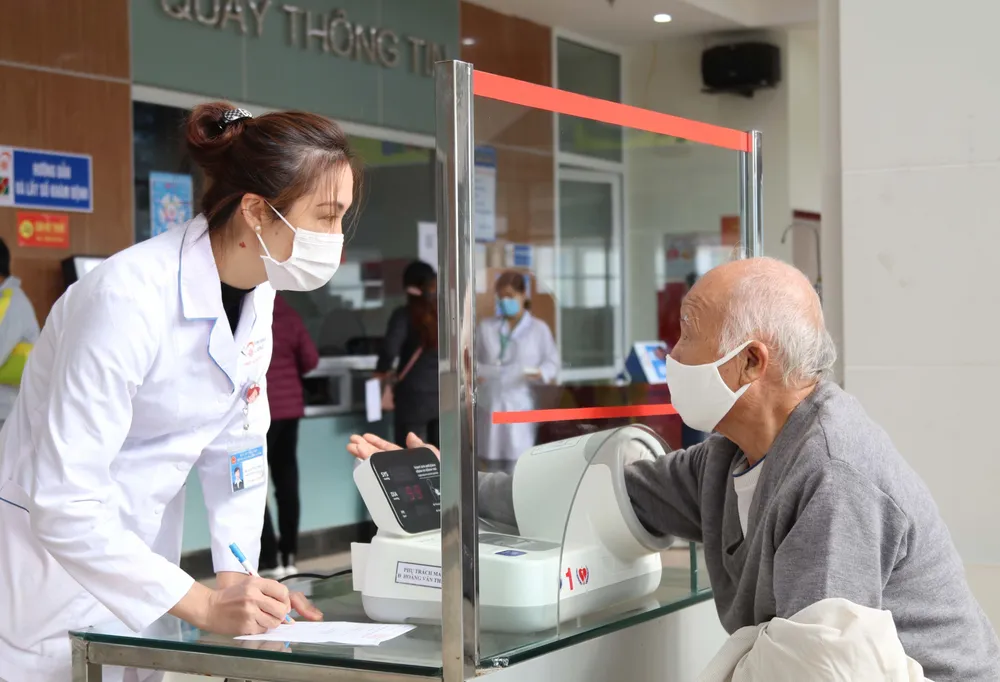
By 2030, the average life expectancy of Vietnamese people will reach 75.5 years.
The resolution states that there should be breakthrough policies and mechanisms in mobilizing and effectively utilizing all resources to improve the quality of health protection, care, and promotion of people's health; promoting the development of science, technology, and digital transformation in healthcare ; strongly reforming healthcare finance to ensure the effectiveness and sustainability of health insurance policies; and continuing to implement the principle that the state budget and health insurance cover basic healthcare services, with users paying for the excess.
The resolution sets the goal of improving the physical and intellectual capacity, stature, and healthy life expectancy of the people. By 2030, the average height of children and adolescents aged 1-18 years will increase by at least 1.5cm; average life expectancy will reach 75.5 years, of which at least 68 years will be lived in good health.
From 2026, citizens will receive free periodic health check-ups or screenings at least once a year, and will have electronic health records created to manage their health throughout their lives, gradually reducing the burden of healthcare costs. By 2030, citizens will be exempt from basic hospital fees within the scope of their health insurance benefits according to the roadmap. By 2026, the health insurance coverage rate will reach over 95% of the population, and by 2030, universal health insurance coverage will be achieved; various types of health insurance will be developed.
The vision for 2045 is for the average life expectancy of the population to reach over 80 years, with the number of years lived in good health increasing to over 71 years, and the average stature, physical fitness, and height of young people to be comparable to countries with similar levels of development…
At least 1,000 doctors will be deployed to work temporarily at commune-level health stations.
To achieve the above objectives, the resolution sets out tasks and solutions, including a strong renewal of thinking and action in leadership, direction, and organization of the work of protecting, caring for, and improving the health of the people; promptly perfecting institutions, focusing on improving the capacity of the health system, especially preventive medicine and primary healthcare, and promoting the strengths of traditional medicine; improving medical ethics, developing high-quality and comprehensive medical personnel to meet patient satisfaction and international integration; and promoting health finance reform and developing effective and sustainable health insurance policies.
During the period 2025-2030, each year localities will rotate, transfer, and assign at least 1,000 doctors to work temporarily at commune-level health stations; supplementing permanent doctors at commune-level health stations, so that by 2030 there will be enough doctors to meet the functions and tasks.
The resolution also stipulates the implementation of free periodic health check-ups or screenings for citizens at least once a year, categorized by target groups and priority schedule. From 2026, coordination will be established between periodic health check-ups, free screenings, health checks for students, occupational disease examinations, health check-ups for workers as prescribed, and medical examinations and treatment under health insurance to provide free medical care and complete the creation of electronic health records for all citizens; appropriate support policies will be implemented for the cost of out-of-hospital emergency transportation for certain social policy beneficiaries.
Implementing the policy of waiving hospital fees step by step.
In particular, the policy of waiving hospital fees will be implemented step by step, primarily for social policy beneficiaries, vulnerable groups, low-income individuals, and other priority groups within the scope of health insurance benefits, according to a planned schedule.
From 2026, gradually increase the rate and level of payment for disease prevention, early diagnosis, and treatment of certain diseases and priority groups according to the roadmap from the Health Insurance Fund to reduce the financial burden on patients, in line with the increase in health insurance contributions as stipulated by law from 2027. The state budget and the health insurance fund will cover some services for disease prevention, chronic disease management, periodic health check-ups, and screening examinations as required by professional standards at the primary and basic healthcare levels according to a suitable roadmap…
The Politburo also requested pilot programs to diversify health insurance packages and supplementary health insurance based on people's needs, linking health insurance with health insurance provided by insurance companies. The development of diverse types of health insurance was encouraged.
Simultaneously, there will be breakthroughs in science and technology development, innovation, and comprehensive digital transformation in healthcare. The plan is to establish a pharmaceutical industrial park by 2030. The highest priority will be given to the healthcare sector in the use of the National Science and Technology Development Fund, focusing on research and production of new drugs, high-tech drugs, standardized herbal medicines, modern dosage forms, vaccines, and biological products for disease prevention and treatment. Research will also be conducted to develop centers for producing new technologies for vaccines, contributing to the prevention of tropical diseases, emerging and re-emerging diseases.
The resolution also stated: promoting the development of private healthcare, mobilizing and effectively utilizing all resources for healthcare development. It stipulated that land use fees would be waived, and land lease fees and land taxes would be reduced for domestic healthcare facilities. Corporate income tax would not be applied to public and private healthcare facilities operating on a non-profit basis. Priority would be given to allocating surplus state-owned office buildings after restructuring to healthcare facilities; and the leasing of state-owned facilities to private healthcare facilities would be permitted according to regulations.
The Politburo assigned the Party Committee of the National Assembly to lead and direct the amendment, supplementation, and improvement of laws to create breakthroughs in the work of protecting, caring for, and improving the health of the people, prioritizing the consideration and approval of a number of laws, resolutions, and the National Target Program on health care, population, and development for the period 2026-2035 at the 10th session of the 15th National Assembly.
Source: https://www.sggp.org.vn/den-nam-2030-nguoi-dan-duoc-mien-vien-phi-o-muc-co-ban-post812658.html






























































































Comment (0)