


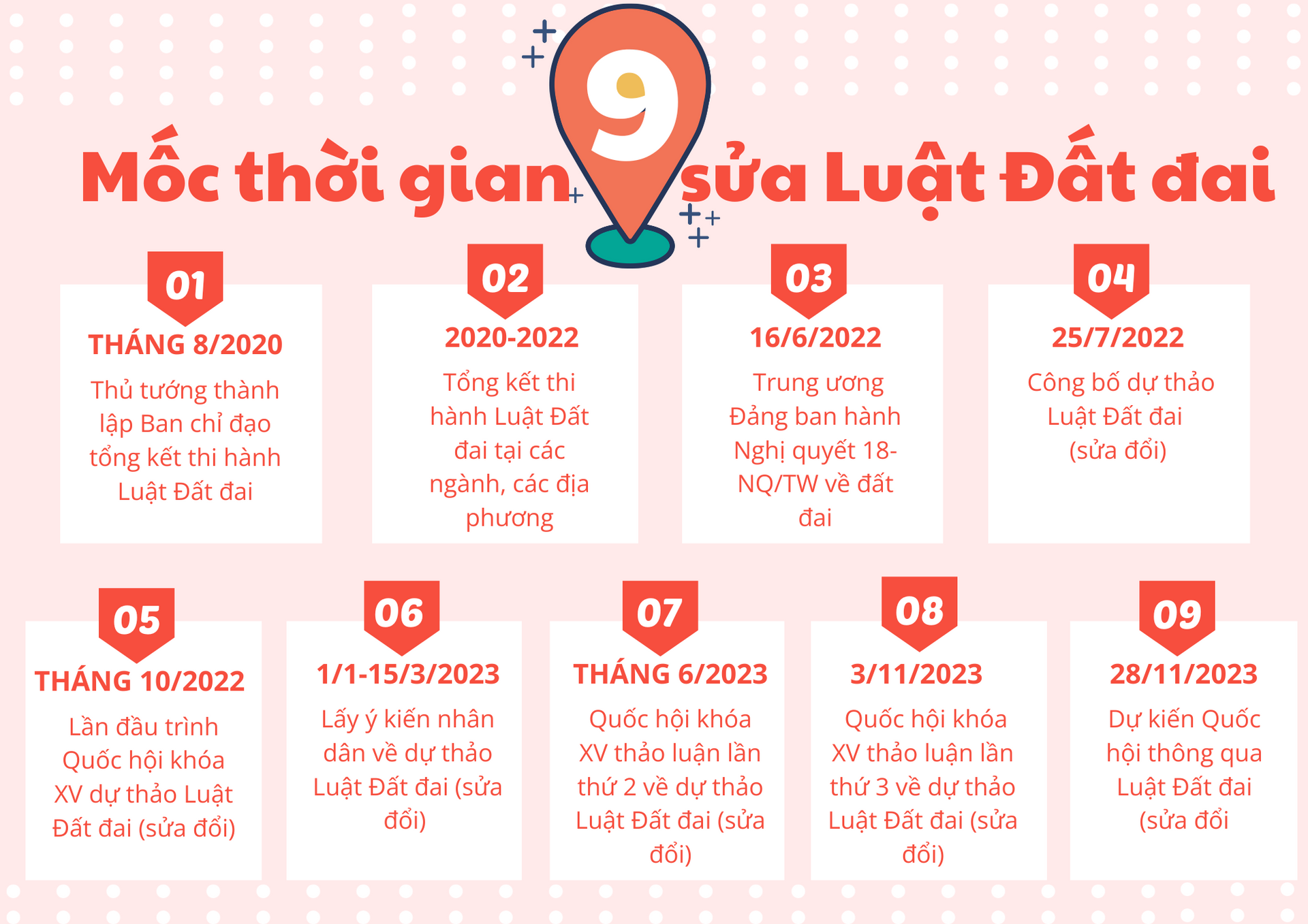
The process of amending the 2013 Land Law was officially launched three years ago, in August 2020, when the Prime Minister decided to establish a Steering Committee to review the implementation of the Land Law and develop a draft amended Land Law, and assigned the Ministry of Natural Resources and Environment as the lead agency to develop the draft law.
The decisive milestone in shaping the main viewpoints and policies of the draft amended Land Law was June 16, 2022, when General Secretary Nguyen Phu Trong signed Resolution No. 18-NQ/TW on "Continuing to innovate and improve institutions and policies, enhance the effectiveness and efficiency of land management and use, and create momentum to make Vietnam a high-income developed country." The resolution anticipates innovation and improvement in the institutional framework for land management and use, unlocking and creating momentum from land resources.
The new points of Resolution 18-NQ/TW, if institutionalized in the Law, will fundamentally change some current land policies. These include abolishing land price frameworks, hopefully eliminating the situation of inflated and inflated prices; primarily allocating and leasing land through auctions and tenders; establishing a market for land use rights; expanding the scope and limits of agricultural land transfers; and more strictly managing multi-purpose land…
" Land resources are managed, exploited, and used in a way that ensures maximum efficiency, sustainability, and effectiveness; meeting the requirements of promoting industrialization and modernization in a fair and stable manner; ensuring national defense and security; protecting the environment and adapting to climate change; and creating momentum for our country to become a developed country with high income."
Resolution 18-NQ/TW
Following the guiding principle of Resolution 18-NQ/TW, the amendment of the Land Law entered a phase of research, analysis, and identification of regulations that were both in line with the policy and feasible in practice. To achieve these high-quality provisions, the Standing Committee of the National Assembly decided to organize a public consultation process.
Perhaps after the public consultation on the 2013 Constitution, the consultation on amending the Land Law in early 2023 was the most extensive in recent years. In just two and a half months, from January 3rd to March 15th, 2023, the drafting agency – the Ministry of Natural Resources and Environment – received over 12 million comments, demonstrating the public's particular interest in this extremely important law.
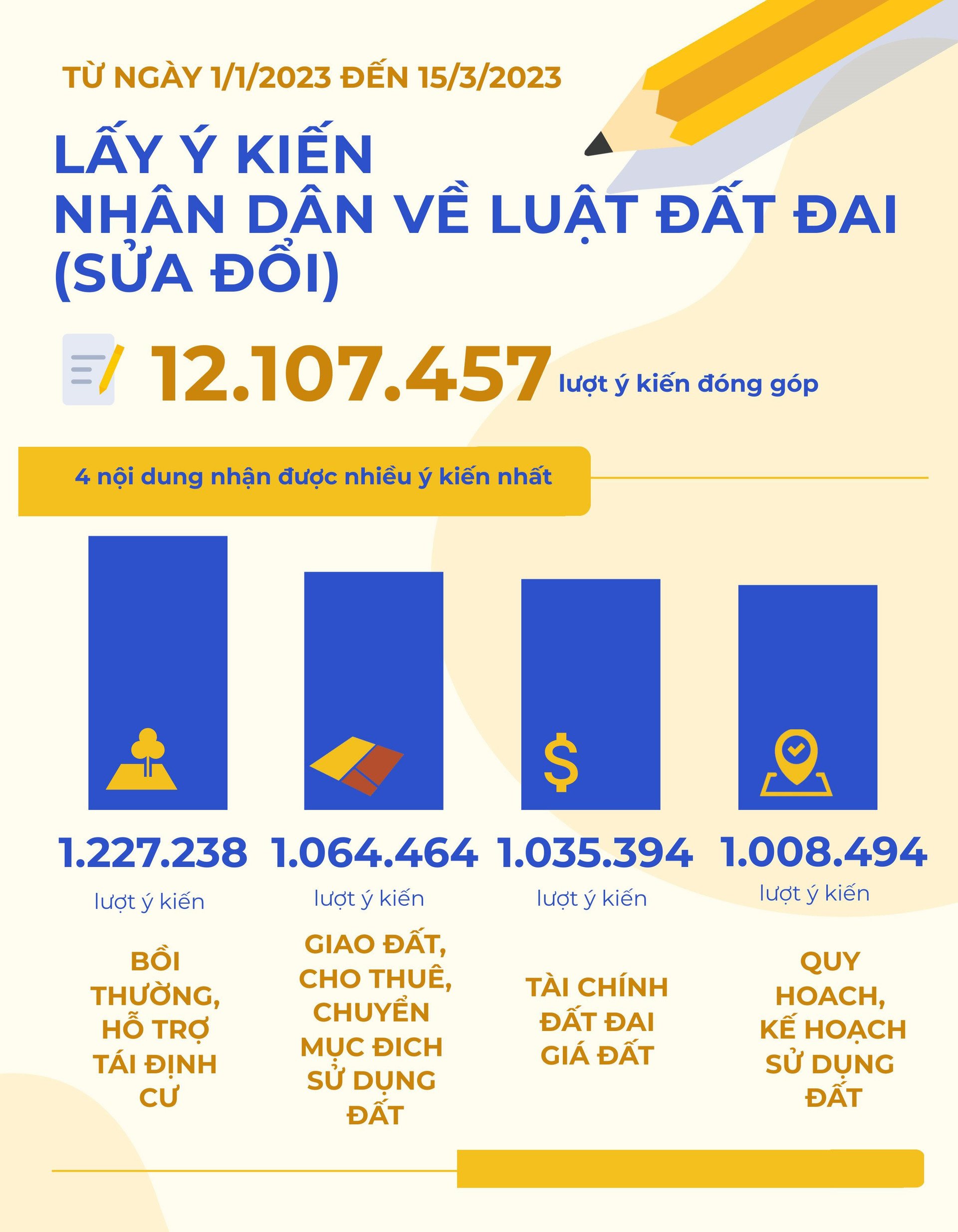
Of the more than 12.1 million comments, 89% came from socio-political organizations, with the Central Committee of the Vietnam Fatherland Front receiving over 8.36 million comments (accounting for 69%); the Central Committee of the Vietnam Women's Union receiving over 2.3 million comments (accounting for 19.4%). Comments from provincial and city People's Committees totaled over 1.3 million (accounting for 10.8%)...
Thus, people from all localities, organizations, professions, intellectuals, businesspeople, and farmers are all consulted and have the right to express their opinions.
During this consultation process, we not only gathered feedback to develop the draft law, but also allowed citizens to express their innermost feelings about the land they live on, giving "land" a voice in relation to its users.
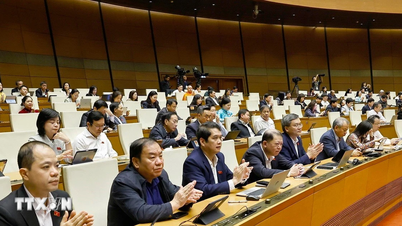
Recognizing that this is a complex law with a significant impact on the country's socio-economic development and on every citizen, the National Assembly decided to hold an additional session for discussion compared to other draft laws. This means that instead of considering and passing it in two sessions, the Land Law (amended) will be discussed in three sessions (4th, 5th, and 6th sessions) and is expected to be passed in the 6th session (November 2023). Furthermore, in all three sessions, the discussion time in the assembly hall will be a full day, double the time spent discussing other draft laws.

In the last 10 years, no draft law has received as much attention from the country's leaders as the amended Land Law.
During a meeting with voters in May 2022, General Secretary Nguyen Phu Trong emphasized that amending the Land Law to maximize the strengths of land resources is very difficult. Therefore, it requires both strategic and practical research and analysis; a combination of theory and practice; ensuring the livelihoods of the people; and serving the national interest.
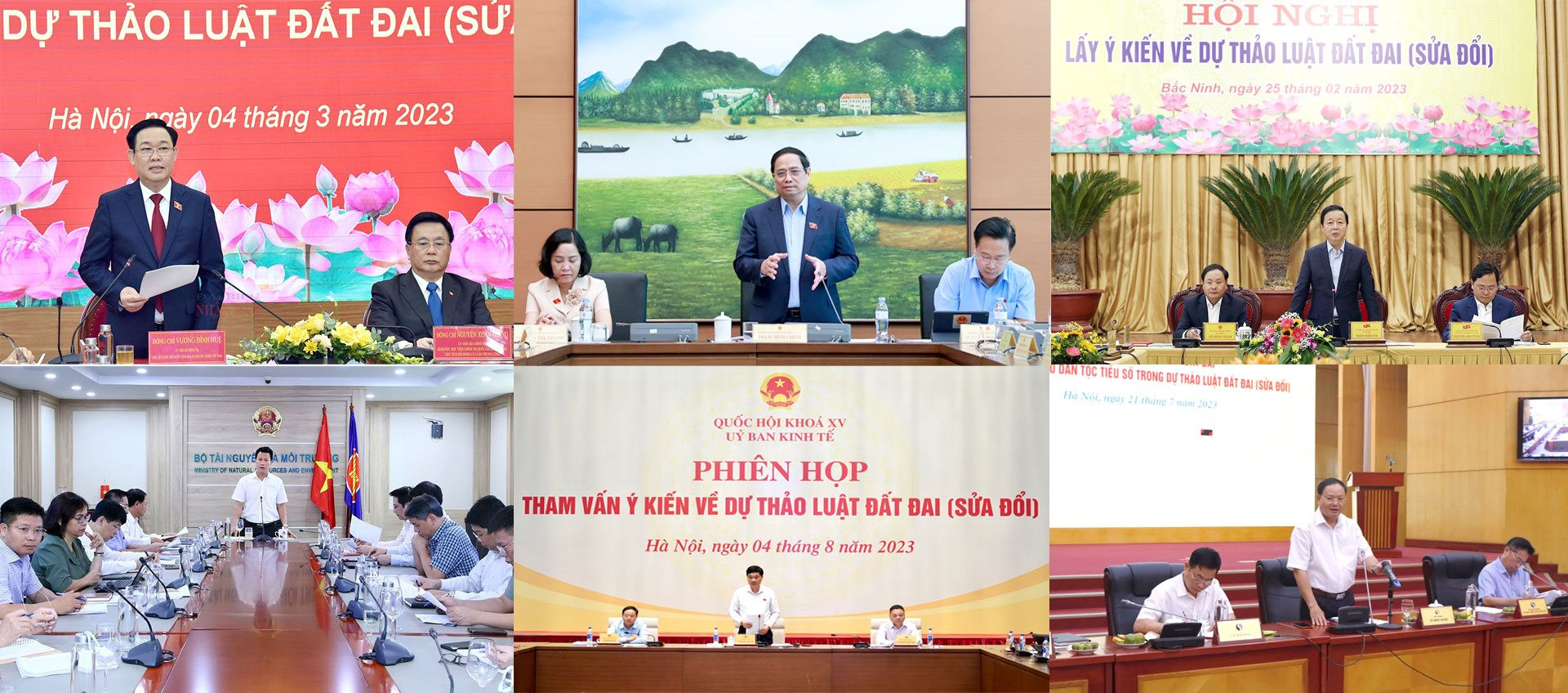
National Assembly Chairman Vuong Dinh Hue has chaired at least five conferences, seminars, and forums to discuss the draft Land Law, and has repeatedly offered suggestions on individual provisions within the draft law.
The final outcome of the legislative process, through the Land Law, is the most vivid example for evaluating the legislative capacity of the Government, the National Assembly, and relevant organizations and agencies; for assessing their ability to institutionalize the Party's guidelines into state policies and laws; for evaluating their capacity to foster development; for their ability to resolve past difficulties and avoid creating new ones; and for demonstrating transparency in lawmaking. It is also the most vivid example of how we effectively implement the Central Committee and the Party's policy of combating corruption and the insertion of vested interests into the legislative process.
National Assembly Chairman Vuong Dinh Hue
The head of the 15th National Assembly affirmed that the drafting and completion of the revised Land Law project is a key task of legislative work during the 15th National Assembly's term.
At various forums, Prime Minister Pham Minh Chinh also shared his thoughts on land management and his expectations for legal reforms aimed at making land a true resource for national development.
Deputy Prime Minister Tran Hong Ha closely followed the process of amending the Land Law since he was Minister of Natural Resources and Environment. He always emphasized the need to listen to and synthesize information from practical experience to accurately reflect the voices, thoughts, and aspirations of people in each region, with their distinct cultural characteristics, economic conditions, and natural environment.
Minister of Natural Resources and Environment Dang Quoc Khanh assumed the position of head of the Natural Resources and Environment sector in May 2023. Since then, he has consistently worked closely with the Drafting Committee and Editorial Team, and directed close coordination with the reviewing agency to ensure the highest quality of the draft amended Land Law.
As a National Assembly representative from the mountainous province of Ha Giang, Minister of Natural Resources and Environment Dang Quoc Khanh paid special attention to land policies for ethnic minorities, alongside pressing land management issues such as land acquisition, resettlement support, and land valuation.
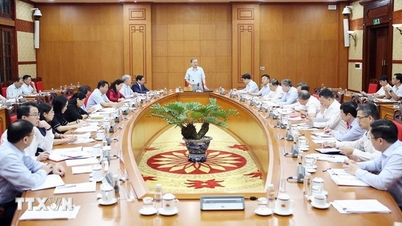
Since the 5th session of the 15th National Assembly, the National Assembly's Economic Committee has been the leading body in reviewing, explaining, and finalizing the draft Law. In August 2023 alone, National Assembly bodies held seven working sessions, workshops, and in-depth discussions on the draft Land Law (amended). The specialized National Assembly delegates' conference on August 30th gathered many diverse opinions. In two consecutive sessions (session 25 and 26), the National Assembly Standing Committee also discussed various aspects of the draft Law. Each clause, concept, and content was thoroughly examined and compared with reality to find the most feasible and appropriate solution.
At this point, the draft Law on Land (amended) has been meticulously prepared and is awaiting contributions from elected representatives at tomorrow's discussion session on November 3rd. Hopefully, major issues regarding land policy and law will gradually become clearer.

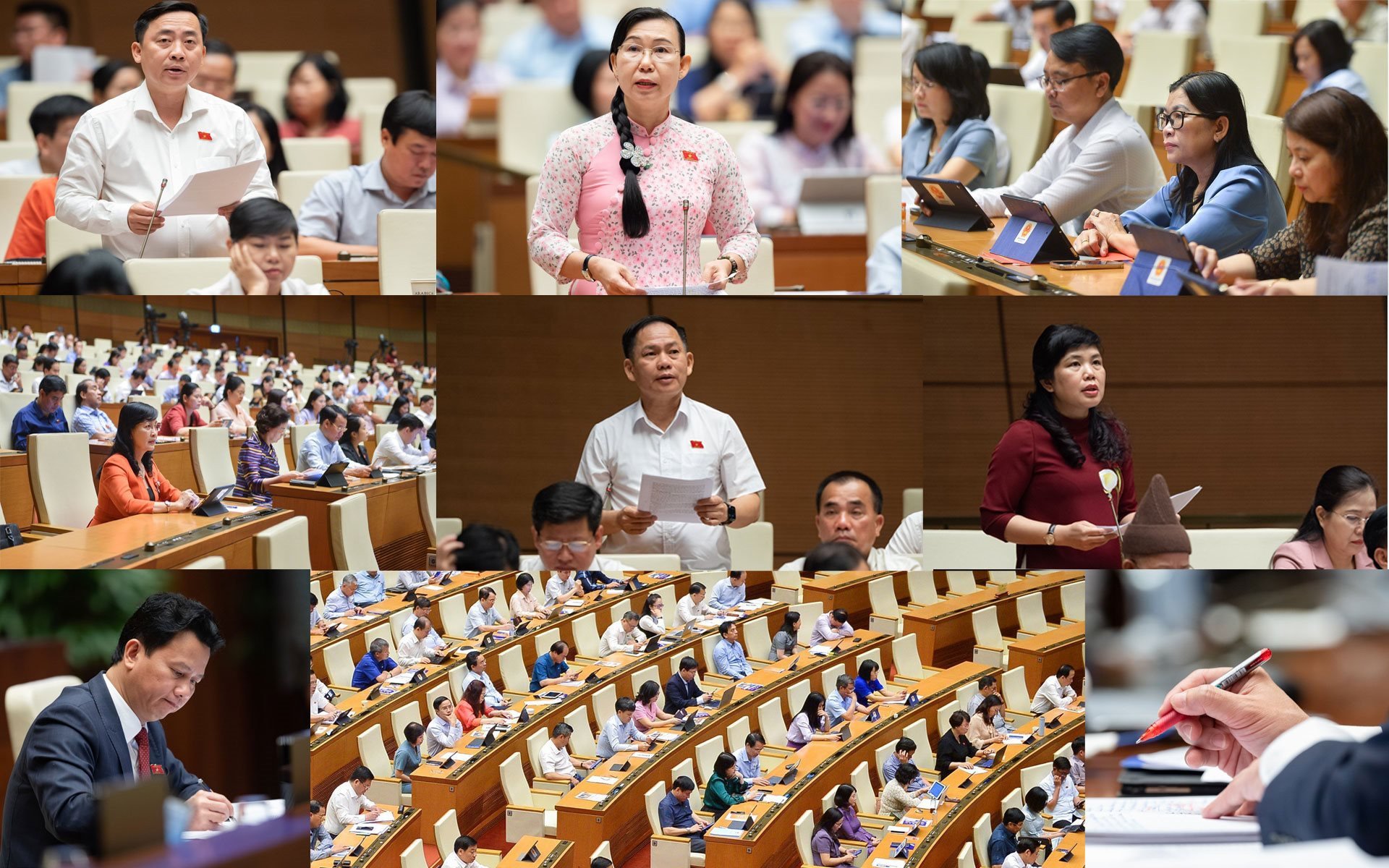
After two sessions of National Assembly discussions and nationwide public consultations, along with the participation and input of many experts, the draft Law on Land (amended) has undergone numerous revisions and improvements.
So far, we can highlight nine new points in the draft Law submitted to the National Assembly at this 6th session.
Firstly, ensure overall consistency within the legal system between the Land Law and related laws . The latest draft stipulates that relevant provisions of other laws should be included in transitional provisions for handling. In addition, establish principles for referencing land-related regulations in other laws.
Amendments to the Land Law must align with the guiding principles of Resolution 18/NQ-TW, while simultaneously addressing issues related to socio-economic development, ensuring national defense and security; guaranteeing continued national development and improved living standards for the people; and resolving pressing, inadequacy-ridden, and unresolved issues in the land sector.
Minister of Natural Resources and Environment Dang Quoc Khanh
Secondly, regarding the issue of land allocation for ethnic minorities , this draft law adds several provisions, such as: strictly prohibiting the transaction of residential and production land allocated or leased by the State under the land support policy for ethnic minorities; district-level land use planning and plans must specify targets for different land types and land allocation projects to ensure land policies for ethnic minorities; and adding a provision for the State to reclaim land to implement land policies for ethnic minorities. In addition, it stipulates the reclamation of a portion of poorly utilized agricultural and forestry land to provide land for ethnic minorities.
In addition, the draft also includes provisions on preferential policies to address housing issues for officers, soldiers, members of the armed forces, teachers, and medical staff working in border and island areas.
Thirdly, regarding land use planning, the draft review and detailed regulations on land use planning at all levels have also been revised to simplify and integrate the content of provincial-level land use plans, national defense land use plans, and security land use plans into the phased land use planning phase at the same level to reduce procedures for preparation, submission, and approval, ensuring simultaneous effectiveness. The draft imposes a mandatory time limit for project implementation once it has been identified in the district-level land use plan to ensure the land use rights of land users in the area included in the land use plan.
Fourth, regarding land finance and land prices, this draft continues to provide more specific, clear, and coherent regulations on abolishing land price frameworks, stipulating that land price tables will be issued from January 1, 2026, and amended annually in accordance with market principles; reviewing policies on land use fees and land lease fees to ensure transparency; and perfecting policies on exemptions and reductions of land use fees and land lease fees to suit different sectors, localities, and target groups.
This involves expanding the scope of cases where price tables can be applied to determine land prices and reducing the number of cases requiring specific land price determination. In determining specific land prices, criteria and indicators are stipulated, and provincial People's Committees are tasked with providing clearer regulations. This makes it easier for those involved in land valuation to perform their duties, preventing buck-passing and fear of responsibility.
Fifth, regarding land acquisition, compared to the previous draft, this draft continues to specify in detail the cases where land acquisition is truly necessary for socio-economic development in the national interest, ensuring compliance with the Constitution. The draft adds a "sweeping" provision allowing for amendments and additions to the land acquisition cases of the Land Law through a simplified procedure to address urgent cases arising in practice that were not regulated in the Law after its promulgation, while still ensuring the principles of the Constitution.

Sixth, regarding land allocation, land leasing, and land use conversion, the Draft continues to implement a mechanism of self-negotiation between citizens and businesses in the transfer of land use rights for the implementation of urban and commercial housing projects to ensure the legitimate rights of those currently holding land use rights.
The draft clearly defines the cases in which auctions and tenders are applicable, specifying the criteria and conditions for conducting them. Accordingly, auctioning land use rights for land that has been compensated, supported, and resettled, or land under the management and use of the State, helps to ensure transparency in land allocation and leasing, increasing revenue for the state budget to serve the common interests of the nation and people. Tendering to select investors for land-use projects is applicable to projects that are significant, have a ripple effect, create momentum, and are consistent with the socio-economic development plan identified by the local government and Party committee as key projects with a ripple effect on the local socio-economic development plan in each period.
Seventh, regarding compensation, support, and resettlement, land price policies and compensation, support, and resettlement payment policies have been revised and improved relatively synchronously to ensure they are in line with market principles and protect the legitimate rights of land users.
The draft review aims to refine the procedures for compensation, support, and resettlement, as well as the responsibilities of government agencies at each stage. Compensation, support, and resettlement must be carried out proactively, ensuring transparency, fairness, and a balance of interests between the State, landowners, and investors. The goal is to ensure that landowners have housing and a living standard that is equal to or better than their current standard, consistent with the cultural traditions and customs of the communities where the land is located.
Eighth, regarding the multi-purpose land use regime, one of the requirements for multi-purpose use is that it must not change the primary land use purpose. For certain types of land, when used in combination, a land use plan must be prepared and submitted to the competent state agency for approval (land for public service facilities, agricultural land combined with commerce and services; land with water surface combined with commerce and services, etc.).
Ninthly, regarding administrative reform, the Draft Law amends administrative procedures related to land allocation, land leasing, permission for land use conversion, land registration, issuance of land use right certificates, and provision of land information... This reform aims to reduce administrative procedures, minimize time, human resources, and related paperwork, and clearly define the responsibilities of each agency and unit in the process of handling administrative procedures to meet the needs of citizens and businesses. The provisions in the draft Law will be an important basis for implementing transparency and simplification of administrative procedures, creating a foundation for modernizing the provision of public services in the land sector for citizens and businesses, contributing to the overall socio-economic development of the country.

Land laws and policies have always been of particular interest to the people, the business community, and policymakers, because land is the living space, the means of production for each individual and family, and a tremendous resource for national development. In this revision of the Land Law, the interest and expectations are even greater. Over 12 million comments on the revision show that the people are eagerly awaiting a comprehensive revision of land laws.
The amended Land Law, expected to be passed at the end of November, will address many practical difficulties and shortcomings, contributing to transparency and concretizing regulations, especially those concerning land use planning, land allocation, land leasing, land use right auctions, land-use project bidding, land finance, land prices, compensation, support, and resettlement…
These are crucial factors in ensuring a harmonious balance of interests among the State, investors, and the people; unlocking land resources for national development, ensuring national defense and security, protecting the environment, and responding to climate change; and maximizing convenience for individuals and organizations in exercising their rights and protecting their interests when the amended Land Law comes into effect.
I hope that during this 6th session, the National Assembly will pass the draft amended Land Law, but it must include solutions to address practical obstacles. An amended Land Law, in conjunction with related laws, will become an important solution to unlock resources and promote socio-economic development in the coming period.
National Assembly representative Vu Tien Loc
The report summarizing the opinions and recommendations of voters and the public submitted to the 6th session of the 15th National Assembly also stated that voters and the public were pleased to have the opportunity to widely contribute their opinions to the draft amended Land Law. The Presidium of the Central Committee of the Vietnam Fatherland Front recommended that the National Assembly and the Government closely adhere to the Resolution of the Central Committee of the Party, thoroughly discuss the contents on which there are differing opinions in the draft amended Land Law, and fully incorporate the feedback from voters and the public, especially those directly related to the legitimate rights and interests of the people when the state reclaims land.
Across the country, from local and sectoral leaders to businesses and citizens, everyone is eagerly awaiting the approval of the amended Land Law project.
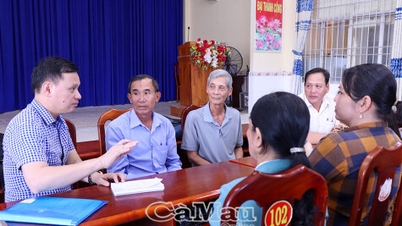
Mr. Tran Huu The, Chairman of the People's Committee of Phu Yen province, stated that the 2013 Land Law still has some limitations and shortcomings. The most frequently mentioned issue is the contradictions, overlaps, and inconsistencies between the Land Law and other related legal documents. This leads to unclear management responsibilities and difficulties in implementation for localities in general and Phu Yen province in particular. Phu Yen proposes the need for mechanisms to amend, adjust, and supplement land policies and laws, other related laws, and administrative procedures to ensure consistency and address some emerging issues and shortcomings in practice.
Mr. Nguyen Duy Thanh, Chairman and CEO of Global Home Management Joint Stock Company, believes that the new Land Law, soon to be passed by the National Assembly, will resolve outstanding issues, making it easier for businesses to implement projects and accelerating the issuance of land use rights certificates ("red books") for real estate projects that have been stalled for quite some time without being issued to residents.

Mr. Tan Dieu Quang (Dao ethnic group), Chi Sang village, Sin Suoi Ho commune, Phong Tho district (Lai Chau province), said: "Voters and people are eagerly awaiting the approval of the amended Land Law so that it can be promulgated and implemented soon. I dare not discuss the major issues here, but regarding land, land policies will affect every household and every person in society, including ethnic minorities like us."
People across the country are eagerly awaiting the passage of this law. Of course, it must be a law with well-defined and clear regulations, ensuring maximum transparency, fairness, and equity at this time.

Source











































































Comment (0)