

 |
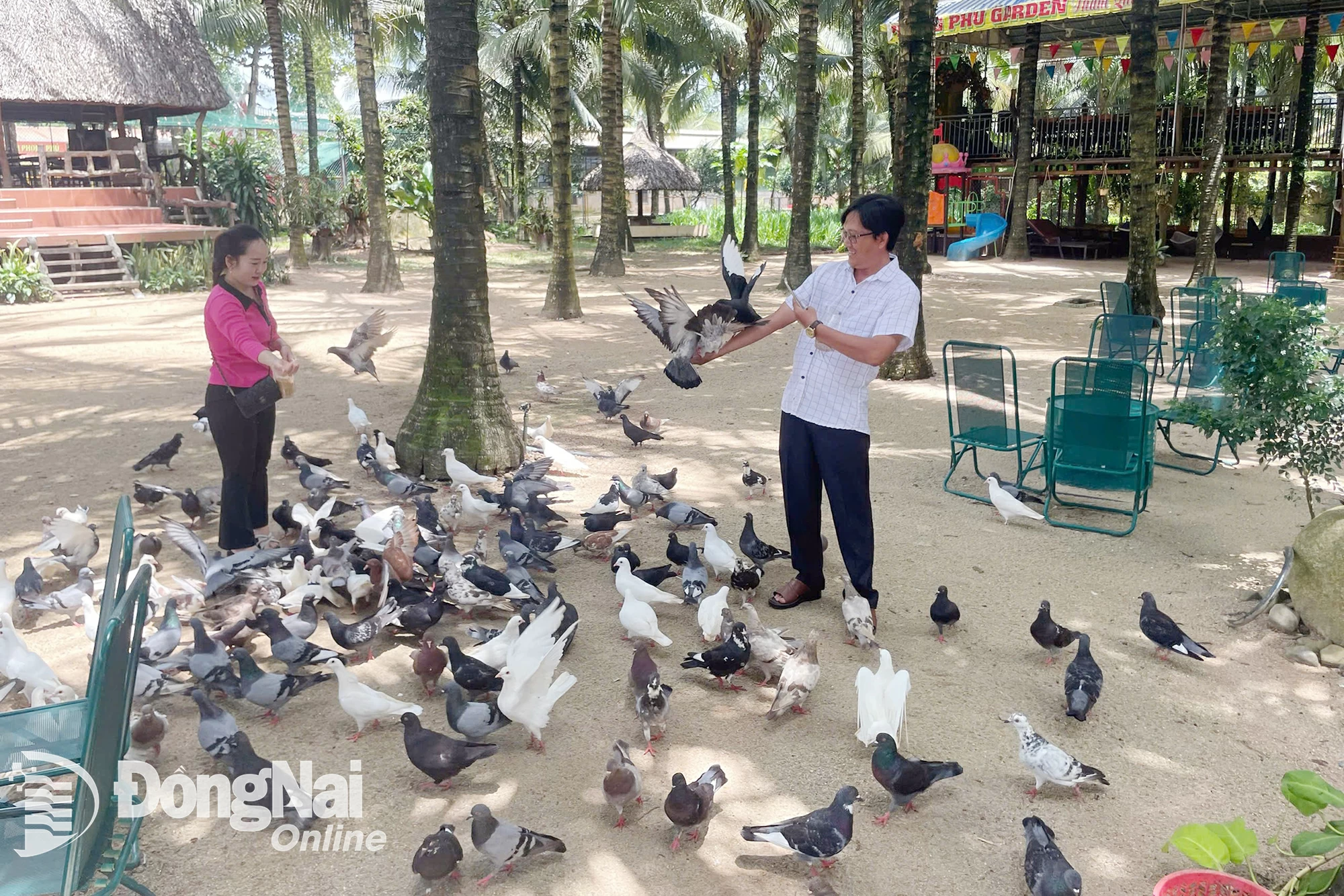
| Visitors enjoy strolling under the cool shade of trees and watching flocks of pigeons fly around the grounds of Phong Phu Garden farm (Phu Lam commune). Photo: Le Duy |
Awaken the dream of precious birds.
Before venturing into the world of ornamental birds, Mr. Nguyen Thanh Phong spent many years in traditional poultry farming. The turning point came when he witnessed a peacock spreading its tail feathers.
"The first time I saw it spread its tail and walk around, I felt mesmerized. It was like touching a part of my memory that I had never named before," Mr. Phong shared.
From there, he decided to shift his focus to raising peacocks and pheasants – beautiful ornamental birds that are quite selective in terms of enthusiasts because they are difficult to raise. On a plot of land over 1 hectare that used to raise poultry, Mr. Phong developed a model combining animal husbandry, breeding, and ecotourism (called a 3-in-1). Currently, his farm has more than 1,000 pigeons and dozens of peacocks of various types, from the common green peacock to the rare white peacock…
Unlike many people who raise livestock for commercial sale, he focuses on breeding and transferring technology.
"I share my breeding stock and experience, hoping that more people will learn how to raise birds properly. Not just for aesthetics, but to understand the process," Mr. Phong confided.
Raising ornamental birds, especially rare ones like peacocks and pheasants, requires advanced techniques and meticulous attention to detail. From incubating the eggs and raising the chicks to adulthood, the environment must be clean, sheltered from drafts, and quiet. Peacocks only become healthy and stable after they are over a year old. "They're beautiful but hard to please," Mr. Phong chuckled, checking the incubator while observing the baby peacocks.
The peacock breeding season typically lasts from December to June. This is when peacocks are at their most beautiful, as male peacocks often spread their tails to attract mates.
Besides peacocks, the garden also has a well-cared-for flock of pheasants. He raises red pheasants, green pheasants, and emperor pheasants. Each species has different habits, food requirements, and living environment needs.
"Emperor pheasants are beautiful but shy and easily frightened, so they need to be kept in separate, quiet enclosures to avoid stress," Mr. Phong explained.
Besides raising birds, Mr. Phong has expanded to include other ornamental animals such as sheep, grouse, ostriches, and Dutch geese, creating an open space for visitors. The area behind the farm is designed like a small meadow, with sheep roaming freely, shady trees, and low fences so that young children can easily access it.
Of all the animals, raising ostriches was the most challenging for him. "They're big, fast, and easily knock down fences. Building a sturdy enclosure required three repairs before it was stable. But in return, visitors love the ostriches, especially the children," Mr. Phong said.
As one of the frequent visitors to Mr. Phong's ecological model farm, Mr. Tran Thanh Binh (residing in Thanh Tho hamlet, Phu Lam commune) said: "I learned about this place from friends. I loved it after just one visit. The space is airy and cool, and there are many rare bird species that I've only seen on TV. Whenever I have free time on weekends, I bring my children here; they absolutely love it."
"I want to focus on pheasants and peacocks, diligently hatching and breeding them. I want to do less but ensure quality. I want to preserve these valuable breeds and then pass on my experience to others. It's not about big-scale commercial sales, but about creating more people who love birds, understand them, and appreciate nature more," shared Mr. Nguyen Thanh Phong.
The person who "sows the seeds" for the dream of living in harmony with nature.
When asked about the success of this model, Mr. Phong just smiled slightly and shook his head: "I wouldn't call it success. I'm just living the life I want to live."
Mr. Phong can stand still for dozens of minutes just to admire a white peacock spreading its tail or quietly watch a flock of pheasants chirping behind the trees. In the way he talks about animals, there is something like a "teacher" who is also a "student" of nature.
"A peacock's beauty doesn't automatically mean it will thrive. You have to pay attention to the climate, wind, food, and even noise. They're very sensitive. Raising peacocks teaches you observation, patience, and humility," Mr. Phong shared.
Behind his calm exterior, Mr. Phong is a seasoned veteran who dared to start over, even at an age when others are hesitant to change. He used to raise livestock using traditional methods, facing many difficulties. But instead of retiring, he chose to start anew, fueled by the one thing that has never faded within him: his passion for birds and animals.
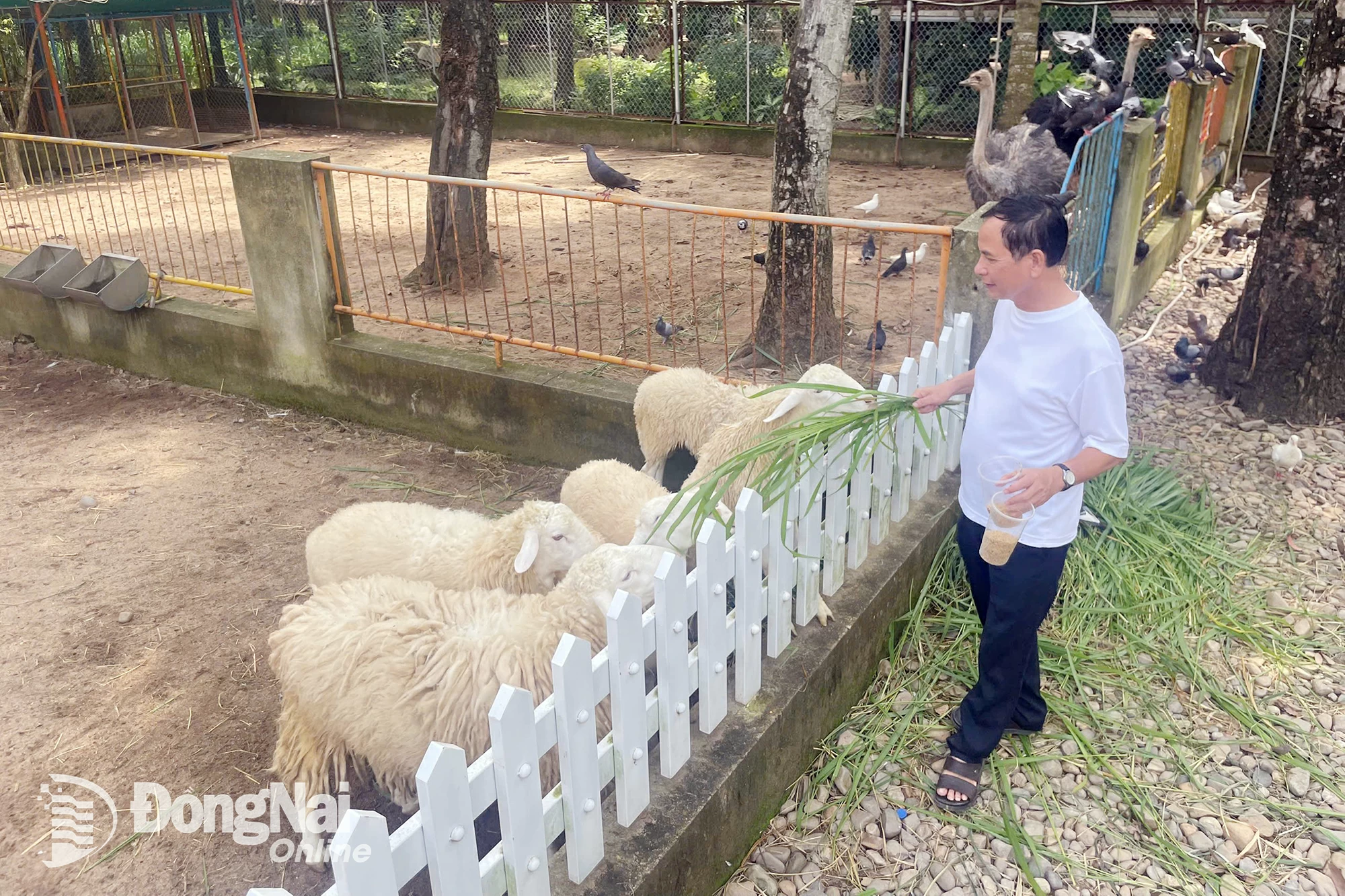 |
| Mr. Nguyen Thanh Phong feeds his sheep in the grazing area, which is designed to be close to nature. |
His dedication has also inspired many others. Numerous students, farmers, and people from other villages have come to learn from him how to care for birds, how to incubate eggs, how to distinguish between purebred and hybrid peacocks, and how to create a harmonious living space for humans and animals.
“Once, a group of students came to visit, and I asked them if they knew which season peacocks lay eggs. Most of them didn't know that peacocks lay eggs in early spring and early summer. Then I showed them the color of their feathers, observed their gait, and tried to guess their health status. They were very surprised. From then on, I thought that perhaps nature is a classroom that everyone should learn from at least once in their lifetime,” Mr. Phong recounted.
Mr. Phong doesn't have a degree in biology, but his decades of experience and persistent observation have allowed him to memorize the life rhythms of each bird species in his garden. He uses modern incubation equipment, but he doesn't neglect the natural elements. Each time he moves a peacock chick to a different environment, he meticulously monitors it, ensuring the enclosure is draft-free, has sufficient light, and enough space so the chick doesn't experience environmental shock.
What he wants to preserve, more than rare birds, is the way humans treat nature. "Rare birds are one thing. What's more valuable is when people sit down, patiently listen to the bird's calls, and understand what it wants and needs. That's when we're slowing down, relearning life lessons from nature," Mr. Phong confided.
As the sun blazed down, Mr. Phong was still busy adjusting the birdcage door. The sounds of pigeons filled the air, the distant calls of peacocks echoed... all creating a harmonious symphony in what he considered his home.
Mr. Phong confided: "Every time I see a baby bird hatch, I feel young again. Perhaps people don't grow old because of time, but only when they stop loving something."
Mr. Phong not only raises birds, but also harbors the hope that, in Phu Lam commune, more people will believe that nature can "heal" and that people can slow down and pursue their pure passions.
Le Duy
Source: https://baodongnai.com.vn/dong-nai-cuoi-tuan/202507/giac-mo-tao-dung-nong-trai-sinh-thai-8ce20c8/
![[Photo] Closing Ceremony of the 10th Session of the 15th National Assembly](/_next/image?url=https%3A%2F%2Fvphoto.vietnam.vn%2Fthumb%2F1200x675%2Fvietnam%2Fresource%2FIMAGE%2F2025%2F12%2F11%2F1765448959967_image-1437-jpg.webp&w=3840&q=75)



![[Photo] Prime Minister Pham Minh Chinh holds a phone call with the CEO of Russia's Rosatom Corporation.](/_next/image?url=https%3A%2F%2Fvphoto.vietnam.vn%2Fthumb%2F1200x675%2Fvietnam%2Fresource%2FIMAGE%2F2025%2F12%2F11%2F1765464552365_dsc-5295-jpg.webp&w=3840&q=75)














![[Photo gallery] Long Thanh Airport 'lights up' ready to welcome its first flight](https://vphoto.vietnam.vn/thumb/402x226/vietnam/resource/IMAGE/2025/12/11/1765467251707_bia_20251211222704.jpeg)






















![[OFFICIAL] MISA GROUP ANNOUNCES ITS PIONEERING BRAND POSITIONING IN BUILDING AGENTIC AI FOR BUSINESSES, HOUSEHOLDS, AND THE GOVERNMENT](https://vphoto.vietnam.vn/thumb/402x226/vietnam/resource/IMAGE/2025/12/11/1765444754256_agentic-ai_postfb-scaled.png)


































Comment (0)