

On March 13, the US House of Representatives officially passed a bill forcing ByteDance, TikTok's parent company, to divest from the short -video app within six months. Otherwise, TikTok faces the risk of being banned from operating in the US.
The bill was passed with overwhelming support from both Democratic and Republican members, with a vote of 352-65. However, there is no guarantee that this bill will pass in the US Senate in the near future.
"This is a critical national security issue. The Senate must consider this and pass it," Steve Scalise, a Republican member of the House of Representatives, declared on social media after the vote.
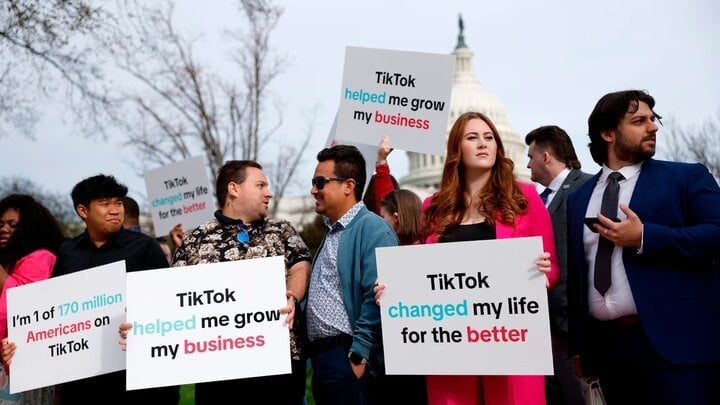
TikTok supporters protested outside the US Capitol building as the House of Representatives passed a bill forcing ByteDance to divest on March 13. (Photo: ABC News)
The fate of TikTok – an app used by approximately 170 million Americans – has become a hot topic in Washington. Lawmakers say their office has received numerous calls from teenage TikTok users protesting the bill.
TikTok CEO Chow Shu-Tzu stated on March 13th that if the bill is signed into law, there is a high probability that TikTok will be banned in the US. He also emphasized that users of the app (digital content creators, small and medium-sized businesses) in the US would lose billions of dollars in income, affecting 300,000 American workers who currently benefit from TikTok.
The TikTok CEO asserted that his company would "fight relentlessly" and exercise its legal rights to prevent the ban.
The bill to force ByteDance is the latest in a series of moves in Washington in response to U.S. national security concerns about China, ranging from mobile devices and chips for artificial intelligence development to cranes at U.S. ports.
US President Joe Biden said last week that he would sign a bill against TikTok if it is passed by the US Congress.
According to White House National Security Advisor Jake Sullivan: "We want TikTok to be a platform owned by an American company and not by China. The U.S. wants data from TikTok to remain in the U.S. instead of being sent to China."
On March 12, China's Foreign Ministry criticized the law, stating that the U.S. has never found any evidence that TikTok poses a threat to U.S. national security but has consistently pursued measures to block TikTok.
Source


























![[Photo] Prime Minister Pham Minh Chinh holds a phone call with the CEO of Russia's Rosatom Corporation.](/_next/image?url=https%3A%2F%2Fvphoto.vietnam.vn%2Fthumb%2F1200x675%2Fvietnam%2Fresource%2FIMAGE%2F2025%2F12%2F11%2F1765464552365_dsc-5295-jpg.webp&w=3840&q=75)




















































Comment (0)