

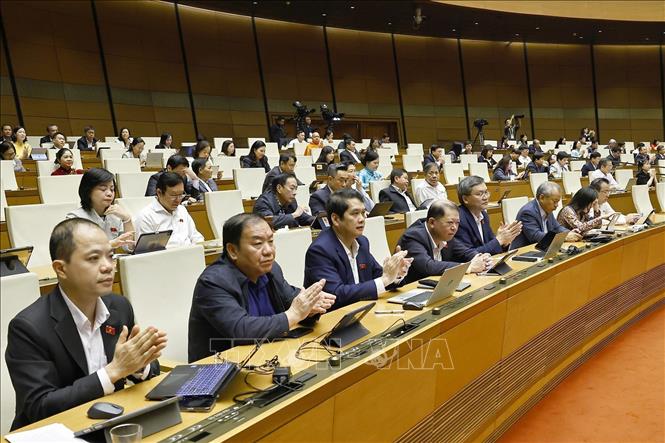
Accordingly, with 421 out of 432 National Assembly delegates present participating in the vote (representing 89.01%), the National Assembly approved the Law amending and supplementing a number of articles of the Law on Geology and Minerals.
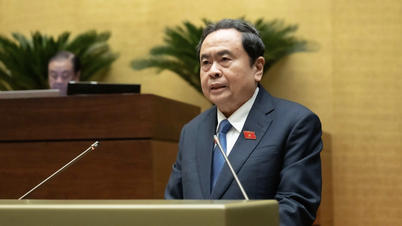
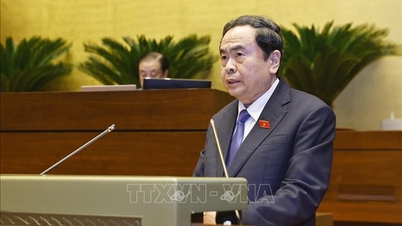
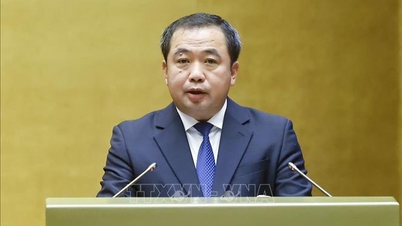
The National Assembly heard Minister of Agriculture and Environment Tran Duc Thang, authorized by the Prime Minister, present the report explaining, accepting, and revising the draft Law amending and supplementing a number of articles of the Law on Geology and Minerals. Accordingly, the Government has accepted and coordinated with relevant agencies to review, revise, and finalize the draft regarding issues ensuring the consistency and uniformity of the legal system, fully stipulating transitional cases, and some other specific issues.
Regarding the licensing mechanism for mineral exploitation serving public works and key projects, the draft Law adds a provision that mineral exploitation investment projects or mineral exploitation plans must include provisions on technical safety in mineral exploitation, environmental protection, and the determination of the deposit amount for environmental remediation and restoration as prescribed by the Minister of Agriculture and Environment. This regulation is a measure to reduce administrative procedures to accelerate the construction progress of five types of specific projects while still ensuring technical, safety, and environmental protection requirements.
Regarding rare earth management, the drafting agency believes that this is a very important issue. Regulations on rare earth management are implemented based on the guidance of the Party and State leaders on the strategy for managing, exploiting, and utilizing rare earth resources to serve national development, with specific and special management requirements.
According to Minister of Agriculture and Environment Tran Duc Thang, the draft Law stipulates strict mechanisms for managing rare earth elements, based on the principle that strategic and development-oriented matters will be decided by the Government . Technical details and specific tasks are stipulated in sub-laws, and appropriate authority is assigned to ministries, sectors, and localities. In addition, the lead agency has revised the general regulations on rare earth management with the goal of ensuring that exploration, exploitation, and processing go hand in hand with the formation of a closed value chain to avoid exporting raw materials; using modern, low-emission mining and processing technologies; and affirming the Government's unified management role in guiding the exploration and exploitation of minerals and rare earth elements.
Regarding the criteria for areas where mineral exploitation rights are not subject to auction, the draft Law has designed principles for delineating these areas, along with specific criteria, with the goal of creating a stable source of raw materials for investors constructing important and urgent projects, as well as for investors implementing mineral processing projects that have a significant impact on socio-economic development. Simultaneously, a Government Decree will specify the conditions and procedures for delineating areas where mineral exploitation rights are not subject to auction. This approach helps control risks from the initial stage of area identification, preventing abuse of the policy.
The Law amending and supplementing a number of articles of the Law on Geology and Minerals contributes to accelerating the procedures for implementing infrastructure development projects and key national projects that need to be started to celebrate the 14th National Party Congress and the subsequent period; at the same time, it is a practical solution to promote socio-economic development, contributing to achieving the 8% GDP growth target in 2025 and creating a solid foundation towards double-digit growth rates in the following years.
Representative Nguyen Thi Thu Ha ( Quang Ninh Province Delegation) highly appreciated the new management thinking in the draft Law on Geology and Minerals (amended); in particular, the regulations allowing for expanded exploration to deeper levels without adjusting planning or granting overlapping surface boundaries for exploitation in different geological layers.
With 436 out of 436 delegates voting in favor, representing 92.18% of the total number of delegates, the National Assembly passed the amended Law on National Reserves.
The National Assembly listened to Minister of Finance Nguyen Van Thang present a summary report on the acceptance and explanation of the draft law.
Regarding strategic reserves, the Government has adopted and revised the principles for managing national reserves. Strategic reserves have become national reserves, and must be managed strictly, safely, and confidentially in accordance with the law on protecting state secrets, preventing loss and waste, and proactively and promptly meeting the objectives and requirements of national reserves.
Furthermore, the revised regulations on the State's policy regarding national reserves stipulate that the State prioritizes investment, research, development of science and technology, innovation, and digital transformation in the field of national reserves to modernize national reserve operations.
The regulations on strategic reserves for natural resources, important minerals, and digital resources are revised as follows: strategic resources, important minerals, national energy, and high-tech products that meet the requirements of economic security, energy security, and food security strategies.
Regarding the socialization of national reserves, the Government has incorporated and revised the draft to ensure that units, organizations, and enterprises participating in strategic reserves receive preferential treatment in terms of taxes, credit, and other preferential policies as stipulated by the Government in each period, guaranteeing the legitimate rights and interests of the State and all participants in strategic reserves.
The purchase and sale of strategic reserves, using both state budget and non-state budget funds, shall be carried out through agreements, voluntary participation, and contracts as prescribed by the Government and other relevant laws.
The purchase and sale of strategic reserve goods from legitimate sources by units, organizations, and enterprises is supported by the State with management and storage costs and other support as prescribed by the Government.
Regarding the scope of strategic reserves, the draft law does not address the issue of reserves of money, gold, or foreign currency, as these are already governed by banking laws and other relevant legislation.
Regarding international integration and cooperation in reserve management, the draft law stipulates proactive international integration and cooperation, exchange, and sharing of resources in national reserve management activities, ensuring national interests and sovereignty .
Regarding the pilot model of revolving reserves, the Government will study it when drafting the Decree to ensure its feasibility, effectiveness, and to avoid wasting state budget funds.
Regarding policies and regulations for those working in national reserves, the draft law inherits and retains the current regulations, without adding any new types of allowances.
The Minister of Finance stated that, in practice, this policy has been implemented stably for over 12 years, creating a secure working environment for national reserve officials and civil servants who still face many difficulties and have very low incomes. This is especially true for national reserve officials and civil servants who have to perform urgent tasks, promptly releasing and delivering national reserve goods under very difficult and dangerous conditions due to natural disasters, storms, floods, and landslides to localities in need of emergency relief.
For the above reasons, the Government respectfully submits to the National Assembly for permission to continue implementing this policy for officials working in reserve management while the Government is conducting a comprehensive review and assessment of the allowance system for officials, civil servants, and public employees, to be submitted to the National Assembly and competent authorities in accordance with Conclusion 83 of the Politburo.
The law comprises 6 chapters and 36 articles, a reduction of 30 articles compared to the 2012 National Reserve Law, with amendments to 31 articles and additions to 5 articles.
The law is considered a significant step forward in enhancing state reserve capacity, proactively responding to natural disasters, epidemics, non-traditional security threats, and market fluctuations, while also aligning with the requirements of macroeconomic regulation and ensuring national defense and security in the new situation.
Representative Thach Phuoc Binh (Vinh Long) stated that the amendment to the Law on National Reserves has expanded the scope of regulation, restructured the objectives, added the concept of strategic reserves, and clearly affirmed the role of national reserves as an important tool to regulate the market, contributing to ensuring the stable, efficient, and socialist-oriented operation of the economy.
Source: https://baotintuc.vn/thoi-su/hoan-thien-khung-phap-ly-ve-dia-chat-khoang-san-va-du-tru-quoc-gia-20251211122550263.htm

![[Photo] Closing Ceremony of the 10th Session of the 15th National Assembly](/_next/image?url=https%3A%2F%2Fvphoto.vietnam.vn%2Fthumb%2F1200x675%2Fvietnam%2Fresource%2FIMAGE%2F2025%2F12%2F11%2F1765448959967_image-1437-jpg.webp&w=3840&q=75)



![[Photo] Prime Minister Pham Minh Chinh holds a phone call with the CEO of Russia's Rosatom Corporation.](/_next/image?url=https%3A%2F%2Fvphoto.vietnam.vn%2Fthumb%2F1200x675%2Fvietnam%2Fresource%2FIMAGE%2F2025%2F12%2F11%2F1765464552365_dsc-5295-jpg.webp&w=3840&q=75)


































![[OFFICIAL] MISA GROUP ANNOUNCES ITS PIONEERING BRAND POSITIONING IN BUILDING AGENTIC AI FOR BUSINESSES, HOUSEHOLDS, AND THE GOVERNMENT](https://vphoto.vietnam.vn/thumb/402x226/vietnam/resource/IMAGE/2025/12/11/1765444754256_agentic-ai_postfb-scaled.png)















































Comment (0)