

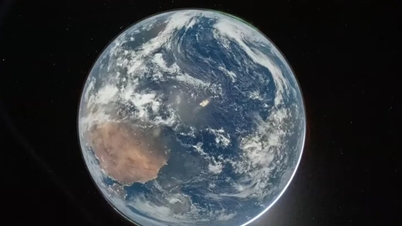
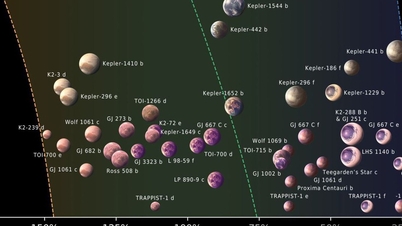
The era of exoplanet hunting is entering a new phase. Telescopes like NASA's Kepler and TESS have discovered thousands of planets, creating a massive database for scientists to study. This has given them a better understanding of planetary diversity and raised the big question: Could an Earth-like world exist somewhere in the universe?
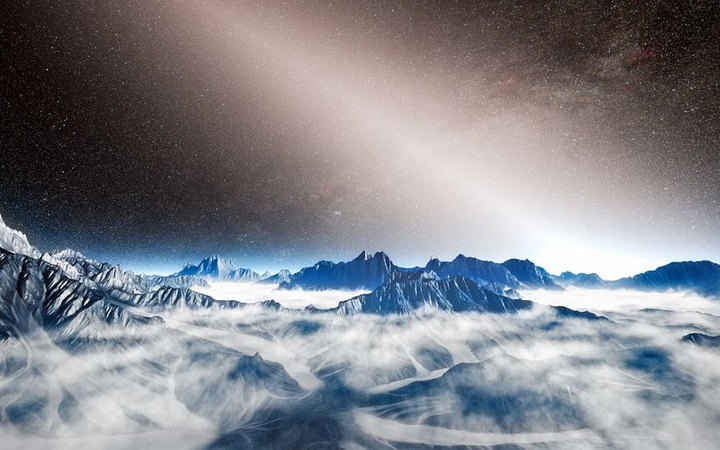
The illustration shows the light of cosmic dust, a faint white glow above the horizon of the hypothetical planet; the amount of dust around this star system is so abundant that it has astonished astronomers. (Source: ESO/L. Calçada)
To date, astronomers have confirmed more than 6,000 exoplanets. This has led to the biggest question: Does a “second Earth” exist somewhere in the universe? In other words, humanity is searching for a planet with conditions similar to Earth's. To pursue this goal, scientists are placing high hopes on the Habitable World Observatory (HWO). The HWO's mission is to image at least 25 Earth-like planets and analyze their atmospheres for signs of life.
However, this journey encounters a major obstacle. Many stars are surrounded by extra-ecliptic dust – tiny particles of dust in space. Light from this dust penetrates the telescope, creating a phenomenon called "light leakage" that makes observing the planet difficult.
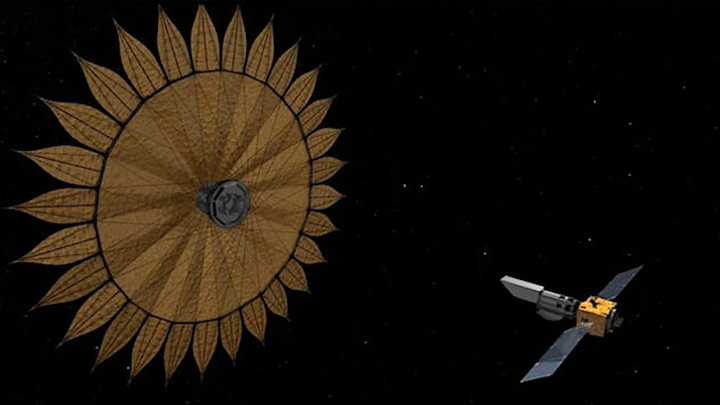
The image illustrates a design for a habitable World Observatory with a star shield; in reality, the telescope could use either a corona or a shield, both of which help block light from the star. (Source: NASA)
A new study focuses on the Kappa Tucanae A star system, located about 68 light-years from Earth. This is a unique star system with abundant cosmic dust, emitting unusual infrared light. Scientists discovered that this variation is linked to a new companion star – Kappa Tuc Ab, a small, cold, and dim red dwarf with a mass about one-third that of the Sun, orbiting in a very distorted path.
The appearance of Kappa Tuc Ab is believed to be the cause of the dust "stirring," especially as it approaches Kappa Tucanae Aa. This star can alter the paths of asteroids or comets, thereby adding more dust to the system. As a result, Kappa Tucanae A has become a "natural laboratory" for studying extra-ecliptic dust.
Understanding how dust affects observational signals is a crucial step for HWO and future telescopes to distinguish between genuine planetary signals and noise. Kappa Tucanae A isn't the only star system that may be hiding previously undetected companion stars; many other star systems can also conceal previously undetected companion stars.
As researcher Thomas Stuber shared, the discovery of this companion star was a major surprise, as the Kappa Tucanae A system had been observed many times before. This very surprise makes the system even more unique, opening up new avenues of research into cosmic dust and posing challenges in the quest for a version 2.0 of Earth.
Source: https://vtcnews.vn/kham-pha-bi-an-bui-vu-tru-mo-duong-tim-trai-dat-2-0-ar991672.html


























![[Photo] Prime Minister Pham Minh Chinh receives the Chinese Ambassador to Vietnam](https://vphoto.vietnam.vn/thumb/1200x675/vietnam/resource/IMAGE/2026/04/05/1775397481797_ndo_br_dsc-5512-jpg.webp)

























































![[Infographic] Key indicators for the period 2026-2030 to achieve "double-digit" growth targets](https://vphoto.vietnam.vn/thumb/402x226/vietnam/resource/IMAGE/2026/04/06/1775450004801_fb4e219c8aa77c339a75ff13c44b2e595f8db215db15da7b4648b200deade68240d89ec5e4bd2e86c42f5ed9eeb-_ndo_br_chi-tieu-2-con-so-thumb-1.jpeg)













Comment (0)