

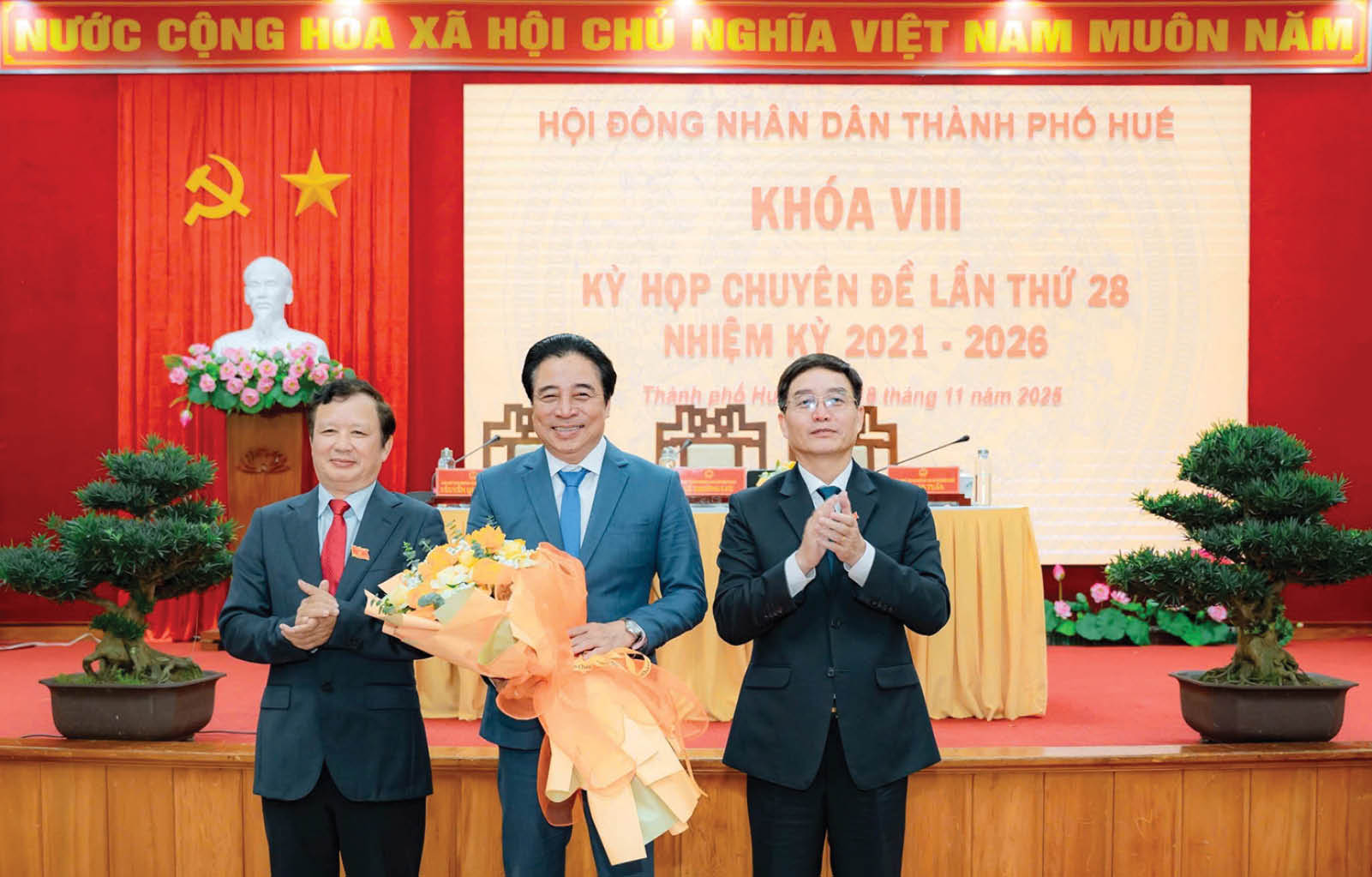
 |
| City leaders presented flowers to congratulate the new Chairman of the City People's Committee Nguyen Khac Toan. Photo: DINH HOANG |
From history
According to historical documents, the Hong Duc Code issued under the reign of King Le Thanh Tong (1460 - 1497) had provisions on "avoidance" (meaning to avoid, to avoid), which set out strict regulations for the appointment of officials. Accordingly, if an official is the head of a locality, he is not allowed to marry, get married, or become in-laws with people in that place, nor is he allowed to buy land, fields, gardens... where he is an official, nor is he allowed to use people from the same hometown as him as servants...
During the Nguyen Dynasty, especially under King Minh Mang, the law of avoidance was more strictly regulated and thoroughly enforced, in which the prohibitions against officials in charge of a locality (province, prefecture, district) were expanded.
The ultimate goal of the law of refuge is to prevent the formation of local separatist forces based on clan and friendship relationships - which could threaten the power of the Central Court. However, on the other hand, it has a positive effect in limiting corruption, harassment, and taking advantage of public affairs for personal gain... by officials, contributing to building the integrity of the apparatus.
It is not until now that the Party has raised the issue of arranging key leaders in provinces and centrally-run cities who are not local people. On February 25, 2002, the Politburo (9th tenure) issued Resolution No. 11-NQ/TW on rotation of leaders and managers, which specifically mentioned the necessity, requirements, goals and subjects of leaders and managers who need to be rotated. Party congress documents of all terms have mentioned this issue as one of the solutions to educate and train cadres, limit negativity in local leadership, management and administration.
In recent years, many central cadres have been transferred and assigned to local areas and vice versa. Through practical work in the local areas, many cadres have proven their capacity and qualities, left their mark and been assigned and promoted to higher positions. However, due to many subjective and objective reasons, the rotation of leaders and managers has not been uniform and consistent, has not become a routine and binding regulation.
To the policy
At this time, when the conditions are ripe, along with the determination and drastic leadership and direction of the Central Committee, the Politburo, the Secretariat, headed by General Secretary To Lam , the arrangement of secretaries and chairmen of provincial People's Committees is carried out synchronously and decisively.
To evaluate the effectiveness and correctness of a policy or strategy requires time and practical experience, but by implementing the policy that the provincial and municipal party secretaries must not be local people, the Party wants to convey a strong message about innovation in personnel work - the "key of the key" factor that determines the success or failure of the revolution.
When key leaders in a province or city are not local people, they are less influenced and influenced by familiar relationships - which can cause deviations and distortions in public activities. Public opinion has not forgotten the story nearly ten years ago when the son of a provincial party secretary was hastily appointed as director of a provincial department (later discovered to not ensure procedures and standards), or the story of a "chess doctor" who was transferred to be secretary of a city in the province and is the son of this provincial party secretary, or the story of "the whole family being officials" is not absent... Stories that are "unbelievable, even though they are true" like that have happened, causing many cadres, party members and people to be extremely dissatisfied... With the arrangement of key leaders who are not local people, such incidents cannot continue.
A leader who is not a local will bring a new working atmosphere, overcoming the old ways in the working routine of cadres and civil servants, or in other words, the whole apparatus must also change. From another perspective, when taking on the responsibility of leading in another locality also helps the leader to supplement knowledge and experience in leadership, management, operation...
The Party's consistent, drastic, and synchronous policy in arranging a number of key leadership positions in provinces and cities that are not local people is expected to create new momentum for each locality in socio-economic development, while also creating a new order and framework in the Party's personnel work.
Source: https://huengaynay.vn/chinh-tri-xa-hoi/theo-dong-thoi-su/khi-lang-dao-chu-chot-tinh-thanh-pho-khong-phai-nguoi-dia-phuong-160706.html
























































































Comment (0)