


Mr. Phuc stands by his pond, raising thick-shelled fish, which helped him successfully start his business.
New job starting with 2 kilograms of thick fish.
Inside his house, Mr. Phuc has a prominent place for a fish tank containing four thick-skinned fish with beautiful patterns on their bodies. Mr. Phuc explained that these are four of the 11 thick-skinned fish, weighing a total of 2kg, that he bought from U Minh Thuong in 2017 to start his business. Thanks to them, he has become successful, so he keeps them in the tank as a way to preserve the memories.
Phuc recounted that, wanting to improve his family's economic situation , he tried raising many different animals but without success. In 2017, after learning about a species of fish with firm, flavorful meat, high economic value, and relatively easy to raise, he went to the U Minh forest to buy fingerlings. The 2kg of thick-fleshed fish, worth 220,000 VND at the time, unexpectedly turned out to be a successful turning point in his family's entrepreneurial journey.
Although thick-skinned fish are found in many localities, he chose those from the U Minh forest because of their many superior characteristics. After raising them in a tarpaulin tank, only 8 fish survived and grew quite well, but due to lack of experience, he was unable to identify the male and female fish to use as breeding stock and therefore could not successfully breed them.

Mr. Phuc introduced the school of fish that are thriving.
Through persistent learning from many people, he mastered the habits and sexes of the thick-skinned fish, and after nearly a year, his first batch of fry reached nearly 1,500. Building on this success, Mr. Phuc can now breed thick-skinned fish year-round, supplying over 50,000 fingerlings to the market annually, selling them for 2,500-4,000 VND per fish, depending on size. Thanks to this, selling thick-skinned fish fingerlings brings him high economic returns.

Raising fish in tarpaulin tanks.
Analyzing the farming techniques in detail, Mr. Phuc emphasized: Snakehead fish are easy to raise, rarely get sick, have good resistance, especially less prone to mucus shedding or diseases like scab and parasites compared to common snakehead fish. They can be sold commercially after about a year of raising, requiring little care. Raising them in tarpaulin tanks also makes it easy to control the water regime and monitor feed.
The fish are mainly fed with finely ground trash fish and pellets. Besides selling fingerlings, he sells about 3 tons of commercial catfish annually at an average price of 170,000 VND/kg. In addition, Mr. Phuc also buys commercial fish from households that purchase fingerlings for farming, but he still cannot meet market demand.
The "multi-story house" model: carp on the ground floor, frogs on the upper floor.
Mr. Phuc is very diligent in learning and has a knack for breeding fish. His family's farm is also a large-scale supplier of frog, snakehead, and catfish fry in the local area. Even with just a few square meters of tarpaulin ponds on land or net enclosures in the river, Mr. Phuc can earn millions of dong each month. Currently, he is expanding his operation to three breeding and commercial fish farms, two in Can Tho City and one in Dong Thap province.
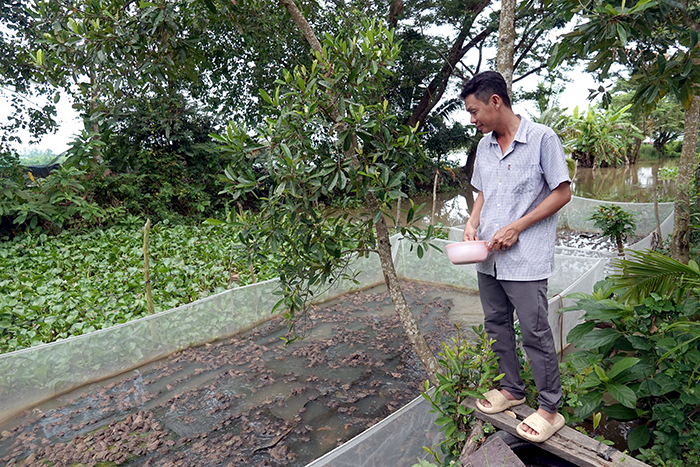
This model combines raising frogs and tilapia in net cages under the river.
In particular, Mr. Phuc's model of raising frogs and spiny-headed catfish in a "multi-story" style is yielding high economic efficiency. In a net enclosure under the river, about ten square meters in size, frogs and catfish live together. Due to their characteristics, frogs live on floating buoys on the water's surface, while catfish live at the bottom. The two species feed on each other's food, utilizing each other's waste products.

Frogs on the "upper floor".
The growth time from raising to harvesting for frogs and tilapia is similar, so after about 2.5 months, he can harvest them simultaneously. The highlight of this model is that it helps reduce costs and increase profits, allowing him to earn tens of millions of dong in just a few months of raising them.
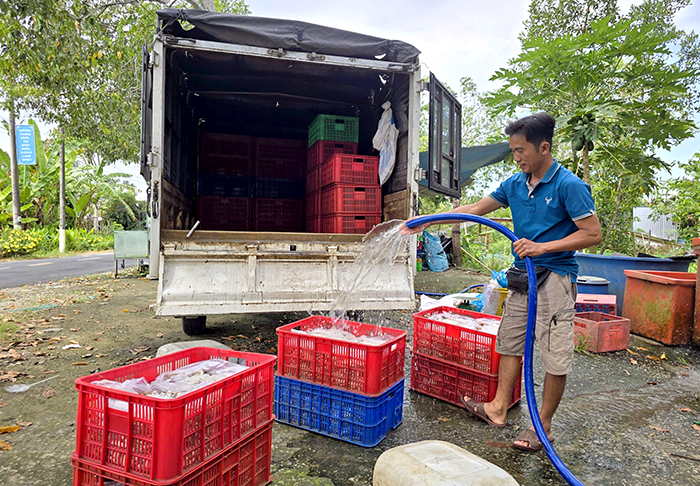
He buys the trash fish to feed his fish and frogs.
Phuc's success demonstrates the creativity and resourcefulness of Can Tho farmers in the digital age. His small garden is now filled with dozens of tarpaulin tanks, each a few square meters in size. "It may look small, but it's not," each tank brings him millions of dong every month.
The snakehead fish resembles the catfish in shape, but has a shorter and rounder body. It has many alternating black and white stripes on its belly and sides, and a distinctive pointed head. The fish meat is delicious, firm, and has a unique flavor. Due to various factors, wild snakehead fish are currently very scarce, so Mr. Phuc's successful breeding has contributed to the conservation of a valuable fish species in the Mekong Delta. |
DANG HUYNH
Source: https://baocantho.com.vn/khoi-nghiep-lam-giau-tu-2-ky-ca-day-a192589.html

![[Photo] First session of the 14th Congress of the Vietnam Trade Union](https://vphoto.vietnam.vn/thumb/1200x675/vietnam/resource/IMAGE/2026/06/03/1780465947883_ndo_br_img-3852-jpg.webp)
![[Photo] General Secretary and President To Lam presides over a meeting with the Central Organizing Committee.](https://vphoto.vietnam.vn/thumb/1200x675/vietnam/resource/IMAGE/2026/06/03/1780482764658_a1-bnd-4741-3342-jpg.webp)
![[Photo] Secretary of the National Assembly Party Committee, Chairman of the National Assembly presides over the meeting of the Standing Committee and Executive Committee of the National Assembly Party Committee.](https://vphoto.vietnam.vn/thumb/1200x675/vietnam/resource/IMAGE/2026/06/03/1780480353201_ndo_br_bnd-2585-jpg.webp)











































![[Video] Sunset at Lap An Lagoon – Where the sun sets over the fishing nets](https://vphoto.vietnam.vn/thumb/1200x675/vietnam/resource/IMAGE/2026/05/31/1780192137701_beach-landscape-sea-water-nature-grass-745871-pxhere-com.jpeg)

























Comment (0)