

The Ede are the 12th largest ethnic group in Vietnam, with a population of more than 331,000 people, concentrated mainly in Dak Lak , southern Gia Lai province and western Khanh Hoa province.
The Ede ethnic group belongs to the Malay language group, originating from the sea. The Ede people migrated to the Central Highlands from the end of the 8th century to the 15th century. Therefore, although they have lived on the plateau for hundreds of years, the images of wharves and boats are still deeply imprinted in the Ede culture and are recreated through the architecture of long houses shaped like boats with the main door opening onto a large yard, windows opening on the side. Inside the house there is a wooden ceiling shaped like a boat's roof.
Matriarchal imprint in long house architecture
The Ede long house is a low stilt house, 15 to over 100m long depending on the size of the family. The main materials include wood, bamboo, thatched roof; the structure of the pillars and beams is made of good wood to ensure resistance to harsh weather.
The materials used to build the traditional long house of the Ede people are mainly wood, bamboo, and thatched roof. The structure of the house is made of good wooden pillars and beams that can withstand harsh weather conditions.
The house has walls and floors made of bamboo, a thatched roof, the top of the roof is about 4m-5m from the floor, the inside of the house is about 4.5m-5.5m wide, the house is located on the North-South axis.
The Ede long house is a unique architectural space complex, expressing the characteristics of daily life, beliefs and spirituality, an impressive work of material cultural creation.
The long house is not only a place of residence but also a symbol of community activities, beliefs and matriarchy, deeply imprinted in the spiritual life of the Ede people. When a female member of the family gets married, the house will be extended. When a son gets married, he will move to live at his wife's house.
Typically, a long house has 7-9 couples living in it. The house layout is divided into two parts: the front half, called “Gah,” is the living and common area with the host chair, guest chair, host kitchen, Kpan bench and gongs; the back half, called “Ok,” is the living quarters of the couples, with a shared kitchen.
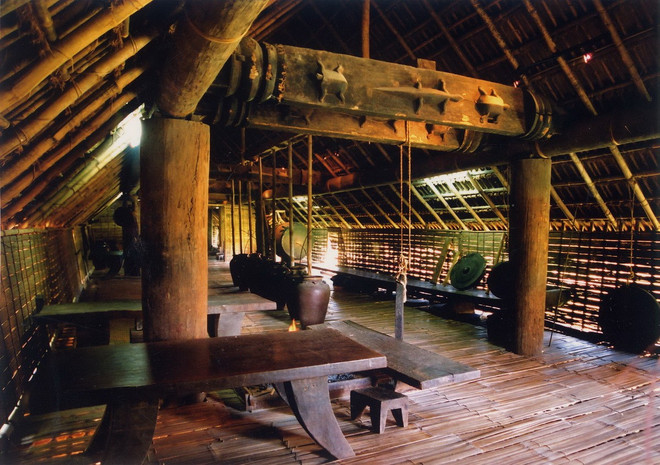
In front of the long house there are two staircases, one for guests, one for family members, each staircase has 5-7 steps, carved from precious wood. The top of the staircase adjacent to the porch is carved with a crescent moon, right below are two round breasts, symbolizing the authority and central role of women in the family.
The space under the long roof is where gong performances, epic singing, brocade weaving and community activities are held.
Every detail of the sculpture and decoration in the long house is based on matriarchal motifs and fertility beliefs. Inside the house, from the Kpan chair, the fireplace, gongs, jars, buffalo horns, drums, rice wine… are arranged reasonably, creating a harmonious whole, reflecting the wealth, honoring the culture and philosophy of life of the homeowner, as well as the connection between humans and nature and the universe.
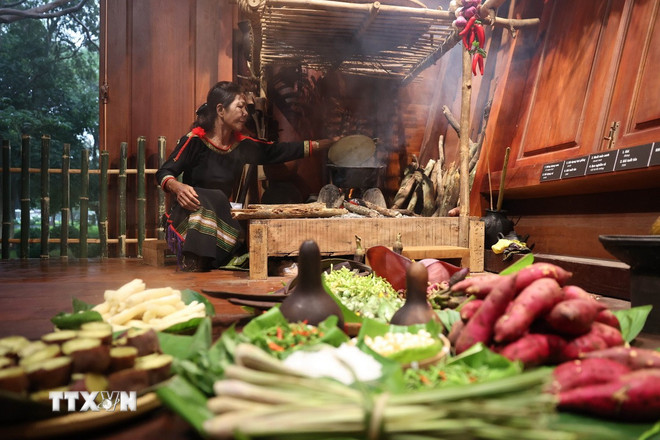
The head of the longhouse is usually a woman. Children carry their mother's surname. Sons do not inherit the property. The youngest daughter inherits the ancestral house and is responsible for taking care of her elderly parents.
Looking at the windows of the long house, one can tell whether a girl is married or not: If the windows are open, it is a sign that she is married. With this layout, the long house is not only a place to live but also a symbol of matriarchy, family relationships and community culture.
Preserving and promoting the value of Ede long houses today
Nowadays, urbanization and changes in village life have caused many long houses to be shortened, their shape, staircases and layouts to change. New long houses are rarely built because of insufficient land area and because wood materials are increasingly rare and expensive.
Faced with the risk of losing an important cultural feature of the Ede people, many efforts to preserve the long house have been and are being strongly implemented in many localities. In particular, the government coordinates with cultural organizations, museums, elderly artisans and Ede people to organize classes to teach techniques of building and decorating long houses.
An effective way is to combine long houses with community tourism development. Many long houses have been renovated into homestays, where visitors can stay, enjoy local cuisine , experience brocade weaving, listen to gongs and learn about matriarchal customs right in the living space of the Ede people.
This not only creates a stable source of income for people but also helps heritage "live" with the community, instead of just being an architectural display.

Most recently, Dak Lak Provincial Museum held an opening ceremony for the exhibition space, traditional long house experience and reenactment of the "New House Ceremony" of the Ede people, attracting the attention of many tourists .
Along with that, the work of teaching ethnic culture is promoted through festivals, community activities, and extracurricular activities to help the younger generation understand more about their origins. Local authorities support techniques and funding to restore long houses, encouraging people to preserve original values while still being flexible in application.
Despite facing challenges from urbanization and changes in lifestyle, conservation efforts are helping the Ede long house continue to exist as a living heritage - not only preserving the quintessence of matriarchal culture but also contributing to tourism development, creating sustainable livelihoods and preserving the unique cultural space of the Central Highlands./.
Source: https://www.vietnamplus.vn/nha-dai-e-de-dau-an-mau-he-va-kien-truc-hinh-thuyen-doc-dao-giua-dai-ngan-post1081659.vnp


![[Photo] General Secretary To Lam receives the Director of the Academy of Public Administration and National Economy under the President of the Russian Federation](/_next/image?url=https%3A%2F%2Fvphoto.vietnam.vn%2Fthumb%2F1200x675%2Fvietnam%2Fresource%2FIMAGE%2F2025%2F12%2F08%2F1765200203892_a1-bnd-0933-4198-jpg.webp&w=3840&q=75)



































































Comment (0)