

Perspectives from modern research
As one of the most experienced and dedicated experts in the research topic of history and military technology of ancient Vietnam, engineer Vu Dinh Thanh (Hanoi) has searched and analyzed a system of documents from Vietnamese, British, French historical books, as well as contemporary records, allowing him to look back at the whole picture of military activities in the late 18th century.
In particular, engineer Vu Dinh Thanh paid special attention to the activities of the British, French, Portuguese, Dutch, and Spanish East India Companies – commercial organizations with their own armies, authorized to mint money, declare war, and control vast colonies from Asia to Africa and the Americas. For example, the British East India Company once possessed twice the number of troops as the British Royal Army and controlled 70% of the saltpeter supply to the West after controlling most of India in the late 19th century. The French East India Company also controlled part of the Indian territory, with Pondicherry as its center.
That correlation shows that the Tay Son army had directly confronted not only Nguyen Anh's forces but also the mercenary network of the East India Companies - units with experience in fighting in many colonies. According to engineer Thanh, the battle in which Manuel Man Hoe - commander of the force equipped with copper-clad ships and French cannons - was destroyed along with thousands of mercenaries shows that the scale of the battle was equivalent to major battles such as the victory over the Siamese army (1785) or the battles in the campaign to defeat the Qing army (1789).
Another focus of Mr. Vu Dinh Thanh’s research is the source of saltpeter (KNO3) – an ingredient that accounts for 75% of black gunpowder. Before the advent of modern explosives, all Western guns, cannons and grenades were absolutely dependent on this gunpowder. Despite the development of metallurgical techniques, Europe was still not self-sufficient in saltpeter and had to import it from Southeast Asia until the end of the 19th century.
In hot and humid climates, natural bat guano in Vietnam, Laos, Cambodia and southern China is the world's largest source of saltpeter. Therefore, since the 15th-16th centuries, Western countries have sought every way to exploit or control this area of reserves. Researcher Dupouy's (1913) notes that by 1903, there were still 22 saltpeter mines in operation in Bac Ky. This data shows that saltpeter was an important strategic material that the French exploited vigorously after imposing their rule.
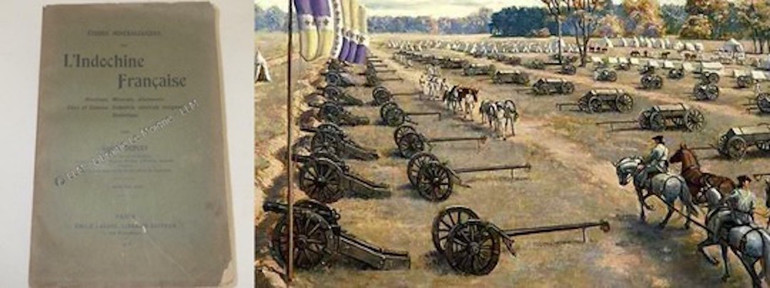
Right photo: The French Auxonne Mobile Artillery Regiment uses gunpowder with saltpeter extracted from Vietnam. (Photo: NVCC)
From the above figures, engineer Vu Dinh Thanh concluded that the economic-military value of saltpeter in modern times was exceptionally large. According to the French Institute for Strategic Research, in the late 17th-18th centuries, the price of 1kg of gunpowder was equal to 0.5kg of gold, of which 80% was for saltpeter, meaning 1kg of bat droppings was nearly equal to 0.4kg of gold in France. That explains why information about Indochina saltpeter mines was kept secret for a long time.
In that context, Dai Viet historical documents show that since the 15th century, our country knew how to manufacture cannons and used black gunpowder earlier than many other regions. In 1390, General Tran Khat Chan used a cannon to shoot down Che Bong Nga; after that, Ho Nguyen Trung was brought to China by the Ming Dynasty to manufacture weapons. Dai Viet matchlock guns were known to international merchants as "Giao Chi guns" since 1479.
These technical hypotheses, when compared with the origin of materials, show that Dai Viet had a natural advantage thanks to its available saltpeter source, allowing for the production of large and stable quantities of gunpowder – an important factor in maintaining military capacity.
Hypothesis on Tay Son gunpowder and its historical scientific value
A notable part of engineer Vu Dinh Thanh’s research is related to the description of Tay Son firearms in Chinese official history and literature. He believes that many documents record signs of a type of gunpowder that can burn for a long time, is difficult to extinguish, and even causes suffocation due to oxygen consumption – a characteristic of phosphorus reactions in the air environment.
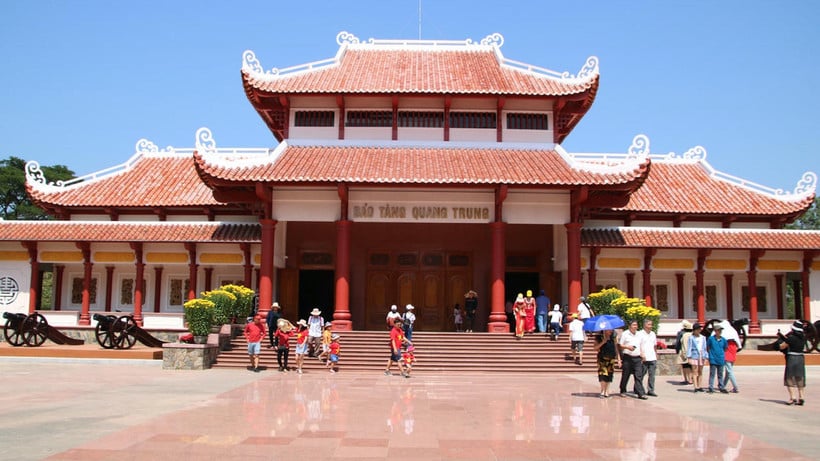
In the Qing Dynasty records of the Ngoc Hoi-Dong Da battle in 1789, the “fireball” was described as “as fast as lightning” and “as hot as putting your hand into a cauldron of oil”. This suggests its fiery and burning properties. The “Tay Son fireball” artifact currently on display at the Quang Trung Museum (Gia Lai), with its thick-walled structure, is also one of the details that Qing engineers used for comparison.
He hypothesized that the Tay Son army knew how to use phosphorus extracted from bat and bird droppings in archipelagos such as Hoang Sa and Truong Sa. Some ethnic communities in the mountainous areas used to practice making luminous substances from the soil of bat caves. The official history of the Nguyen Dynasty recorded that "the Tay Son used tree resin mixed with petroleum to create gunpowder that burned for a long time and could not be extinguished." This hypothesis was assessed by Senior Lieutenant General Nguyen Huy Hieu, Hero of the People's Armed Forces, former Deputy Minister of National Defense, as "well-founded" when compared with actual experience of exposure to phosphorus during the war against the US.
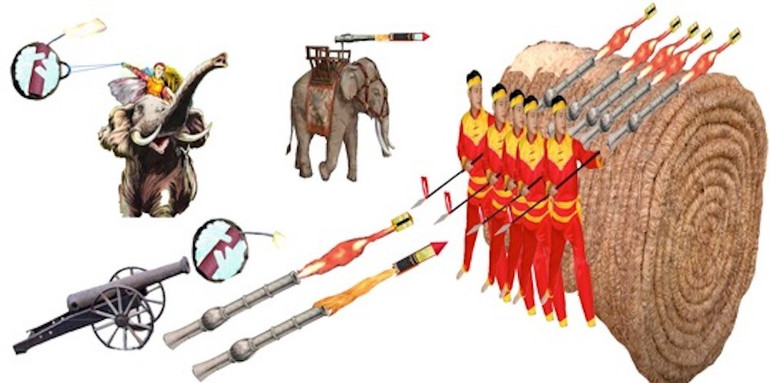
The use of “fire tigers” and “rockets” (primitive rockets) from small launchers that do not create as much recoil as cannons is also analyzed by engineer Thanh as a suitable solution when deployed on elephants or warships. He believes that this could be the reason why the Tay Son army had superior firepower when confronting Manuel Man Hoe’s forces or mercenary troops equipped with copper-plated ships and European cannons.
Between 1782 and 1783, the Tay Son army defeated the combined mercenary forces of several East India Companies, forcing Pigneau de Behaine and Nguyen Anh to retreat. Records from England and France confirm that this force consisted of thousands of soldiers who were not Vietnamese but international mercenaries. However, most of these battles are rarely mentioned in popular history books because the main sources are scattered in Western texts.
According to engineer Thanh, at the same time Emperor Quang Trung passed away, a number of his generals and close associates, along with many workers at factories, were said to have also suffered accidents related to the production of gunpowder, which is understandable when preparing phosphorus.
Meanwhile, European powers continued to improve their techniques. France refined bat droppings, creating gunpowder that was more explosive than conventional black powder; from there, they developed grenades, grapeshot, and advanced mobile artillery. Scientific advances such as Antoine Lavoisier’s discovery of oxygen helped European armies understand the effects of large fires, thereby organizing their formations and building Vauban-style fortifications to minimize the risk of suffocation – something the Qing army did not anticipate in 1789.
Overall, the technical-chemical-military analysis that engineer Vu Dinh Thanh presented further explains why the Tay Son army during the Quang Trung period was able to achieve three consecutive victories: defeating the East India Company (1782-1783), burning down 50,000 Siamese troops (1785), and defeating 300,000 Qing troops (1789).
Although further verification by archaeology, material analysis and multidimensional comparison is needed, the above studies contribute to broadening the approach to Vietnam's military history. Placing Dai Viet's victories in the context of global weapons technology in the 18th century also raises many interesting questions about the scientific and technical level of our ancestors. Exploiting these documents more deeply not only helps clarify hypotheses but also contributes to a better understanding of the intellectual heritage, creativity and self-reliance of the nation through the ages.
Source: https://nhandan.vn/kham-pha-moi-ve-di-san-quan-su-thoi-tay-son-post928804.html

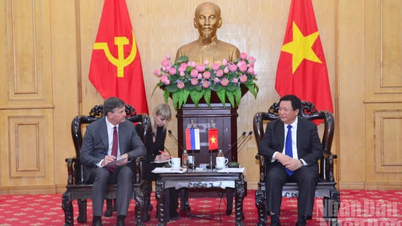
![[Photo] General Secretary To Lam receives the Director of the Academy of Public Administration and National Economy under the President of the Russian Federation](/_next/image?url=https%3A%2F%2Fvphoto.vietnam.vn%2Fthumb%2F1200x675%2Fvietnam%2Fresource%2FIMAGE%2F2025%2F12%2F08%2F1765200203892_a1-bnd-0933-4198-jpg.webp&w=3840&q=75)



































































Comment (0)