

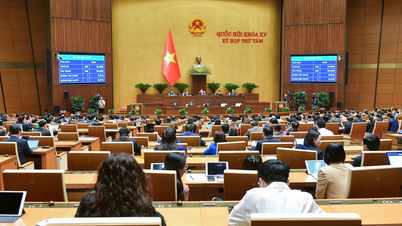
On the afternoon of June 19th, continuing the program of the 7th session of the 15th National Assembly , delegates discussed in groups the draft law on fire prevention and control and rescue operations.
According to the draft law, in addition to the fire safety requirements for ordinary residential buildings, mixed-use residential and commercial buildings must also have fire separation solutions between the residential and commercial areas.

Representative Nguyen Truong Giang
The house is only 30 square meters ; is it feasible to prevent smoke from entering?
Representative Phan Thị Mỹ Dung ( Long An delegation) argued that the regulations on fire prevention measures in the draft are still very general.
According to the female representative, mixed-use residential and commercial buildings come in many forms, from selling drinks, restaurants, and guesthouses to car repair shops… Then, the fire prevention solution here needs to be understood in terms of how to prevent fires and how to implement it…?.
The draft law does not clearly address these issues, nor does it assign the Government the responsibility to regulate them in detail. Therefore, Ms. Dung proposed adding a provision assigning the Government the responsibility to provide detailed guidance on fire safety measures for mixed-use residential and commercial buildings.
Sharing the same concern, delegate Nguyen Truong Giang (Dak Nong delegation) recalled that in 2019, the National Assembly had requested the Government to urge localities to handle establishments violating fire safety regulations. At that time, the number was 5,800 establishments that did not meet fire safety standards.
To date, review agencies have discovered that over 39,500 existing buildings still have fire safety deficiencies that are difficult or impossible to remedy; and over 8,000 buildings have not yet received fire safety certification or have not fully addressed fire safety requirements. Meanwhile, the draft law sets higher requirements for fire safety; will this ensure feasibility?
Mr. Giang gave the example of a house combining residential and commercial use, emphasizing the need for fire prevention measures. "I guarantee that all houses on main streets are in violation. A house with only 30 square meters claiming to have smoke prevention measures is impossible; it would all have to close down," Mr. Giang said.
According to the delegate from Dak Nong, a characteristic feature of large cities, especially Hanoi and Ho Chi Minh City, is the tube-shaped housing, with businesses on the ground floor and residents on the upper floors. Finding solutions to prevent smoke is therefore very difficult.
Based on the above practical experience, Mr. Giang suggested that the draft law should include transitional provisions. Buildings that do not meet fire safety requirements as stipulated in the new law need time to address the issue, rather than immediately implementing it upon the law's enactment, which would negatively impact production and business.

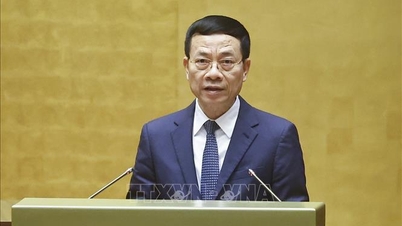
The National Assembly hears presentation on the draft law on fire prevention and fighting and rescue.
Develop evacuation plans for each family.
Joining the discussion, delegate Le Truong Luu (Thua Thien - Hue delegation) mentioned that the cost of fire prevention and control as stipulated by regulations is quite high. For example, a factory with a total investment of 150 million USD spends up to 12 million USD on additional fire prevention and control measures.
Therefore, Mr. Lu suggested that it is necessary to research and develop standards that are appropriate to the capacity of the economy and production.
Delegate Hoang Anh Cong (from Thai Nguyen province) argued that one of the major causes of fires is the use of electricity. Firstly, the quality of the electricity is not guaranteed, and secondly, it is used improperly.
In fact, many electrical devices are not regularly maintained, and when used at high power, they can short circuit and catch fire.
The draft law includes regulations requiring quality assurance for electrical equipment, but Mr. Cong believes the requirements are too lenient and need to be stronger. He suggested that the responsibilities of each relevant ministry and sector should be clearly defined, from ensuring technical standards to eliminating counterfeit and substandard products.
At the same time, the representative from Thai Nguyen province suggested that fire prevention and control plans should be developed for individual residential buildings, so that each family can design their own escape plan in case of fire. Only then will fire prevention and control be highly effective, ensuring the principle of fire prevention is paramount.
Source: https://thanhnien.vn/nha-mat-pho-30-m2-bao-phai-co-giai-phap-ngan-khoi-thi-khong-lam-duoc-185240619171454395.htm












































































Comment (0)