

According to the VNA special correspondent, on the afternoon of October 26, continuing the series of ASEAN Summits with Partners in Kuala Lumpur (Malaysia), Prime Minister Pham Minh Chinh, along with other ASEAN leaders and Japanese Prime Minister Takaichi Sanae, attended the 28th ASEAN-Japan Summit.
At the Conference, ASEAN leaders emphasized that Japan is one of ASEAN's oldest and most reliable partners. Cooperation between the two sides has developed extensively and dynamically, becoming a model of a substantive, mutually beneficial Comprehensive Strategic Partnership in the region.
To date, ASEAN and Japan have implemented 108 out of 130 action lines under the ASEAN-Japan Joint Vision on a Partnership of Trust, Friendship and Cooperation.
Japan is currently ASEAN's fourth-largest trading partner and fifth-largest foreign direct investor, with bilateral trade reaching US$236.6 billion and total investment reaching US$17.5 billion in 2024.
In particular, Japan's initiatives to enhance cooperation in the region and with ASEAN – including the Co-Creation initiative, the Asian Zero-Emission Community (AZEC), and the Asian Energy Transition (AETI) – are bringing tangible benefits to people in both regions.
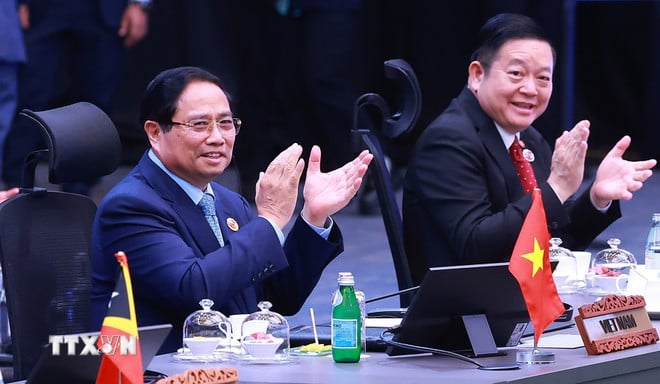
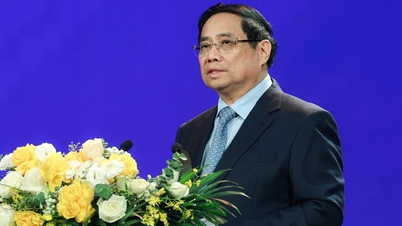
Prime Minister Pham Minh Chinh attended and delivered a speech at the 28th ASEAN-Japan Summit. (Photo: Duong Giang/VNA)
ASEAN leaders and the Japanese Prime Minister agreed that there is still significant potential for cooperation between the two sides and reaffirmed their commitment to further deepening the ASEAN-Japan Comprehensive Strategic Partnership.
Specifically, in the coming period, ASEAN and Japan will prioritize strengthening cooperation in digital transformation, innovation, clean energy, education, health, cybersecurity, climate change response, food security, sustainable agriculture , etc., making full use of the ASEAN-Japan Cooperation Fund (JAIF 3.0) to support project implementation.
ASEAN countries also hope to work with Japan to upgrade the ASEAN-Japan Comprehensive Economic Partnership Agreement (AJCEP) as soon as possible and effectively implement the Regional Comprehensive Economic Partnership Agreement (RCEP).
At the same time, ASEAN countries requested Japan's support for the Association in the implementation of the Digital Economy Framework Agreement (DEFA), the realization of the ASEAN Power Grid (APG), the effective operation of the ASEAN Centre for Emergency Response to Emerging Diseases and Health Situations (ACPHEED), the Regional Medical Supplies Reserve, the ASEAN Integration Initiative (IAI) Work Plan Phase 5 (2026-2030), as well as sub-regional cooperation and narrowing the development gap within ASEAN.
Discussing the global and regional situation, ASEAN and Japanese leaders emphasized adherence to international law and support for a rules-based multilateral trading system. They affirmed the importance of promoting dialogue, cooperation, building trust, and resolving disputes peacefully on the basis of international law, contributing to maintaining a peaceful, secure, and stable environment in the region.
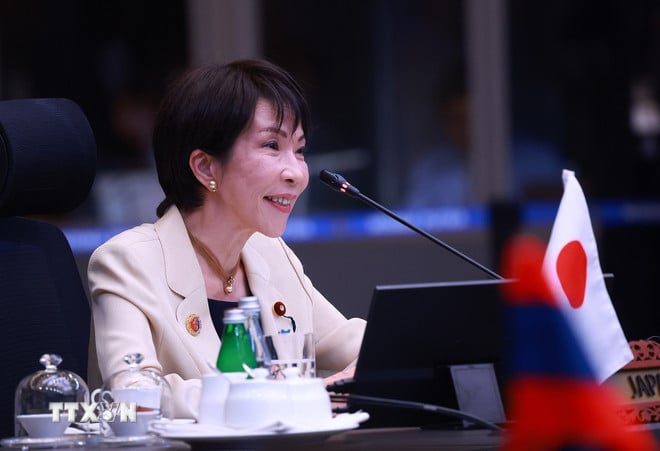
Japanese Prime Minister Takaichi Sanae speaks at the 28th ASEAN-Japan Summit. (Photo: Duong Giang/VNA)
In her remarks, Japanese Prime Minister Takaichi Sanae expressed her pleasure at meeting ASEAN leaders on her first trip as Prime Minister. She affirmed that Japan was the first country to support and will continue to support the ASEAN Indo-Pacific Outlook (AIOP), aligning Japan's major cooperation strategies and programs with the ASEAN Community Vision 2045, and working with ASEAN to further promote the pillars of cooperation between ASEAN and Japan: peace and stability, socio-economic development for the future, and a heart-to-heart partnership for future generations.
The Japanese Prime Minister proposed further strengthening cooperation in specific areas such as maritime security, cybersecurity, combating transnational crime, building a secure, safe, and reliable artificial intelligence (AI) ecosystem, disaster prevention, and promoting education and training.
Speaking at the Conference, Prime Minister Pham Minh Chinh, along with other ASEAN leaders, congratulated Prime Minister Takaichi Sanae on becoming Japan's first female Prime Minister and affirmed their commitment to close cooperation with Prime Minister Takaichi Sanae in promoting common priorities.
The Prime Minister affirmed that after more than 50 years of establishing relations, ASEAN and Japan have become sincere and reliable partners, sharing many common interests and goals for an open, inclusive, rules-based, and ASEAN-centered regional architecture.
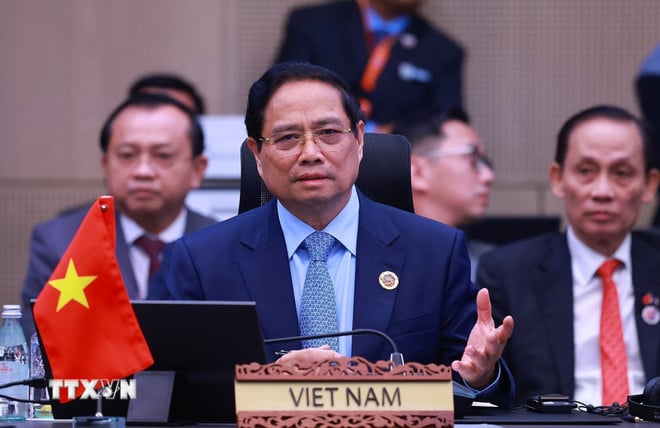
Prime Minister Pham Minh Chinh attended and delivered a speech at the 28th ASEAN-Japan Summit. (Photo: Duong Giang/VNA)
The Prime Minister emphasized that, in the context of the rapidly changing and complex global and regional situation, the ASEAN-Japan Comprehensive Strategic Partnership needs to undergo a strong transformation, "from heart to heart," "from action to action," and "from emotion to effect." Accordingly, the Prime Minister proposed three key areas of cooperation.
Specifically, the Prime Minister proposed that both sides strengthen economic linkages towards a green, inclusive, and comprehensive transformation in the digital age, along with the early upgrading of the Free Trade Agreement, prioritizing cooperation in the digital economy, green economy, sustainable supply chains, and the early completion of the Common Aviation Agreement.
Promoting cooperation in education, training, healthcare, science and technology, and environmental protection is crucial to narrowing the development gap, especially in training high-quality human resources, applying digital technology and AI, and enhancing preventive healthcare, disease warning, and response capabilities. Simultaneously, it is necessary to promote cultural exchanges rich in national identity between ASEAN and Japan.
The Prime Minister also requested Japan to increase technology transfer and human resource training in nuclear power and nuclear safety for ASEAN countries.
Emphasizing cooperation in maintaining regional peace, security, and stability, including the peaceful resolution of disputes, including maritime disputes, in accordance with international law and the 1982 United Nations Convention on the Law of the Sea (UNCLOS) for a prosperous, safe, and sustainable future in the region, the Prime Minister affirmed ASEAN's readiness to play a constructive role in facilitating dialogue among stakeholders, including through ASEAN-led mechanisms, towards lasting peace and stability on the Korean Peninsula.
At the conclusion of the Summit, ASEAN and Japanese leaders adopted a Joint Statement on the Advancement and Implementation of the ASEAN Outlook on the Indo-Pacific (AOIP).
(VNA/Vietnam+)
Source: https://www.vietnamplus.vn/nhat-ban-la-mot-trong-cac-doi-tac-lau-doi-va-tin-cay-nhat-cua-asean-post1072878.vnp


![[Image] Close-up of the newly discovered "sacred road" at My Son Sanctuary](/_next/image?url=https%3A%2F%2Fvphoto.vietnam.vn%2Fthumb%2F1200x675%2Fvietnam%2Fresource%2FIMAGE%2F2025%2F12%2F13%2F1765587881240_ndo_br_ms5-jpg.webp&w=3840&q=75)































































Comment (0)