

Many supermarkets say that goods on their shelves go through multiple layers of inspection, and authorities also confirm that inspections are conducted. So why do cases of contaminated food still slip through this retail channel?
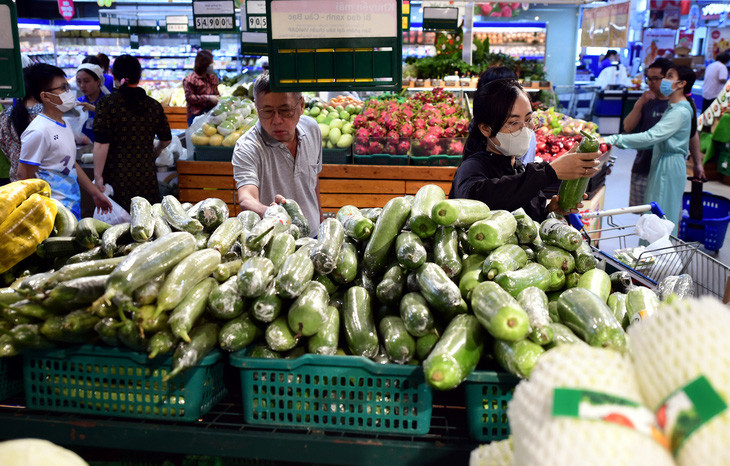
Regarding the story about the price of products containing banned substances sold by Bach Hoa Xanh supermarket, in an exchange with... Tuoi Tre , a representative of a large distribution system, admitted that although suppliers have been screened, it is not easy to control goods entering supermarkets if supermarkets are afraid of spending money on control.
Without testing, it's not good.
"Every year we spend tens of billions of dong just on sampling and testing, but sometimes we're still not reassured because the supply sources are so diverse. Therefore, if supermarkets are afraid of spending money and reluctant to invest in testing, relying only on documents from suppliers, the quality of goods will be very unpredictable, and even very unstable if suppliers do things improperly," this person asserted.
From the perspective of a long-time vegetable supplier to supermarkets, Mr. Trinh Van Dong (Thu Duc City) attributes the inconsistent quality of goods in many supermarkets to a lack of effective management at the grassroots level.
Specifically, according to Mr. Dong, each supermarket has dozens, hundreds, or even thousands of sales points, and suppliers are located almost everywhere, while the quality and brands vary widely. For example, for example, there are hundreds of suppliers to supermarkets, ranging from small businesses to large companies.
"The overall policy sounds good, but whether it's being followed at the point of sale is uncertain. If sales points and purchasing departments aren't strictly controlled, it's easy for negative practices to arise in the import process, and the quality of imported goods becomes difficult to control," Mr. Dong said.
According to Mr. Dong, testing must be maintained regularly, and mobile testing vehicles are needed to conduct surprise inspections of goods from suppliers, even at the production site. Currently, suppliers often select high-quality goods to offer, but over time, if not properly controlled, it will be difficult to maintain consistent quality.
Authorities are also facing difficulties.
Ms. Pham Khanh Phong Lan, Director of the Ho Chi Minh City Food Safety Department, stated that in terms of management, the unit has increased regular and unscheduled inspections, and the Government has also increased the number of regular inspections of businesses. However, the difficulty lies in the lack of sufficient personnel and funding to carry out all the necessary tasks, especially in the sampling process.
Specifically, the department currently has about 250 inspectors divided into 10 teams, each team responsible for 3 districts with a very large number of businesses and shops, resulting in a heavy workload.
Regarding the sampling and testing process, it's currently mostly a matter of persuasion, as the law doesn't mandate supermarkets to take samples in a specific way, or specify how often. Meanwhile, state funding is limited.
"Taking a sample to test for pesticide residue costs millions of dong, equivalent to the price of an entire batch of vegetables. Inspectors aren't magic wands; they can't handle everything alone, they need additional personnel." "Market management, police...", Ms. Lan said.
Meanwhile, a representative from a local food safety management agency stated that regulations do not recognize the results of rapid food testing, and if these results are not recognized, it will be difficult for the treasury to reimburse the cost of purchasing test kits.
Speaking about supermarket management, Ms. Lan acknowledged that some supermarkets still "say one thing and do another," engaging in improper practices, so the role of state management agencies in control is very important.
"Supermarkets have the budget and their own regulations with suppliers, so it's easier for them to handle this, and they must be aware of the importance of this. Because if there is a negative incident, in addition to being penalized according to regulations, it will also greatly affect the supermarket's brand," Ms. Lan stated.
Mr. Nguyen Nguyen Phuong, deputy director of the Ho Chi Minh City Department of Industry and Trade, believes that the role of supermarkets in controlling input costs is very important, and therefore more solutions are needed for these establishments soon; otherwise, the sale of substandard food will continue to recur. consumers There will still be insecurity.
"We have launched the 'Product Quality Control Program in Ho Chi Minh City,' also known as the 'Responsibility Green Tick,' and distribution systems have shown strong commitment to supporting it. This is currently the best solution for distribution systems to overcome this control gap," Mr. Phuong affirmed.
Are there any other solutions?
Recently, Ho Chi Minh City and the Central Highlands provinces held a conference to implement a cooperation program on controlling product quality. Referring to the case of Bach Hoa Xanh selling products soaked in banned substances, the conference raised many concerns and indignation regarding product quality. contaminated food present the current situation and propose solutions.
A representative from a food manufacturer in Ho Chi Minh City suggested reducing on-the-spot inspections because they are cumbersome, costly, and often businesses are aware of the inspections beforehand and have already prepared for them. Therefore, they proposed increasing regular sample testing and implementing "on-the-spot" penalties by transparently publishing both positive and negative results through the media.
Sharing the same viewpoint, from the perspective of a vegetable supplier, Mr. Tran Huy Duong, Chairman of the Board of Directors of Langbiang Farm Co., Ltd. ( Lam Dong ), believes that what is needed now is transparency and public disclosure of all quality control processes implemented by supermarkets and applied and supervised by state management agencies.
Consumers should even be encouraged to proactively bring food samples for testing, and authorities have an obligation to support the publication of these test results, ensuring transparency.
Mr. Dao Ha Trung, chairman of the Ho Chi Minh City Technology Association, believes that it is necessary to further enhance product traceability by applying advanced technologies. This does not cost much but in return allows for better control of product information, making it easier to develop quality management solutions.
"The unit is ready to provide free support to 5 provinces in the Central Highlands for quality control, traceability, and automated recall services applicable to 3 million products, and to businesses in Ho Chi Minh City for 5 million products."
After the free trial period, if businesses wish to continue using the service, they will only pay 35 VND per product. This greatly benefits the "Responsible Green Tick" program implemented by the Ho Chi Minh City Department of Industry and Trade to gradually increase transparency and improve the quality of food entering the distribution system.
Source

![[Photo] Prime Minister Pham Minh Chinh holds a phone call with the CEO of Russia's Rosatom Corporation.](/_next/image?url=https%3A%2F%2Fvphoto.vietnam.vn%2Fthumb%2F1200x675%2Fvietnam%2Fresource%2FIMAGE%2F2025%2F12%2F11%2F1765464552365_dsc-5295-jpg.webp&w=3840&q=75)














































































Comment (0)