

Following his primary defeat in Iowa, DeSantis spent a week discussing the matter with his advisors before deciding to end his presidential campaign.
The Iowa caucus on January 15th was a major disappointment for Florida Governor Ron DeSantis. He finished second with 21.2% of the vote, far behind former President Donald Trump, who received over 51% support. This result marks the beginning of a tense week of consultations between DeSantis and his aides regarding the future of his campaign.
DeSantis, 45, had previously hoped to continue competing with Trump and former US Ambassador to the United Nations Nikki Haley in the early rounds of the primary elections, aiming to build momentum for the final stretch to achieve his ambition of becoming US president. He was considered a "rising star" of the Republican Party and was seen by many donors as a potential alternative to Trump.
DeSantis was at one point considered a serious rival of Trump in the Republican presidential nomination race. Trump attacked DeSantis even before his opponent officially entered the White House race in May 2023. The former president even nicknamed his opponent "DeSanctimonious," an action DeSantis criticized as "childish."
However, in the weeks leading up to the Iowa caucus on January 15th, DeSantis showed signs of faltering, allowing Haley to gradually pull ahead in national polls. Support for DeSantis waned, while Trump increasingly consolidated his lead, despite a series of legal scandals.
DeSantis and his team began to shift their focus. They had initially declared he would win Iowa, but later opted for a second-place finish, avoiding the embarrassing third-place result.
But they faced the reality that the campaign's financial resources were dwindling. DeSantis's campaign and its super Political Action Committees (PACs) were unable to raise enough money to offset the tens of millions of dollars spent on fruitless campaigning in Iowa.
DeSantis wants to understand what happened in Iowa, while also assessing the outlook for the upcoming primary elections in New Hampshire on January 23rd and then South Carolina on February 24th. South Carolina is an area where advisors believe DeSantis has a chance to gain further momentum in the coming months.
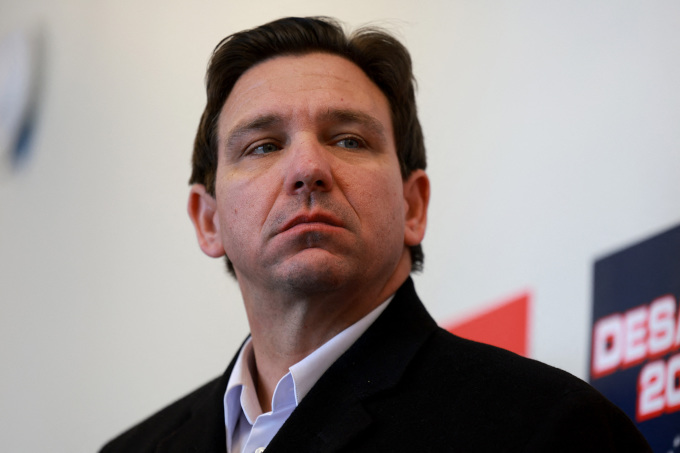
Florida Governor Ron DeSantis speaks in Atlantic City, Iowa, on January 15. Photo: AFP
The Florida governor repeatedly questioned his advisers, dissecting the defeat in Iowa, while continuing his campaign in subsequent states. Over the next few days, he visited South Carolina and New Hampshire, but failed to bring about any tangible change.
The Florida governor ranked third in the polls in New Hampshire, behind Trump and Haley, while the outlook in South Carolina was also bleak.
By January 18th, "the information gap had closed," according to informed sources. But DeSantis still wanted to meet with voters one more time, so he decided to travel to New Hampshire and South Carolina for a final assessment of the situation.
Following a campaign rally in South Carolina, he summoned several of his closest advisors to the governor's residence in Tallahassee, Florida, on the morning of January 21st for a final discussion about the future of his campaign.
Chip Roy, a Texas congressman and one of DeSantis's most prominent supporters, traveled to Tallahassee for the final round of discussions, according to informed sources. Roy was helping the Florida governor weigh his decision to drop out of the race before New Hampshire's primary, as well as consider the pros and cons of supporting Trump.
Congressman Roy said late on January 21 that he had been "in constant communication with the Florida governor" throughout the campaign and thought "he acted correctly" when he ended the race and switched his support to Trump. Roy declined to elaborate on the content of his conversations with DeSantis.
After discussing with his advisors, DeSantis and his wife, Casey, went upstairs for a private conversation. They decided DeSantis would end his campaign as there was no longer a viable path forward. Upon returning to his advisory team, DeSantis prepared a list of points for his announcement withdrawing from the White House race.
The decision to withdraw from the campaign was kept secret by his close circle of advisors. Campaign representative and donor Dan Eberhart only learned the news while en route to New Hampshire, and several other aides and super PACs were not notified in advance. But this was not a surprise to them.
"I'm not shocked at all. I think he would be a great president, but not the best candidate," Eberhart said.
DeSantis and his advisers did not discuss the matter with Trump's team before making the announcement, a senior adviser to the former president said.
Hours before making the announcement, DeSantis canceled his planned television appearances on January 21, a move that gave allies and adversaries some insight into the Florida governor's intentions.
"People want to hold out until South Carolina, but raising funds is becoming increasingly difficult," according to an advisor to DeSantis. He later announced the suspension of his campaign with a post on social media.
"After finishing second in the Iowa caucuses, we considered the path forward. If there was anything that could have improved the outcome or forced more opponents to drop out, I would have done it. However, I cannot demand that supporters invest their time and money if we are not certain of winning. Therefore, today I have decided to end my campaign," he wrote.
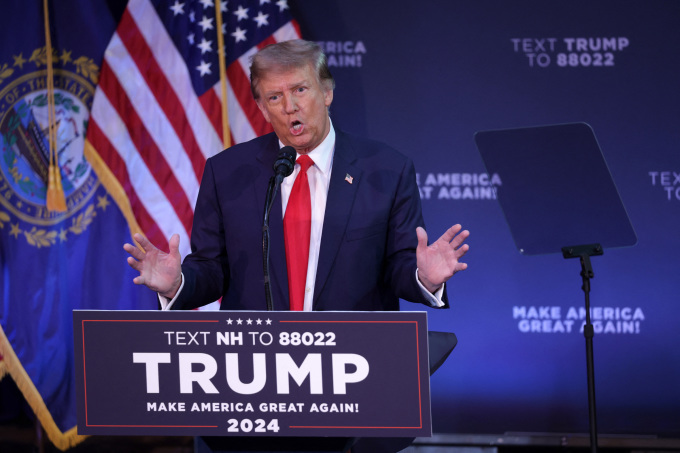
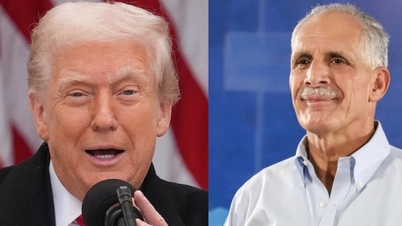
Donald Trump speaks at a campaign event in Rochester, New Hampshire on January 21. Photo: AFP
"They have significant political differences, but DeSantis shares views with Trump on many issues, except for policy on Covid-19," said an advisor to the Florida governor.
DeSantis had previously criticized Trump for issuing federal regulations on social distancing and mask-wearing, and for encouraging vaccination to combat the Covid-19 pandemic. However, DeSantis's inner circle agreed that supporting Trump was the right move, according to three sources familiar with the matter.
Many of DeSantis's allies believe the Florida governor will run in 2028, hoping that no one will be able to stand in his way. Meanwhile, a source familiar with the matter says DeSantis is spending time with his family in Florida.
DeSantis has no intention of campaigning alongside Trump as his running mate, the source said. Following this decision, Halley is Trump's only remaining opponent in the Republican presidential nomination race.
By Như Tâm (According to NBC News, Reuters )
Source link














































































Comment (0)