

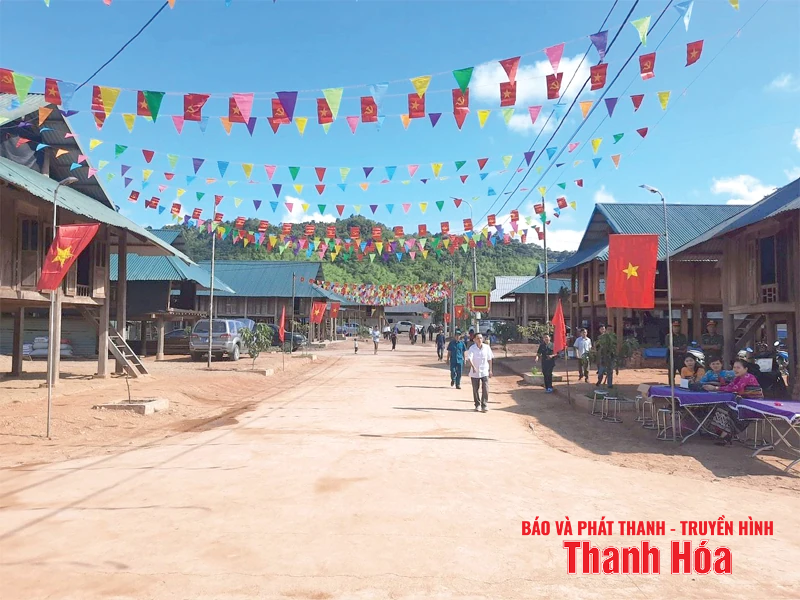
New life in the Co Huong resettlement area, Ngam village, Tam Thanh commune.
In early August, we visited the Co Huong resettlement area in Ngam village, Tam Thanh commune. Witnessing the changes in the resettlement area, each of us felt happy and excited. We visited the family of Mr. Lo Van Hiep, one of the 36 households in the Co Huong resettlement area, and listened to him recount the changes his family has experienced since moving to their new home. Mr. Lo Van Hiep said: "Previously, my family lived in an area at high risk of flash floods and landslides. Every time the rainy season came, my family lived in anxiety and apprehension. Thanks to the attention of the State and the province, in June 2022, my family was relocated to the Co Huong resettlement area, Ngam village, Tam Thanh commune, and received financial support to build a house. After having a safe place to live, my family boldly invested capital in caring for the bamboo and rattan forest area and developing livestock farming. In addition, we take advantage of our free time to cut bamboo for households in the village to increase our family income. Currently, our family life is increasingly stable, and we have the means to provide for our children's education."
Mr. Ha Van Toan, Chairman of the People's Committee of Tam Thanh commune, said: "Thanks to the State's attention, 36 households in Ngam village, living in areas at high risk of flash floods and landslides, have been relocated to the Co Huong resettlement area. After more than 3 years in their new homes, the lives of the people have changed significantly. Currently, the households live in sturdy, spacious stilt houses; the roads have been paved with concrete. The material and spiritual lives of the people have gradually improved. 100% of households have access to the national power grid, clean water, sanitary facilities, and television. The people in the village have actively transformed the structure of crops and livestock, applied science and technology to production, and increased the productivity of crops and livestock." To further improve the lives of people in the Co Huong resettlement area, Tam Thanh commune continues to promote and encourage households to participate in training programs, vocational training, farming, and livestock raising; creating all conditions for them to borrow capital from banks to invest in economic development. The commune fully and promptly implements all government policies for the households. In the long term, Tam Thanh commune encourages people to exploit their potential and advantages to develop community tourism, create jobs, and increase people's income.
Following the directives of the Provincial Party Committee, the Provincial People's Council, and the Provincial People's Committee, the Department of Agriculture and Rural Development (now the Department of Agriculture and Environment) has urgently coordinated with mountainous communes to conduct a comprehensive review and assessment of areas at risk of flash floods, landslides, and mudslides in these areas, classifying them according to levels of natural disaster impact to develop a plan for relocating and stabilizing the population in high-risk mountainous areas prone to flash floods, landslides, and mudslides. Accordingly, the goal by 2025 is to resettle and stabilize 2,255 households, including 599 households in mixed resettlement areas, 300 households in adjacent resettlement areas, and 1,326 households in concentrated resettlement areas. The focus of the project is to allocate sufficient resources and land for resettlement, aiming to stabilize and improve people's lives, minimize damage caused by natural disasters, maximize the effectiveness of infrastructure investment, create jobs, increase income, contribute to sustainable poverty reduction, protect the environment, build new rural areas, and strengthen national defense and security.
As a result, by the end of July 2025, the entire province had 28 resettlement projects under the plan that had received investment approval and funding support from competent authorities to resettle 1,029 households. Currently, 409 households have started building houses in their new locations; of which, 151 households are in concentrated resettlement areas; 26 households are in adjacent resettlement areas; and 232 households are in mixed resettlement areas.
Overall, infrastructure in resettlement areas is gradually being improved, helping people feel secure in their production and stabilize their lives in their new homes. Households have proactively allocated family resources to renovate their houses and quickly stabilize their lives. Many localities have also integrated national target projects and programs to support people in the project areas, thereby contributing to the goals of poverty eradication, rural development, economic development, and strengthening national defense and security in these localities.
The implementation of the resettlement program in the mountainous communes of Thanh Hoa province faces several difficulties and obstacles that need to be addressed to ensure the program's progress and objectives are met. Specifically: The majority of households affected by natural disasters are poor or near-poor, making it difficult for them to find land for relocation. Some projects encounter difficulties due to the rugged terrain of mountainous districts, steep slopes, limited land availability, and high construction costs. Furthermore, investing in resettlement areas requires significant time and numerous procedures, resulting in many areas lacking complete infrastructure to facilitate relocation. While some localities have attempted to mobilize resources for the resettlement program, the effectiveness has been limited, primarily relying on government support.
Mr. Le Ba Luong, Head of the Rural Development Sub-Department (Department of Agriculture and Environment), said: To stabilize and develop production and livelihoods for people in resettlement projects, the Rural Development Sub-Department is currently proposing several key solutions to support livelihoods, production, and stabilize the lives of people in resettlement projects, such as: Focusing on building and replicating projects and models to support production development. Integrating and prioritizing support from national target programs and local programs and projects to build and replicate production development models and projects for households in resettlement areas. Supporting the development of rural industries. Developing One Commune One Product (OCOP). Strengthening vocational training and technology transfer to support production development. Supporting the development of collective economic organizations, cooperatives, and cooperative groups. With the view that the core of the collective economy is the cooperative, which is one of the four important economic components in the national economy, supporting the development of collective economic activities, cooperatives, and cooperative groups in resettlement areas of households affected by natural disasters will have many positive impacts, creating jobs, increasing income for workers, and contributing to socio-economic development.
Text and photos: Xuan Anh
Source: https://baothanhhoa.vn/on-dinh-san-xuat-va-doi-song-nguoi-dan-cac-du-an-nbsp-tai-dinh-cu-vung-nguy-co-lu-ong-lu-quet-sat-lo-dat-258970.htm
![[Photo] Closing Ceremony of the 10th Session of the 15th National Assembly](/_next/image?url=https%3A%2F%2Fvphoto.vietnam.vn%2Fthumb%2F1200x675%2Fvietnam%2Fresource%2FIMAGE%2F2025%2F12%2F11%2F1765448959967_image-1437-jpg.webp&w=3840&q=75)

![[Photo] Prime Minister Pham Minh Chinh holds a phone call with the CEO of Russia's Rosatom Corporation.](/_next/image?url=https%3A%2F%2Fvphoto.vietnam.vn%2Fthumb%2F1200x675%2Fvietnam%2Fresource%2FIMAGE%2F2025%2F12%2F11%2F1765464552365_dsc-5295-jpg.webp&w=3840&q=75)









































![[OFFICIAL] MISA GROUP ANNOUNCES ITS PIONEERING BRAND POSITIONING IN BUILDING AGENTIC AI FOR BUSINESSES, HOUSEHOLDS, AND THE GOVERNMENT](https://vphoto.vietnam.vn/thumb/402x226/vietnam/resource/IMAGE/2025/12/11/1765444754256_agentic-ai_postfb-scaled.png)





































Comment (0)