

Potential from cultural values
With 22 traditional crafts, 8 traditional craft villages, 16 national intangible cultural heritage sites, and 1 representative intangible cultural heritage site of humanity, along with 223 historical and cultural relics, Tay Ninh possesses rich cultural and tourism resources. Its craft villages, festivals, and folk arts are gradually becoming attractive destinations for tourists from within and outside the province.
When mentioning Tay Ninh , one cannot fail to mention Trang Bang, a region famous for its traditional craft of making sun-dried rice paper – recognized as a National Intangible Cultural Heritage – a renowned specialty, a cultural symbol, and a crystallization of the skill and sophistication of the local people. In recent years, through the Trang Bang Sun-Dried Rice Paper Making Culture and Tourism Week, this traditional craft has become more accessible to tourists.
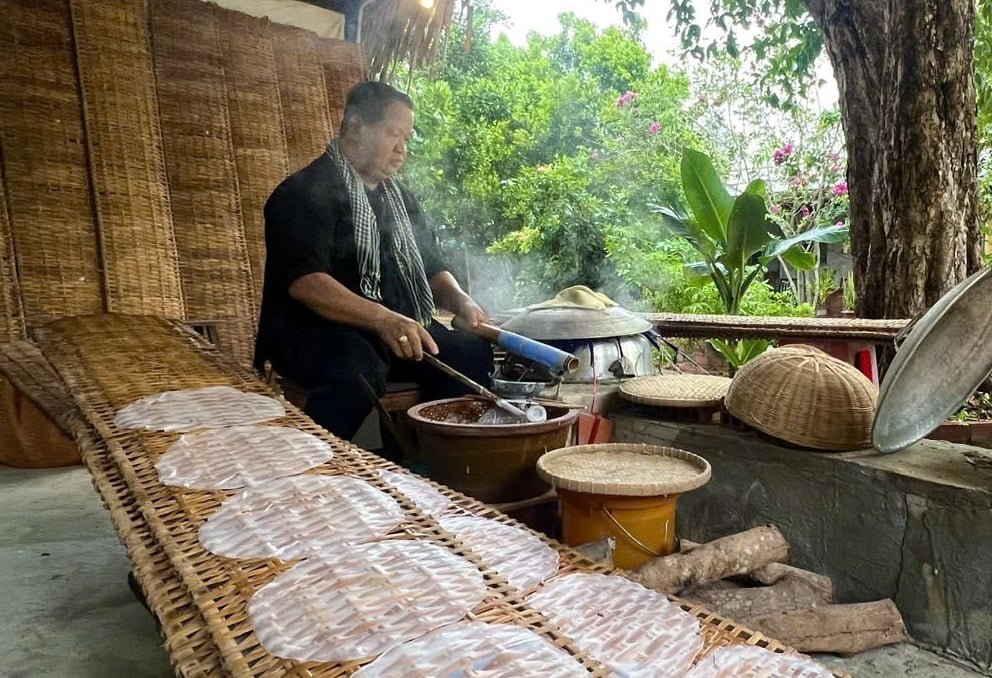
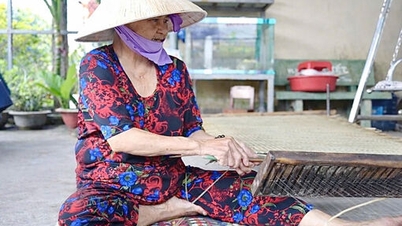
Mr. Le Van Hung makes rice paper rolls to serve tourists at a local tourist spot (Photo: provided by the subject).
Mr. Le Van Hung (residing in Loc Du neighborhood, Trang Bang ward), who has been making sun-dried rice paper in Trang Bang for over 40 years, said: “During the Culture and Tourism Week, those in the profession are invited to demonstrate making and baking rice paper at the stalls. Many tourists also want to experience it to better understand this craft. Thanks to the development of tourism, the income of those in the profession has improved.” Currently, in addition to making rice paper daily, on weekends, Mr. Hung is also invited to perform the art of making sun-dried rice paper at several local tourist spots.
Along with sun-dried rice paper, incense making, mat weaving, rattan and bamboo crafts, chili salt, and the Chhay-dăm drum dance art, the Linh Son Holy Mother Festival at Ba Den Mountain, and the Lam Chay Festival, these traditions are gradually being "awakened," becoming valuable "ingredients" for the development of community tourism. According to Le Quang Trung, Deputy Head of the Tan Xuan Temple Management Board (Tam Vu commune), the Lam Chay Festival has been maintained and developed for hundreds of years, receiving attention and participation from tourists near and far, including overseas Vietnamese and foreign visitors. The hope of those preserving the festival, like Mr. Trung, is nothing less than that the festival will become more widely known to tourists, as it is a source of pride for the local people.
With its rich heritage, numerous traditional craft villages, and distinctive Southern Vietnamese culture, Tay Ninh possesses all the necessary conditions to develop community-based tourism, a type of tourism where local people are the main actors, contributing to both heritage preservation and the promotion of tourism and the local economy .
Efforts to awaken potential
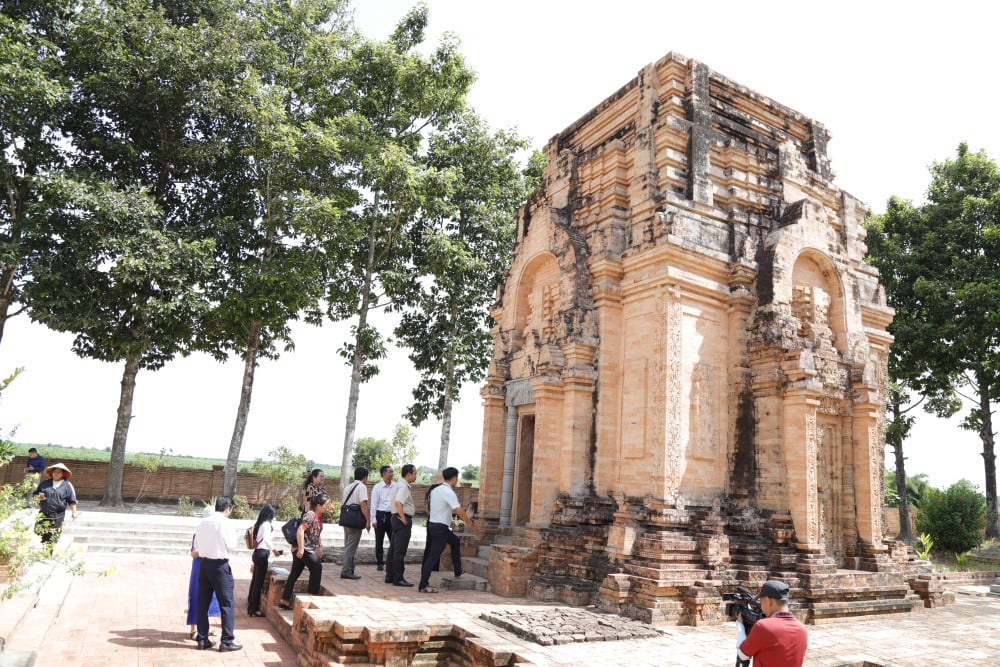
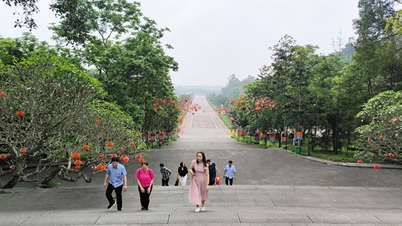
Tourists visiting the Chót Mạt Tower relic (Photo: Ngọc Diêu)
Despite its great potential, community-based tourism in Tay Ninh is still in its nascent stages. Many destinations are still spontaneously developed, tourism infrastructure and supporting services are not yet fully complete, while the tourism communities themselves lack skills and experience. This necessitates stronger collaboration from management agencies, associations, and businesses to truly transform the province's heritage values into vibrant tourism products.
As a state management agency, the Department of Culture, Sports and Tourism of Tay Ninh has taken many concrete steps in developing community-based tourism associated with heritage. According to Deputy Director of the Department of Culture, Sports and Tourism Nguyen Tan Quoc, Tay Ninh possesses a rich treasure trove of heritage, but for these values to become attractive tourism products, many factors need to be synchronized: infrastructure, community skills, and linkages between the State, businesses, and the people.
Over the past period, the Department has implemented many practical activities to gradually build and develop community tourism. In particular, the development of rural tourism products associated with the OCOP program has been emphasized. This has created distinctive local products, serving both experiential needs and opening up job opportunities for the people. In addition, the Department has also organized surveys and connected travel businesses with craft villages, historical sites, and specialty product production facilities to create tours that attract tourists to visit, experience, and better understand the cultural life of the local people.
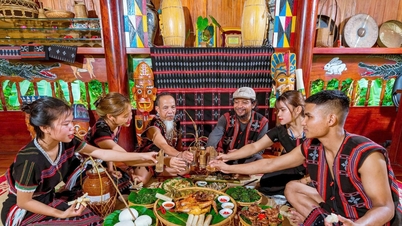
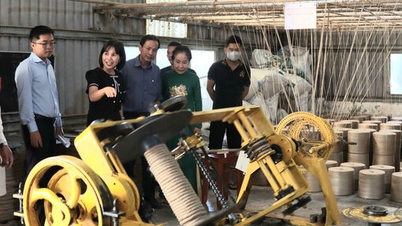
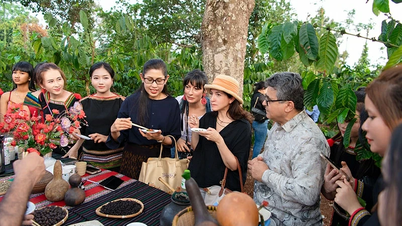
The Tay Ninh Tourism Association plays a crucial role as a "bridge" between businesses, the community, and the government. Chairman Ngo Tran Ngoc Quoc shared: "The Tay Ninh Tourism Association is not only an organization connecting businesses but also a bridge linking people, culture, and tourists, so that each tourism product not only has economic value but also carries the soul of the land and people of Tay Ninh." Based on this orientation, the Association organizes many famtrip programs, seminars, and workshops in craft villages and ecological areas to create opportunities for businesses to meet and cooperate with local people. Many heritage elements have been incorporated into tourism products, from Chhay-dam dance performances and Southern Vietnamese folk music to vegetarian cuisine,... All are exploited respectfully and creatively.
The association also focuses on training local people in community-based tourism skills, from tour guiding and communication to food safety assurance and digital transformation in promotion and business. Alongside this, the "One Village, One Tourism Product" model is being developed, linking heritage with agriculture, ecology, and cuisine.
Thanks to these coordinated efforts, the image of community-based tourism in Tay Ninh is gradually taking shape, and people's perceptions are also changing.
Orientation for a sustainable journey
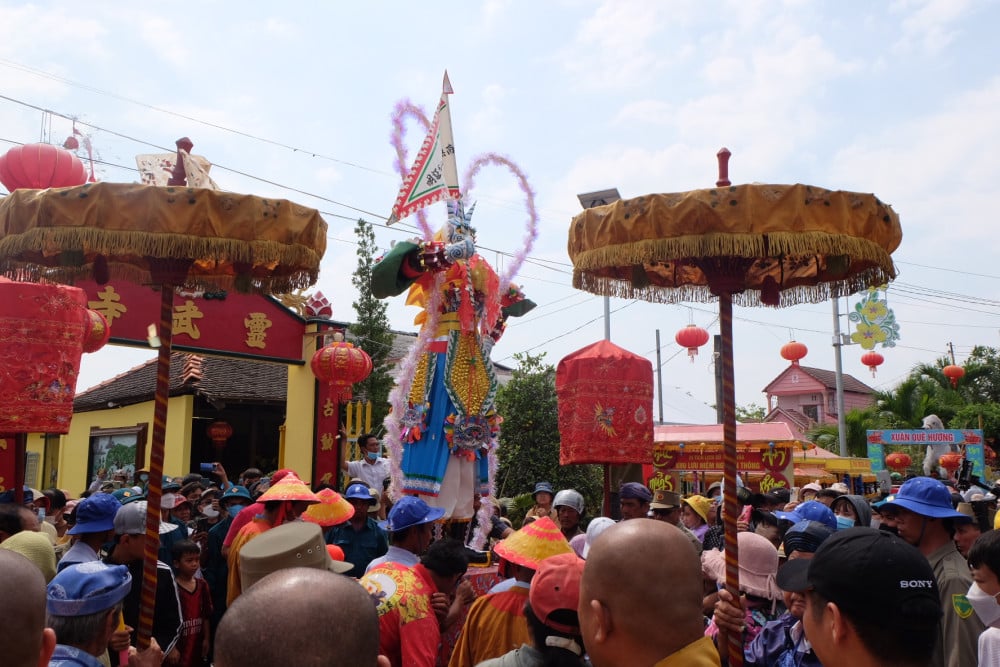
The Vegetarian Festival attracts a large number of visitors from near and far (Photo: Khanh Duy)
Our province possesses a rich cultural heritage and great potential for tourism development. According to the province's general policy and direction, tourism will become a key economic sector. Therefore, developing community-based tourism while preserving and promoting cultural heritage is a correct approach, especially as community-based tourism is a growing trend. Developing tourism in conjunction with heritage preservation not only brings economic and social benefits but also helps to exploit, promote, introduce, and contribute to the preservation of the natural and cultural resources of local communities and ethnic groups.
However, to achieve this, coordination and collaboration with organizations, individuals, and tourism businesses are necessary to attract investment, encourage social participation, and incentivize local communities to invest in community-based tourism development. This will enable joint efforts to develop comprehensive community-based tourism products, improving service infrastructure and enhancing service capacity. Furthermore, communication, promotion, and marketing activities, as well as efforts to build and promote the competitiveness and brand of local community-based tourism, also need attention.
Deputy Director of the Department of Culture, Sports and Tourism Nguyen Tan Quoc affirmed: “The cultural heritage of the local community is the foundation for developing community tourism; community tourism is the driving force for the heritage to be promoted. Therefore, it requires joint efforts, with each citizen acting as a “cultural ambassador,” and each business as a “partner,” working together with the State to develop community tourism associated with the preservation, protection, and promotion of local heritage values.”
According to the Chairman of the Provincial Tourism Association, Ngo Tran Ngoc Quoc, developing community-based tourism linked to heritage is both an economic task and a cultural mission. Therefore, the Association has identified three key tasks for the coming period: developing community-based tourism based on the "living with heritage" model; building Tay Ninh into a "leading green and spiritual destination in Southern Vietnam"; and incorporating local culture, traditional crafts, vegetarian cuisine, and organic agriculture as "distinctive elements" in all tourism products.
With determination, effort, and the joint efforts of the people, businesses, and government, community-based tourism in the province will affirm its position in the hearts of local, domestic, and international tourists—a prospect not far off in the future.
Moc Chau - Huynh Huong
Source: https://baolongan.vn/phat-trien-du-lich-cong-dong-tu-di-san-a205295.html

































































Comment (0)