

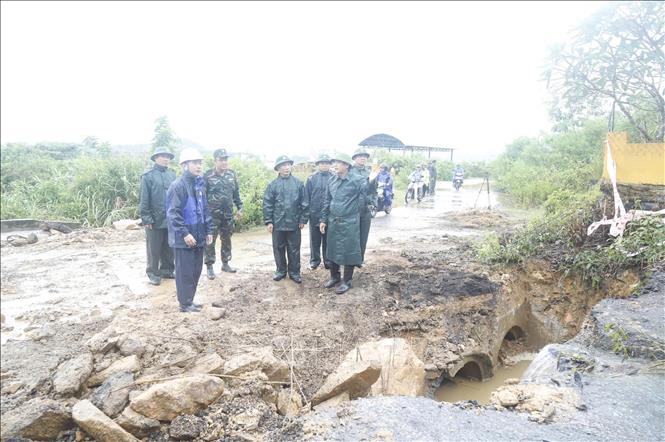
The delegation inspected areas at high risk of landslides at Hoa Son Cemetery, the residential area at alley 161, Me Suot Street, which was considered the "flood epicenter" of the city during previous storms, and the area where people were relocated at Da Nang University.
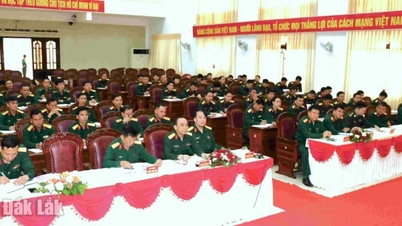
During the inspection, the Da Nang City Military Command, along with local Party committees and authorities, reported on the preparations for responding to the complex developments of Typhoon No. 12. They noted that the forces had proactively reviewed and developed plans, mobilized personnel and resources, and were ready to provide assistance should any situation arise.
Colonel Phan Dai Nghia, Deputy Commander and Chief of Staff of Military Region 5, requested that agencies, units, and local authorities strictly implement the "four on-the-spot" principle (on-the-spot command, on-the-spot forces, on-the-spot means and materials, on-the-spot logistics), staying close to the grassroots, especially in areas frequently affected by flooding; and accurately compile a list of households needing assistance, especially families with elderly people and young children. The City Military Command needs to coordinate closely with local Party committees and authorities to organize the evacuation of people to safe areas, promptly handle any arising situations, and ensure absolute safety for the people before, during, and after the storm.
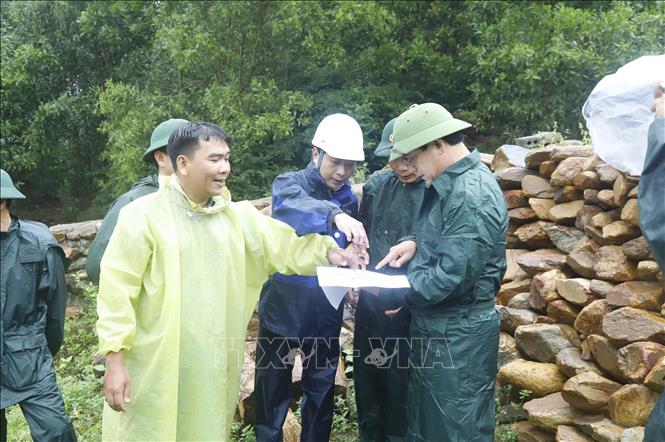
Earlier, the 5th Military Region Command issued a directive to agencies and units regarding proactive response to Typhoon No. 12. The directive stated that agencies and units must strictly maintain a 24/7 rescue, relief, and disaster prevention duty; promptly monitor the situation and effectively handle any incidents that occur; and ensure uninterrupted communication to support command and control of disaster response and search and rescue operations.
Units regularly inspect, review, adjust, and supplement response plans to ensure the safety of warehouses, barracks, technical areas, vehicles, combat facilities, and troop operations; and prepare sufficient supplies, medical equipment, food, and fuel to be ready to respond to any situation.
The Military Commands of provinces and cities are requested to direct the Border Guard to coordinate with relevant agencies to advise local Party committees and authorities on notifying and guiding ships operating at sea to proactively move, take shelter, and anchor safely. The forces must constantly monitor the developments of storms and heavy rains; inspect and review reservoirs, mines, and areas along rivers and streams at risk of landslides; and proactively implement plans to evacuate people and property from dangerous areas when situations arise.
Source: https://baotintuc.vn/thoi-su/quan-khu-5-yeu-cau-thuc-hien-nghiem-phuong-cham-4-tai-cho-20251022141101488.htm



































































Comment (0)