

With monitoring tools in place, tax evasion is impossible.
At the seminar "How to deal with contract vehicles" organized by the Traffic Newspaper, discussing whether disguised contract vehicles that do not enter bus terminals or issue tickets to passengers are "evading" taxes, Mr. Le Ngoc Nam, Chairman of the Board of Members of Vietnam Vehicle Company Limited, affirmed that this is an incorrect assessment, merely the subjective opinion of a few individuals.

Ms. Le Thu Mai, Deputy Head of the Tax Declaration and Accounting Department - General Department of Taxation, shared her views at the seminar "How to deal with contract vehicles" organized by Giao Thong Newspaper on the afternoon of June 13th.
According to Mr. Nam, all organizations, households, businesses, and individuals have an obligation to pay taxes. Regarding passenger transport, only certain entities are exempt from value-added tax; all other types of transport are treated equally and fairly in terms of tax obligations.
"Whether or not a business issues tickets does not reflect whether or not it pays taxes. If a business declares its taxes honestly, issues invoices, and pays all taxes in full, then it cannot be said that it is evading taxes," Mr. Nam emphasized.
They also stated that fulfilling tax obligations is a matter of awareness and responsibility for businesses, and not dependent on the type of transportation they operate.
"With the capabilities of the tax sector, along with current digital transformation, and tools like vehicle tracking and cameras, businesses cannot evade taxes even if they wanted to," Mr. Nam reaffirmed.
Sharing the same view, Ms. Le Thu Mai, Deputy Head of the Tax Declaration and Accounting Department - General Department of Taxation, stated that she disagrees with the opinion that contract vehicles not issuing tickets and not entering bus stations are signs of tax evasion.
According to Ms. Mai, the tax sector manages taxes using a self-declaration, self-payment, and self-responsibility method. Each agency, organization, and individual must proactively learn about tax laws and regulations.
Besides providing support, tax authorities manage through information gathering, data analysis, and risk management. If tax risks are detected, they will focus on analyzing, inspecting, and cross-referencing information to determine the taxpayer's full obligations, thus striving to collect taxes fully and fairly from all parties.
Ms. Mai argued that the risk of tax evasion occurs everywhere because it is a common mentality among business people; it arises wherever management is lax, not just in passenger transport or contract vehicle operations.
Regarding how transportation businesses fulfill their tax obligations, Ms. Mai stated that, based on their revenue, businesses will declare and pay taxes according to the tax rates regulated by the State.
For contract vehicles, no tickets are issued, and they do not enter bus terminals, but businesses sign contracts with service users. Invoices are issued based on the contract value and used for tax declaration purposes.
"If contract vehicles comply with this regulation, then the tax payment will be the same as for other services," Ms. Mai observed.
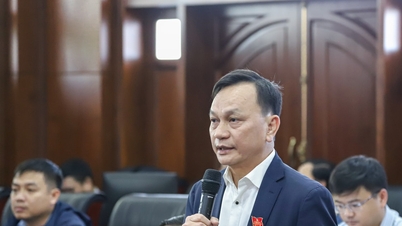
The guests shared their views at the panel discussion, discussing the current tax management practices for ride-hailing services.
Sharing transport vehicle data facilitates tax calculation.
According to Ms. Mai, currently all vehicles used for transportation services must be equipped with GPS tracking devices to determine the number of kilometers traveled and monitor the vehicle's starting and ending points.
This is crucial information for the tax authorities to manage vehicle mileage and, consequently, to determine the correct tax obligations of businesses.
"Digitizing business operations makes it easier for all parties to fulfill their tax obligations correctly and completely," Ms. Mai said.
Regarding this issue, Mr. Do Van Bang, Chairman of the Hanoi Transport Association, said that the current tax laws and policies are very strict. He supports the self-declaration policy, which requires the self-awareness of business owners and individuals, and calls for a change in mindset about tax declaration, recognizing it as both an obligation and a right.
However, since June 1st, Decree 41 amending Decree 10 has come into effect, eliminating the requirement for contract vehicles to submit contracts to the local Department of Transport or the software of the Vietnam Road Administration. The only remaining regulation is that businesses must retain the contract for that trip for a period of 3 years to facilitate inspections and audits by the management agency.
Regarding the question of whether businesses will truthfully declare the number of trips and journeys, Mr. Bang believes that clear regulations are needed in a Government Decree or an inter-ministerial circular so that the tax authorities can easily extract data from the transportation businesses' journey monitoring systems for comparison and verification.
On the other hand, according to Mr. Bang, in order to comprehensively control the operation of transport vehicles and monitor the number of kilometers and distances traveled, it is necessary to improve the comprehensive management of transport vehicles, from vehicle tracking systems to VETC and ePass cards.
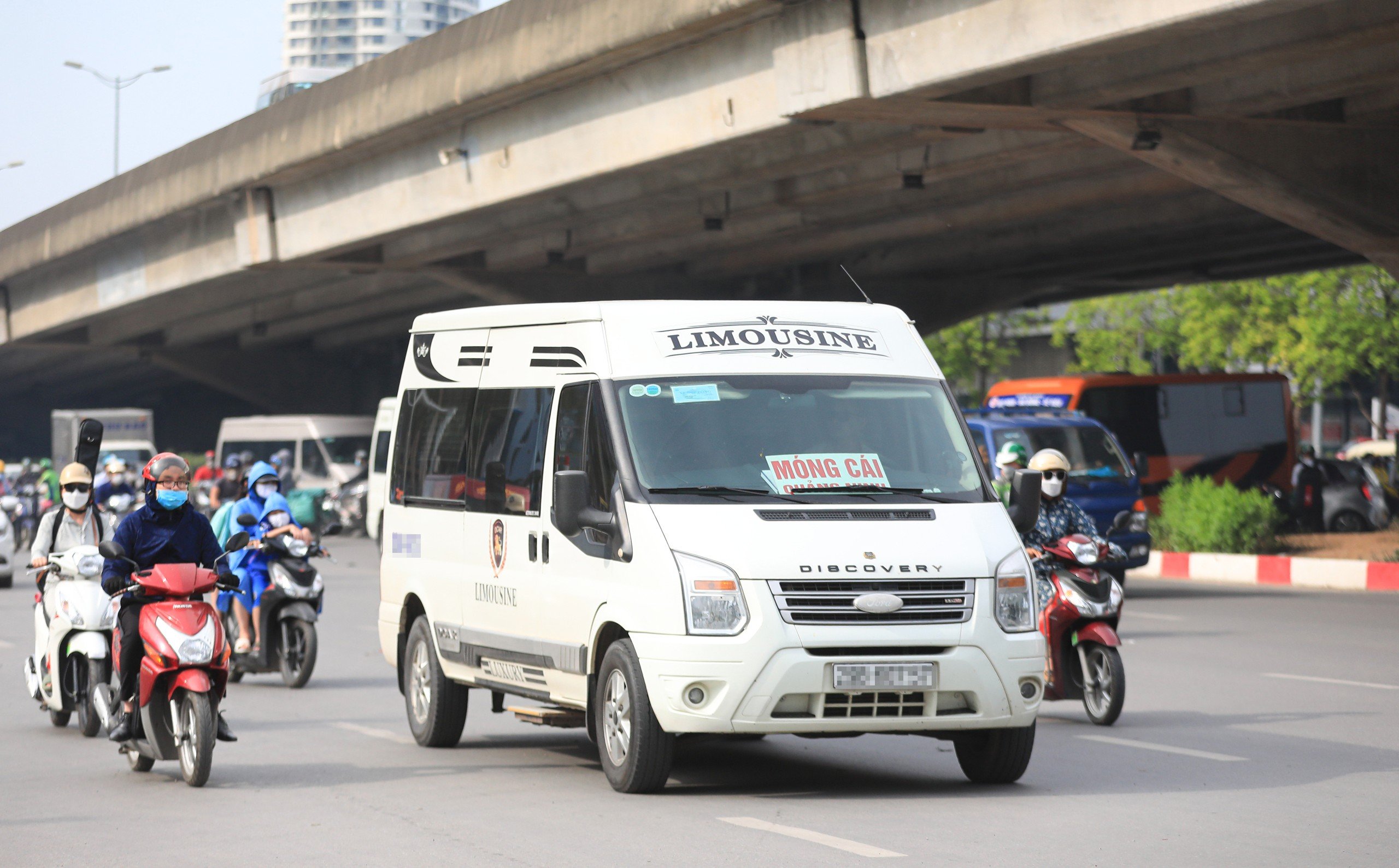
According to Mr. Hoang Anh, although vehicle tracking devices are available to help calculate taxes for transportation businesses, additional data and tools are still needed to compel businesses to pay taxes in full, as there will be cases where businesses use excuses to "avoid taxes".
Regarding this issue, Mr. Nguyen Hoang Anh, Deputy Head of the Department of Transport Management, Vehicles and Drivers - Vietnam Road Administration, said that with the new regulations in Decree 41, passenger transport businesses operating under contract must store their contracts for 3 years, and the tax authorities can use this as a basis to require businesses to pay taxes.
According to the Decrees and Laws on Road Traffic, all transport vehicles are now equipped with vehicle tracking devices. This allows users to know the distance traveled, the starting point, and the ending point of the journey.
At the same time, according to current regulations on data sharing for state management purposes, when agencies such as the General Department of Taxation, the General Department of Customs, and the Traffic Police need it, the Vietnam Road Administration is ready to provide data from the vehicle tracking system.
"In fact, many local tax departments such as Thanh Hoa, Hai Phong , the General Department of Customs, etc., have requested a list of vehicles operating in their areas for tax calculation," Mr. Hoang Anh added.
However, according to Mr. Hoang Anh, even with data from GPS tracking devices for tax calculation, tax declaration still depends on the self-discipline of transportation businesses.
"There will be cases where businesses claim that their vehicles are undergoing maintenance when they are not carrying passengers, while in reality they are still operating to circumvent the law."
Therefore, when relying on vehicle tracking devices, other data and tools should also be added to provide concrete evidence to compel businesses to pay taxes in full," Mr. Hoang Anh stated.
Source: https://www.baogiaothong.vn/quan-ly-thue-voi-xe-hop-dong-the-nao-192240613200329329.htm


![[Photo] Closing Ceremony of the 10th Session of the 15th National Assembly](/_next/image?url=https%3A%2F%2Fvphoto.vietnam.vn%2Fthumb%2F1200x675%2Fvietnam%2Fresource%2FIMAGE%2F2025%2F12%2F11%2F1765448959967_image-1437-jpg.webp&w=3840&q=75)
![[Photo] Prime Minister Pham Minh Chinh holds a phone call with the CEO of Russia's Rosatom Corporation.](/_next/image?url=https%3A%2F%2Fvphoto.vietnam.vn%2Fthumb%2F1200x675%2Fvietnam%2Fresource%2FIMAGE%2F2025%2F12%2F11%2F1765464552365_dsc-5295-jpg.webp&w=3840&q=75)













































![[OFFICIAL] MISA GROUP ANNOUNCES ITS PIONEERING BRAND POSITIONING IN BUILDING AGENTIC AI FOR BUSINESSES, HOUSEHOLDS, AND THE GOVERNMENT](https://vphoto.vietnam.vn/thumb/402x226/vietnam/resource/IMAGE/2025/12/11/1765444754256_agentic-ai_postfb-scaled.png)












































Comment (0)