

The scandal involving the "Chinese robot and Hanoi University of Technology logo" had been simmering for over a month, but only after the media got involved did the university issue an explanation. However, the way the university responded and the content of its explanation only further fueled public concern.
WHEN THE NEEDLE INSIDE THE PACKAGING IS PROUD
According to Thanh Nien newspaper's investigation, the story began on September 7th, when a user named Henry Cuong posted a 46-second clip on his personal TikTok channel titled "Robot created by Hanoi University of Technology." The clip shows a crowd (mostly children) excitedly surrounding a bipedal robot with the Hanoi University of Technology logo, which is shown moving around. The clip was filmed at the "80 Years of Independence - Freedom - Happiness" exhibition commemorating the 80th anniversary of the successful August Revolution and National Day on September 2nd (A80 exhibition).
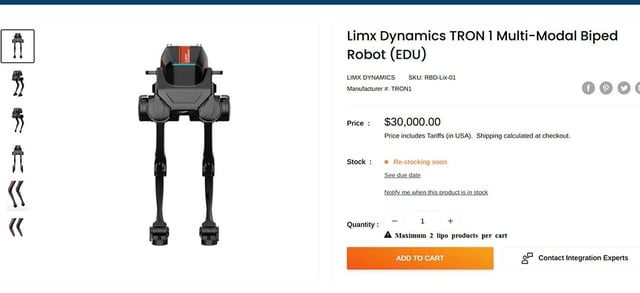
The TRON 1 Edu robot is sold for $30,000. (IMAGE: SCREENSHOT)
PHOTO: SCREENSHOT
This clip spread like wildfire, receiving 350,000 views, 7,000 likes, and 2,000 shares in just one day. Many recognized it as a Chinese robot, advertised on a website for over $30,000. Almost immediately, the image of the robot with the Hanoi University of Technology logo received a barrage of criticism from the online community. However, these angry comments only created "a small storm." Throughout that time, Hanoi University of Technology remained completely silent until the press got involved.
In a press release issued on the afternoon of October 15th, Hanoi University of Science and Technology outlined three points. First, the university affirmed that the bipedal robot displayed at the A80 exhibition had its mechanical components legally imported by the Precision Mechanical Engineering Research Joint Stock Company (RPMEC), a subsidiary of Hanoi University of Science and Technology. The purpose of the import was development, training, research, and technology transfer. Based on this, a research team led by Hanoi University of Science and Technology lecturers developed new control algorithms, giving the robot new capabilities.
Secondly, Hanoi University of Science and Technology stated that the affixing of its logo sticker to the robot was done by the university's exhibition management department for the purpose of management and preservation (as was done with all other exhibits the university brought to the A80 exhibition). Due to an oversight, this department affixed the Hanoi University of Science and Technology logo sticker over the manufacturer's logo.
Thirdly, regarding remediation, the school leadership has "severely criticized the relevant departments for the aforementioned negligence" and has also reported the matter to the competent authorities.
N. MANY QUESTIONS REMAIN UNRESOLVED
The responses in the press release from Hanoi University of Science and Technology caused a media storm, from mainstream newspapers to social media platforms, and even spread into real life, sparking controversy and skepticism among experts and those knowledgeable about robot control.
Le Nguyen Thanh Luan, a young man from Da Nang , commented: "If they can still stick stickers over the visible hardware, who knows whose software is inside! If it's just code development, it's just like how students 20 years ago remade the ROM (storage space) of a phone. Even if it's code redevelopment, there should be a running version of the manufacturer's code for comparison to prove that they've upgraded it for better performance. Just saying it verbally, who would believe that?!"
According to Vu Huy Hieu, a software development engineer at NAB Innovation Centre Vietnam, with robot products like TRON 1 (which Hanoi University of Technology demonstrated at the A80 exhibition), the manufacturer has pre-programmed some basic actions, such as forward, backward, lifting, and lowering, and packaged them into functions as a basis for buyers to further develop, but at a simple level (essentially just controlling the robot). It's like someone building the foundation and the rough structure of a house, and the buyer then adds paint and plaster. To truly develop (upgrade the product), one must master the robot manufacturing technology, that is, the core technology (and must have the manufacturer's permission).
Mr. Le Quang Thanh (from Da Nang) noticed that in the video clips recording the robot's demonstrations, as well as in the photos from the A80 exhibition, the robot's indicator light was blue. According to the TRON 1 robot's user manual, a blue light indicates the robot is running in default mode (according to the manufacturer's pre-programmed settings), while a green light indicates it's running in a customized program (developed by the buyer). "I don't believe Hanoi University of Technology could have improved anything on that robot. I searched high and low and couldn't find a single article or research paper from Hanoi University of Technology about bipedal robots, and suddenly they claim to have 'improved,' 'enhanced stability,' and 'added features' to a commercial product?" Mr. Thanh expressed his frustration.
Another noteworthy detail from experts is that a representative from Hanoi University of Science and Technology told the press after the exhibition that the university had disassembled the robot used for teaching, and therefore no longer has the complete TRON 1 robot. According to experts, the reason the university had to hide the robot was to avoid revealing that it had made false statements about improving the algorithm.
On RPMEC's fanpage in early June, Dr. Nguyen Chi Hung, Director of RPMEC, boasted about having recently purchased a bipedal robot. According to experts, displaying it at an exhibition just three months after purchase suggests a lack of confidence in showcasing a program they developed themselves. "If we speculate positively, they may have already done it, but it wasn't running smoothly enough, so they didn't dare risk showcasing it," commented one scientist.
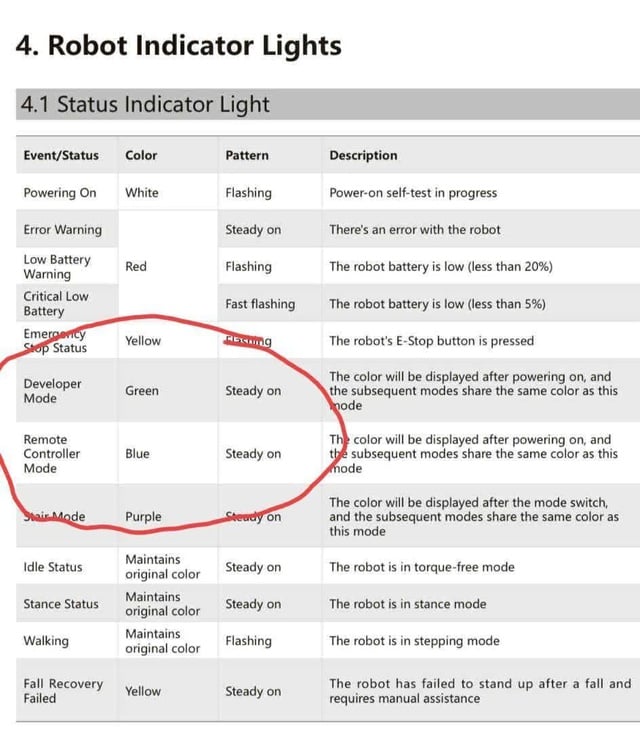
According to the TRON 1 robot instruction manual, the blue light indicates that the robot is running with the manufacturer's default program.
PHOTO: LE QUANG THANH
THE PROBLEM WITH REVEALING THE TRUTH
In response to a question from a Thanh Niên reporter regarding whether the act of pasting the Hanoi University of Technology logo over the manufacturer's logo, even if unintentional, constituted a violation of the integrity principles of the exhibition staff, Associate Professor Huynh Dang Chinh, Deputy Director of Hanoi University of Technology, replied that the university did not see any such indication.
However, on social media, the issue of academic integrity became the first major lesson after the "Chinese robot, Hanoi University of Technology logo" incident. According to Quang Tuan, a member of the Vietnamese Users community, "a small stamp reveals a huge gap in Vietnamese technical education." This is not simply a case of mistakenly affixing the wrong stamp, but a reflection of how our universities are dealing with academic truth.
Around the world, using commercial hardware to develop software and algorithms is commonplace. The difference lies in how it is disclosed publicly, honestly, and in context. A simple line like "Hardware by LimX, Software by HUST Robotics Lab" can dispel any misunderstanding.
Quang Tuan said: "The issue isn't about whether the robots are imported or domestically produced, but about the gap between the truth and how the truth is told. When a leading technical university in the country inadvertently misleads the public, it's a wake-up call about the standards of integrity and transparency in scientific research. A small stamp, affixed with the phrase 'asset management habits,' inadvertently exposes a major flaw in our scientific communication mindset. If Hanoi University of Technology truly considers this a lesson, then what needs to be done is not just to learn from the experience, but to standardize the process of publication - labeling - display - attribution, so that each contribution is recognized at its correct level of value: integration, development, or invention. Because society's trust in academia is not built on stamps, but on responsibility for the truth."
Source: https://thanhnien.vn/robot-trung-quoc-logo-dh-bach-khoa-ha-noi-con-tem-nho-lo-hong-to-185251021150609756.htm















































































Comment (0)