

According to authorities, the trade of fake functional foods of unknown origin is still widespread.
At the end of the year, when exported workers, international students and overseas Vietnamese return home for Tet, the demand for buying functional foods as gifts for family increases.
However, this is also the time when many people take advantage to trade in fake functional food products of unknown origin, causing harm to consumers' health.
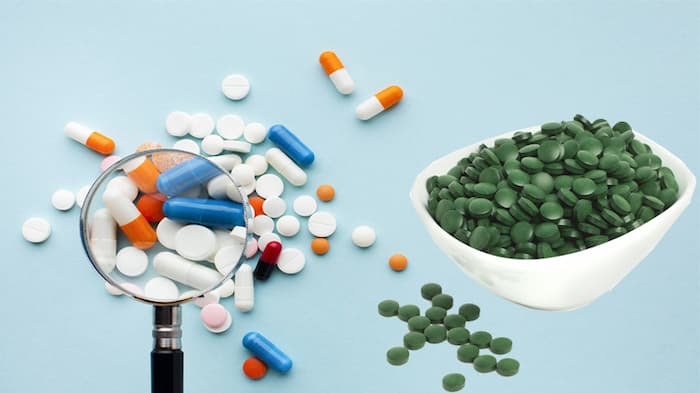 |
| Functional foods have a direct impact on public health, so the management of these products must be strictly implemented. |
Recently, the Police Department of Investigation of Crimes on Corruption, Economy , Smuggling and Environment (Tay Ninh Police) coordinated with Team 4 of the Market Management Department of Tay Ninh Province and Tan Chau District Police to destroy a ring trading fake functional foods through e-commerce platforms.
Previously, the Market Management Department of Thanh Hoa province fined MOMKID Vietnam Joint Stock Company 32 million VND for trading functional foods without invoices and documents proving their origin.
The Da Nang Market Management Department also discovered a series of smuggled functional food products of unknown origin worth 34 million VND and fined one violating establishment 30 million VND.
Although regulations on functional foods have been issued, such as product declaration and secondary labeling requirements as prescribed by Vietnamese law, the trade of fake functional foods of unknown origin is still widespread. These products are not inspected by authorities, causing consumers to face risks regarding quality and health safety.
This situation becomes more complicated when functional food products "carried" from abroad, even though used for individuals are not subject to management, when brought into trade, must fully meet the requirements for product declaration and quality control.
In fact, many subjects have taken advantage of high consumer demand and large profits to consume products of unknown origin or processed products with changed labels.
To protect consumers, the Ministry of Health, the Market Management Department and relevant authorities have strengthened control measures, especially on e-commerce platforms and social networks, where the sale of fake and unknown-origin functional foods is quite common.
Health Minister Dao Hong Lan said that functional food products must be licensed by the authorities before being put on the market. However, managing sales via social networks and e-commerce platforms is facing great difficulties, especially when advertising servers are located abroad.
The Ministry of Health has issued product declaration certificates for more than 24,600 functional food products since 2022 and conducted inspections and checks of functional food production and trading establishments. In particular, the Ministry has handled 126 violations in the field of functional foods, imposing fines of more than VND 16.8 billion.
In addition, localities have inspected more than 941,000 establishments and imposed fines of over VND123 billion for violations. The violations are mainly related to the production and consumption of fake functional foods, substandard quality or false advertising.
To effectively manage functional foods, experts say it is necessary to build a complete legal system with detailed regulations on quality standards, ingredients and production of functional foods.
In addition, there needs to be a mechanism to check product quality before putting it on the market, requiring production facilities to comply with food safety and hygiene standards.
Control of functional food advertising also needs to be strengthened to avoid false advertising of product uses, misleading consumers. Authorities need to closely monitor advertising campaigns, especially through social media platforms.
Furthermore, the Ministry of Health and relevant authorities need to continue to promote propaganda and educate consumers on how to choose and use functional foods safely and effectively.
At the same time, strengthen the application of information technology to monitor and manage the functional food market, from tracking product origin to quality control and enforcement of legal regulations.
Functional foods have a direct impact on public health, so the management of these products needs to be strictly implemented.
Authorities will continue to coordinate to inspect, monitor and handle violations in the business of functional foods, to protect consumers' rights and minimize potential risks to public health.
Source: https://baodautu.vn/siet-chat-kiem-soat-thuc-pham-chuc-nang-gia-dip-cuoi-nam-d232933.html

![[Photo] Urgently help people soon have a place to live and stabilize their lives](/_next/image?url=https%3A%2F%2Fvphoto.vietnam.vn%2Fthumb%2F1200x675%2Fvietnam%2Fresource%2FIMAGE%2F2025%2F12%2F09%2F1765248230297_c-jpg.webp&w=3840&q=75)


![[Photo] General Secretary To Lam works with the Standing Committees of the 14th Party Congress Subcommittees](/_next/image?url=https%3A%2F%2Fvphoto.vietnam.vn%2Fthumb%2F1200x675%2Fvietnam%2Fresource%2FIMAGE%2F2025%2F12%2F09%2F1765253019536_a1-bnd-0983-4829-jpg.webp&w=3840&q=75)






























































































Comment (0)