

" Tourism is only sustainable when its core product meets standards."
Located in Hong Thai 2 hamlet, Tan Cuong commune (Thai Nguyen city), Tien Yen Tea and Community Tourism Cooperative is currently considered the "nucleus" of the Tan Cuong tea region in linking agricultural production with community tourism development.
Previously, many households in the area specialized solely in tea cultivation, preserving the traditional occupation passed down from their ancestors. However, after participating in training courses and learning about community tourism models within the Rural Tourism Development Program associated with the New Rural Development Program, the local people realized that tea is not only an economic crop but also a cultural heritage that attracts tourists.
Based on that idea, Mr. Bui Trong Dai, Director of Tien Yen Cooperative, began building the Tien Yen Farmstay model, where tourists can not only enjoy tea but also immerse themselves in the living space of tea growers. After nearly two years of preparation, the farmstay officially opened in March 2025, becoming one of the typical destinations featured in the Famtrip program "Thai Nguyen Culinary Tourism Tour 2025".
Spanning over 3 hectares, Tien Yen Farmstay is comprehensively planned, featuring a nearly 1,000-meter-long concrete road around the tea hills, a system of lakes, wooden bridges, rest pavilions, an experiential area, a community center, and 6 five-star standard rooms. In addition to its self-managed area, the Tien Yen Cooperative also collaborates with local households, increasing the total tea plantation to 30 hectares, of which 5 hectares are organically certified and produced according to VietGAP standards.
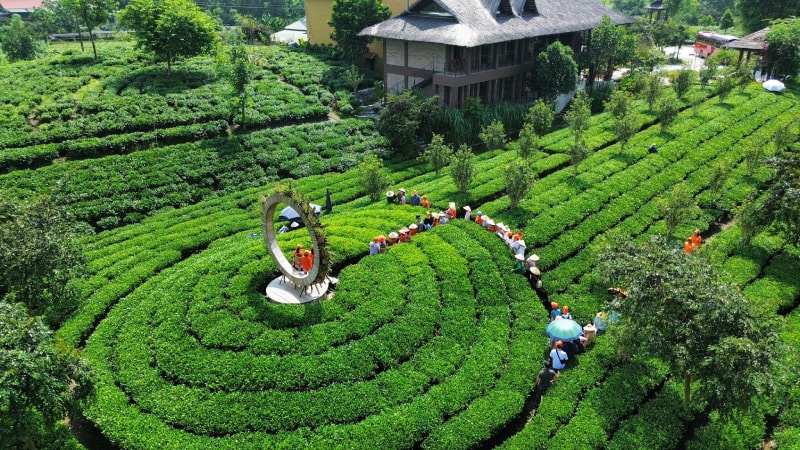
At Tien Yen Farmstay, visitors can experience the complete journey "from bud to cup of tea." They can admire the tea hills, learn how to pick tea buds and process tea, understand the processing procedures, or participate in "tea plantation sessions," where locals offer tea, share stories about tea plants, customs, and lifestyles closely associated with the profession.
The cuisine here also bears its own unique mark, with dishes creatively made from tea ingredients: fish stewed in green tea, peanut candy with green tea, tea cakes… Each meal is a harmonious blend of traditional flavors and the innovative spirit of the people of Xinjiang.
According to Mr. Bui Trong Dai, Director of Tien Yen Cooperative, since its opening, Tien Yen Farmstay has welcomed approximately 2,000-3,000 visitors each month, with 60% purchasing tea and local specialties to take home. In addition to domestic tourists, many groups from Europe and North America have also visited, particularly impressed by the welcoming yet high-standard atmosphere.
Community-based tourism in Tien Yen has created jobs for 15 local workers, including 5 permanent employees. Many schools in the area also organize field trips for students to visit and learn about the area, transforming the tea hills into vibrant "outdoor classrooms" about culture and agriculture. Above all, the image of Tan Cuong tea has been more widely promoted. Many tourists, even after returning home, continue to contact the Tien Yen Cooperative to place orders.
Beyond developing experiential services, Tien Yen Cooperative also focuses on elevating the quality of its tea products. In 2024, the cooperative's clove tea product was recognized as a 4-star OCOP product at the provincial level, leading to a 20% increase in selling price. This is proof of the right direction – prioritizing the quality of agricultural products and combining tourism as a leverage to enhance their value. According to the cooperative's director, Bui Trong Dai, "tourism is only sustainable when the core product meets standards." Therefore, the cooperative maintains a clean tea cultivation, care, and processing process, ensuring food safety, environmental protection, and upholding the Tan Cuong brand.
It possesses both economic value and reflects local culture.
With its herbal pillows made from local medicinal herbs, the Dong Tien Community Agriculture and Tourism Cooperative (Phu Luong commune) not only creates livelihoods for the people but also preserves and promotes folk knowledge, opening up a path for sustainable community tourism development.
Ms. Hoang Thi Hang, Director of Dong Tien Community Agriculture and Tourism Cooperative, said that from its inception, the members determined that the main product must have both economic value and reflect the unique cultural characteristics of the locality. Therefore, herbal pillows were chosen as the flagship product, as they are both practical and embody the essence of traditional medicine knowledge of the people. On average, the cooperative produces and sells about 200 herbal pillows per month, at a price of 180,000 VND per pillow.
Accordingly, the cooperative carefully selects the materials for its herbal pillows, primarily familiar medicinal plants and herbs such as mugwort, lemongrass, cinnamon, star anise, and stevia. All are grown and cared for using safe methods, without chemicals, ensuring the preservation of their medicinal properties. After harvesting, the herbs are processed, treated with fragrances, and then placed into pillow covers made from brocade fabric, a type of fabric hand-woven in Hoa Binh province. Each pillow is carefully hand-sewn by members, and a label and QR code are attached for customers to look up information about the origin of the materials, the production process, and usage instructions.
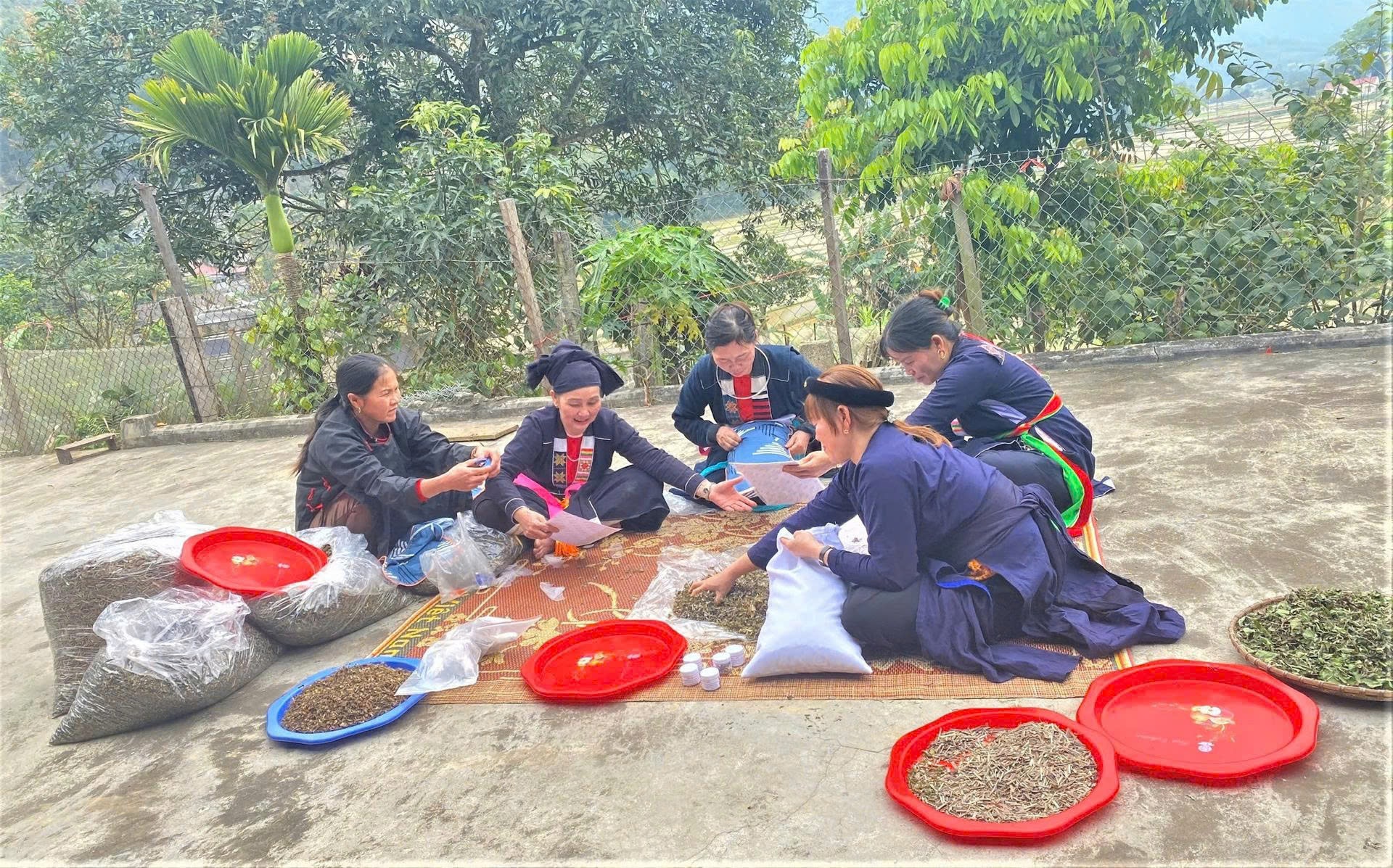
What makes Dong Tien Cooperative special is not just its production activities, but also its focus on developing community tourism. The goal is to transform herbal pillows into a "bridge" for tourists to explore and experience local culture.
According to the plan, visitors to Dong Tien will be able to participate in many unique activities such as staying in homestays, joining locals in the forest to gather medicinal herbs, learning how to identify and process medicinal plants, experiencing herbal steam baths, enjoying the Tac Xinh dance, singing Soong Co songs, and listening to stories about traditional medicine. This experiential space helps visitors better understand the cultural values and folk medical knowledge of the local people. This is also a green tourism and experiential tourism trend that many localities are moving towards, simultaneously developing the economy and preserving resources and cultural identity.
The combination of herbal pillow production and community tourism activities creates a closed value chain: from cultivating medicinal herbs, processing products, promoting the brand, to welcoming tourists for experiential activities. Each stage brings direct economic benefits to the people, while increasing the attractiveness of Phu Luong as a destination on the Thai Nguyen tourism map. It can be seen that, from a small product like the herbal pillow, the Dong Tien Cooperative has opened up a larger story about economic development linked to the preservation of folk knowledge and green tourism.
Source: https://daibieunhandan.vn/thai-nguyen-hop-tac-xa-la-cau-noi-de-du-khach-kham-pha-van-hoa-ban-dia-10400166.html
![[Photo] Closing Ceremony of the 10th Session of the 15th National Assembly](/_next/image?url=https%3A%2F%2Fvphoto.vietnam.vn%2Fthumb%2F1200x675%2Fvietnam%2Fresource%2FIMAGE%2F2025%2F12%2F11%2F1765448959967_image-1437-jpg.webp&w=3840&q=75)
![[Photo] Prime Minister Pham Minh Chinh holds a phone call with the CEO of Russia's Rosatom Corporation.](/_next/image?url=https%3A%2F%2Fvphoto.vietnam.vn%2Fthumb%2F1200x675%2Fvietnam%2Fresource%2FIMAGE%2F2025%2F12%2F11%2F1765464552365_dsc-5295-jpg.webp&w=3840&q=75)









































![[OFFICIAL] MISA GROUP ANNOUNCES ITS PIONEERING BRAND POSITIONING IN BUILDING AGENTIC AI FOR BUSINESSES, HOUSEHOLDS, AND THE GOVERNMENT](https://vphoto.vietnam.vn/thumb/402x226/vietnam/resource/IMAGE/2025/12/11/1765444754256_agentic-ai_postfb-scaled.png)








































Comment (0)