

Two strategic pillars for enhancing long-term competitiveness.
While many major economies face slowing growth, persistently high inflation, rapidly rising public debt, the consequences of the pandemic, conflict, and fiscal tightening, Vietnam has emerged as a "positive exception."
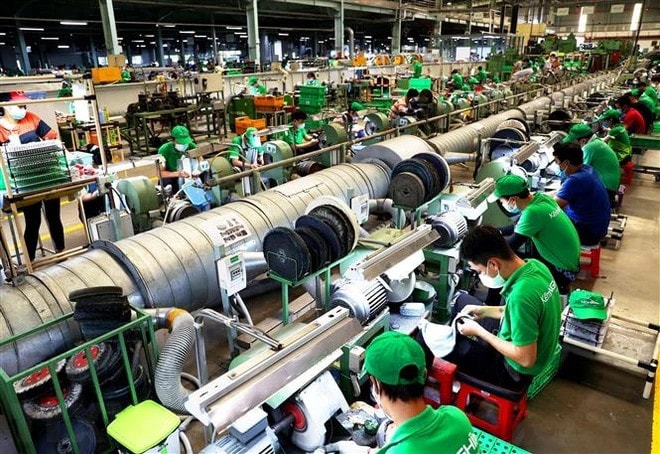
Accordingly, Vietnam's growth has maintained its recovery momentum; major balances in finance, currency, budget, and trade have been maintained; the political and social environment remains stable; and the confidence of international investors and the domestic business community has been preserved. In particular, national public debt has decreased quite impressively: five years ago, public debt was at approximately 56% of GDP, but now it is only about 36% of GDP, a reduction of 20 percentage points. This is not just a technically positive figure, but an indicator that Vietnam's policy space is being strengthened to prepare for a period of strong investment in digital transformation, green transformation, and innovation.
Thanks to maintaining macroeconomic stability and building confidence, per capita income has steadily increased, the material and spiritual quality of life for the people has improved, and Vietnam's international standing has been enhanced through visits, dialogues, and strategic cooperation frameworks with many important partners. But the more crucial point is that Vietnam is not just "maintaining stability amidst instability," but is proactively restructuring its growth model towards greater sustainability, lower emissions, and a greater reliance on technology, knowledge, and innovation.
In this context, digital transformation and green transformation are not fleeting slogans but two strategic pillars, closely linked to the long-term competitiveness of the economy. Digital transformation helps improve productivity, reduce transaction costs, enhance the quality of public services, and increase transparency, thereby creating a more favorable and equitable business environment. Meanwhile, green transformation helps Vietnamese businesses meet the increasingly stringent environmental standards and technical barriers in major export markets, while reducing dependence on fossil fuels and increasing resilience to energy shocks and climate change.
Looking deeper, it's clear that the dual transformation – digital and green – can only succeed when placed within an ecosystem of innovation. Digital products, digital services, green business models, energy-saving technology solutions, circular economy… all require an institutional environment that encourages innovation, accepts new ideas, and allows experimentation within a suitably designed “sandbox” framework. That's why, at the first Autumn Economic Forum (November 2025), the Prime Minister specifically emphasized the need to “promptly issue superior preferential mechanisms and policies to encourage investment in green and digital technologies,” considering this an urgent task to avoid missing the wave of investment shifts and restructuring of global supply chains.
Double transformation is only sustainable when the legal framework is synchronized and stable.
However, the dual transformation is not a short-term race, nor is it a fleeting trend. If we rush into pursuing "glamorous" models without a stable macroeconomic foundation, high-quality human resources, and a synchronized legal system, the risk of wasting resources, or even failure, is very high. The significant reduction in public debt and the maintenance of the safety of the financial and banking system demonstrate Vietnam's cautious yet proactive approach: willing to create room for growth, but not sacrificing stability for growth at all costs.
"Not rushing" therefore means, first and foremost, continuing to persistently pursue the goal of maintaining macroeconomic stability, controlling inflation, ensuring major balances; and preventing risks of public debt and bad debt. This is the foundation for the state to have sufficient fiscal capacity and credit credibility to mobilize and allocate resources for digital infrastructure projects, renewable energy infrastructure, power grid upgrades, and programs to transform production and consumption models towards greener, cleaner, and smarter ones. At the same time, "not rushing" also means avoiding chasing trends, investing haphazardly without proper planning, and lacking comprehensive impact assessments, which can easily lead to outstanding debt, waste, and social backlash.
However, if Vietnam only remains "cautious" without taking decisive action, it will miss the opportunity. Currently, technology corporations and large-scale manufacturers are seeking new destinations for chip factories, data centers, renewable energy equipment production facilities, and green logistics supply chains. This window of opportunity will not remain open forever. Therefore, along with maintaining stability, Vietnam needs to demonstrate its determination to reform, sending a strong signal about a favorable investment environment, transparent institutions, and simple and efficient administrative procedures.
The message, "especially the acceleration of administrative reform, reduction of administrative procedures and business conditions, and creating all favorable conditions for businesses and investors," is therefore not just an internal requirement, but an "institutional commitment" to the international community. In the digital economy era, cumbersome procedures, overlapping permits, informal costs, and long waiting times are factors that cause investment opportunities to be lost faster than any tax rate or labor cost. Digital transformation in the operations of state agencies – from population, land, and business data to customs, taxes, and investment registration – must be one step ahead to support the transformation process of businesses and citizens.
From a legislative and supreme oversight perspective, the role of the National Assembly, its agencies, and people's representatives is particularly important. The dual transformation can only be sustainable when guaranteed by a synchronized, stable legal framework that is predictable and adaptable to new trends in the digital economy, green economy, and circular economy. Laws and codes related to investment, land, energy, environment, science and technology, data, cybersecurity, and digital consumer protection need to be continuously reviewed, amended, and perfected to remove barriers, unlock resources, while still ensuring digital security, safety, sovereignty, and the long-term interests of the nation.
Furthermore, the monitoring of the implementation of laws and policies must be strengthened to avoid the situation where "the law is good but its implementation is weak." Implementation is the ultimate measure of reform and determines whether businesses and investors perceive "superior preferential mechanisms and policies" as effective.
An indispensable element of the dual transformation strategy is human resource development. Digital and green technologies cannot function without well-trained people with digital skills, the ability to adapt to change, and the capacity for innovation. Educational reform, linking training with labor market needs; promoting business-school linkages; and encouraging retraining and professional development programs for the existing workforce are key requirements. Digital and green transformation must become a continuous component of national human resource development strategies, rather than just isolated projects!
Source: https://daibieunhandan.vn/chuyen-doi-kep-khong-nong-voi-nhung-khong-bo-lo-co-hoi-10400209.html


![[Photo] Closing Ceremony of the 10th Session of the 15th National Assembly](/_next/image?url=https%3A%2F%2Fvphoto.vietnam.vn%2Fthumb%2F1200x675%2Fvietnam%2Fresource%2FIMAGE%2F2025%2F12%2F11%2F1765448959967_image-1437-jpg.webp&w=3840&q=75)
![[Photo] Prime Minister Pham Minh Chinh holds a phone call with the CEO of Russia's Rosatom Corporation.](/_next/image?url=https%3A%2F%2Fvphoto.vietnam.vn%2Fthumb%2F1200x675%2Fvietnam%2Fresource%2FIMAGE%2F2025%2F12%2F11%2F1765464552365_dsc-5295-jpg.webp&w=3840&q=75)













































![[OFFICIAL] MISA GROUP ANNOUNCES ITS PIONEERING BRAND POSITIONING IN BUILDING AGENTIC AI FOR BUSINESSES, HOUSEHOLDS, AND THE GOVERNMENT](https://vphoto.vietnam.vn/thumb/402x226/vietnam/resource/IMAGE/2025/12/11/1765444754256_agentic-ai_postfb-scaled.png)












































Comment (0)