

Da Nang and Phu Quoc have seen a sharp drop in the number of South Korean tourists, despite being in peak season, due to fear of flying following the Jeju Air aviation disaster that killed 179 people.
According to tourism service providers, the peak season for South Korean tourists in Vietnam lasts from December to April, but the number of visitors has decreased following the Jeju Air accident on December 29th.
Thanh Bach Tourism Transport Company, headquartered in Phu Quoc, which specializes in serving Korean tourists, said that before the accident, their fleet always had to run at full capacity, but now the number of tourists has decreased by 30%. About 30% of contracts with Korean tourist groups have also been canceled, lasting until March. A company representative said that Korean tourists are "afraid to fly" after the aviation disaster that killed 179 people.
Tran The Hai, Director of Sales and Marketing at Sailing Club Leisure Group, also noted that approximately 10% of bookings were cancelled following the accident. New bookings decreased by 30% compared to the 100 rooms per night before the accident.
"The most intense wave of flight cancellations occurred about two weeks after the accident," Mr. Hai said, adding that the situation is currently favorable but it will take time to return to orbit.
A Jeju Air plane carrying 181 people crashed while landing at Muan Airport in South Jeolla Province, South Korea. The plane's landing gear failed to open and the plane landed on its belly, skidding along the runway before crashing into a concrete wall at the edge of the airport and exploding. Only two flight attendants sitting in the back of the plane survived.

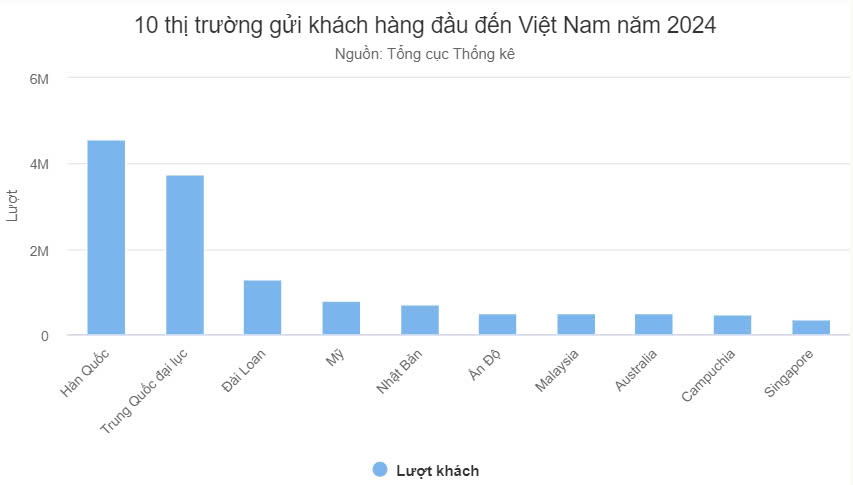
According to Agoda's statistics from December 18th, South Korea, Japan, Thailand, Taiwan, and the United States are the top five markets where tourists choose Vietnam for the New Year holiday. The most popular destinations for South Korean tourists are Nha Trang, Da Nang, and Phu Quoc, respectively.
Members of the Khanh Hoa Provincial Tourism Association specializing in receiving Korean tourists have noted a 30-40% decrease in the number of Korean visitors, mainly due to the closure of Muan Airport. Permanent Vice Chairman Pham Minh Nhat stated that the aviation incident and political issues in South Korea have affected the psychology of tourists.
A 4-star hotel owner in Ngu Hanh Son district, Da Nang, also said that 80 nights, equivalent to 50-60 guests, were canceled between December 30 and January 10. The cancellations were so close to the date that the hotel had almost no chance of filling the empty rooms. However, they accepted the support because they had long-term business partners and Korean guests accounted for 30% of international guests staying at the facility.
"We suffered almost all the damage," said the hotel owner.
Just one day after the accident, Jeju Air recorded approximately 68,000 canceled tickets. South Korean travel companies also simultaneously removed all online advertisements, canceled sales on online shopping platforms, and focused on handling requests for canceled flights and tours.
According to the portal Nate News, The incident has also made consumers in the country worried about using low-cost airline products. About 101 Boeing 737-800s, the type of aircraft involved in the crash, are in operation in South Korea, most of them operated by low-cost airlines, including 39 operated by Jeju Air. Most winter travel packages to popular destinations such as Southeast Asia and Japan using low-cost airlines have been canceled due to customer concerns.
Aram Jeong, who lives in Seoul, said she would refrain from traveling for a while to recover emotionally after hearing about the Jeju Air accident. She had traveled to Vietnam about 10 times, mostly on budget airlines.
"I think I've been lucky and I don't want to fly with budget airlines anymore," she said.
In contrast to Aram Jeong, Choi, who lives in Seoul, does not believe that the Jeju Air accident will make Koreans hesitant to travel abroad or refuse to use budget airlines.
The National Transportation Safety Board's 2020 Survivability Report found that 1.3% of people died in commercial airline crashes between 2001 and 2017. That's down from 4.7% between 1983 and 2000. Airplanes remain the safest mode of transportation thanks to safety regulations and design improvements.
According to many units specializing in Korean inbound tourists to Phu Quoc, Vietnam ranks second only to Japan in the top most favorite foreign tourist destinations because of its friendliness, good service and affordable prices. After the boom in the Central region, visitors tend to move south, specifically to Cam Ranh and Phu Quoc in 2025 and 2026. Therefore, tourism businesses expect the number of Korean visitors to recover soon from February when tourist psychology is more stable.
Source




























![[Video] The craft of making Dong Ho folk paintings has been inscribed by UNESCO on the List of Crafts in Need of Urgent Safeguarding.](https://vphoto.vietnam.vn/thumb/402x226/vietnam/resource/IMAGE/2025/12/10/1765350246533_tranh-dong-ho-734-jpg.webp)

























































Comment (0)