

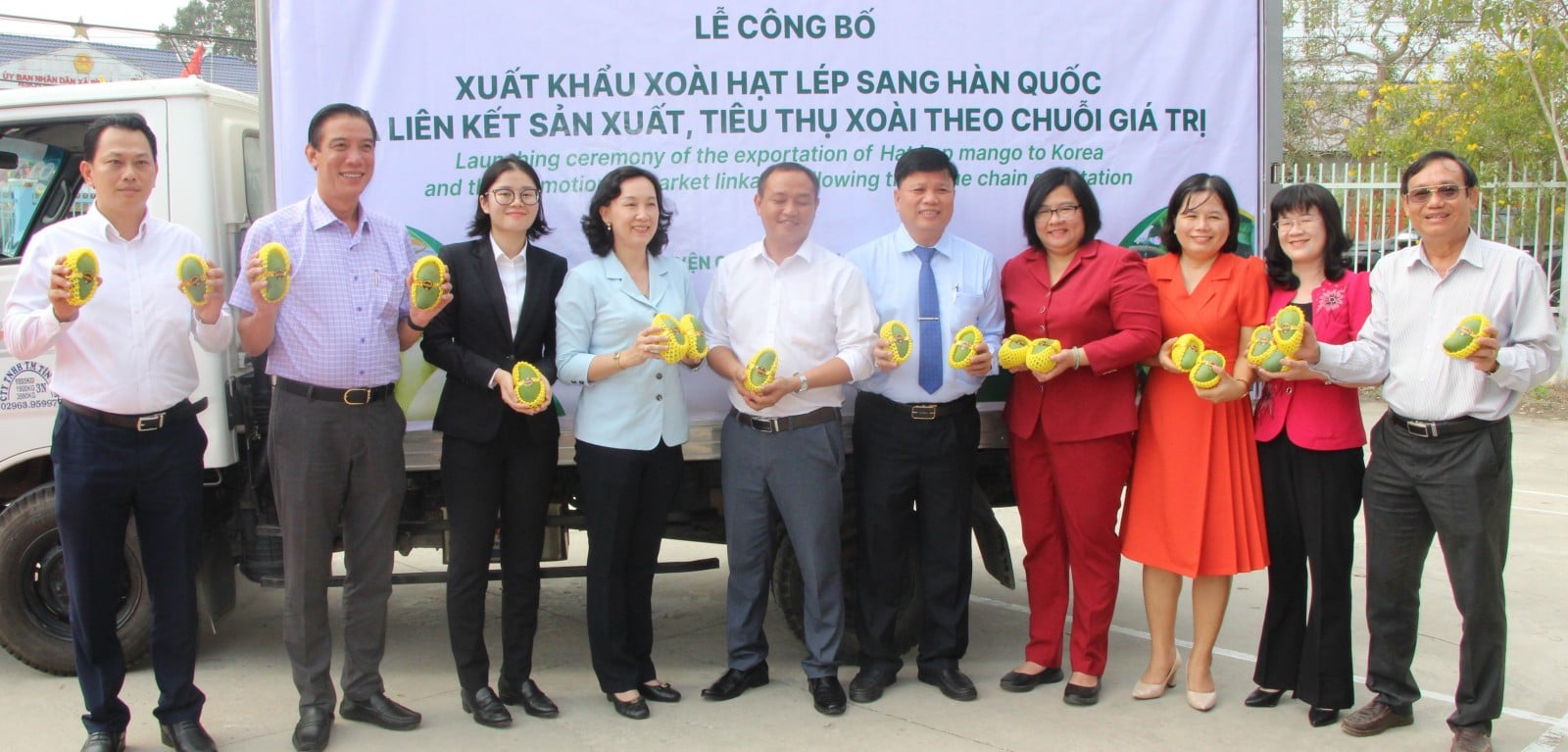
Exporting Cu Lao Gieng seedless mangoes to South Korea. Photo: HANH CHAU
Chairman of the Board of Directors and Director of Cu Lao Gieng GAP Cooperative (HTX) Nguyen Minh Hien said: “Since the beginning of the year, the Cooperative has exported nearly 2,000 tons of mangoes to demanding markets such as Korea, New Zealand, Australia, the US and China. The province organized two mango export ceremonies to the US, Australia and Korea; signed a memorandum of understanding to consume 8,170 tons of mangoes with large enterprises. Currently, the Cooperative has more than 550 hectares of raw material areas meeting VietGAP and GlobalGAP standards, with 51 official members and 243 associate members.”
Cu Lao Gieng mangoes meet strict requirements on quality, growing area codes, pesticide residue control and application of quality and safe cultivation techniques. “We cooperate with the Netherlands Cooperative Development Organization (Agriterra) and the German International Cooperation Organization (GIZ) to organize many training courses for members; send staff for training so that the cooperative can continue to innovate and operate according to international standards,” said Mr. Nguyen Minh Hien.
Mr. Pham An Toan - an expert of the Economic Department of Cu Lao Gieng commune said: "Mangoes are harvested twice a year, with an average yield of 18 - 25 tons/ha, of which grade 1 and 2 mangoes account for about 60%, the remaining is seedless mangoes (green mangoes). In the area, there are 3 cooperatives and 60 mango warehouses. In addition to Cu Lao Gieng GAP Cooperative for export, Cho Moi GAP Cooperative also exports 60 tons of mangoes to the Korean market."
While harvesting mangoes at a good price, Mr. Thai Duc Sang, residing in Tan Quoi hamlet, said: “I grow 5 hectares of mangoes. This crop, the first harvest is probably more than 2 tons, the mangoes are very beautiful, the skin is green and smooth, the mangoes are large, 650 - 800 grams/fruit. Traders come to the garden to buy, the price is good so I take advantage of the harvest. The price of grade 1 mangoes for export fluctuates between 35,000 - 40,000 VND/kg, the price of mangoes with small seeds is over 20,000 VND/kg. Thanks to mango trees, farmers have an income of hundreds of millions of VND/crop.”
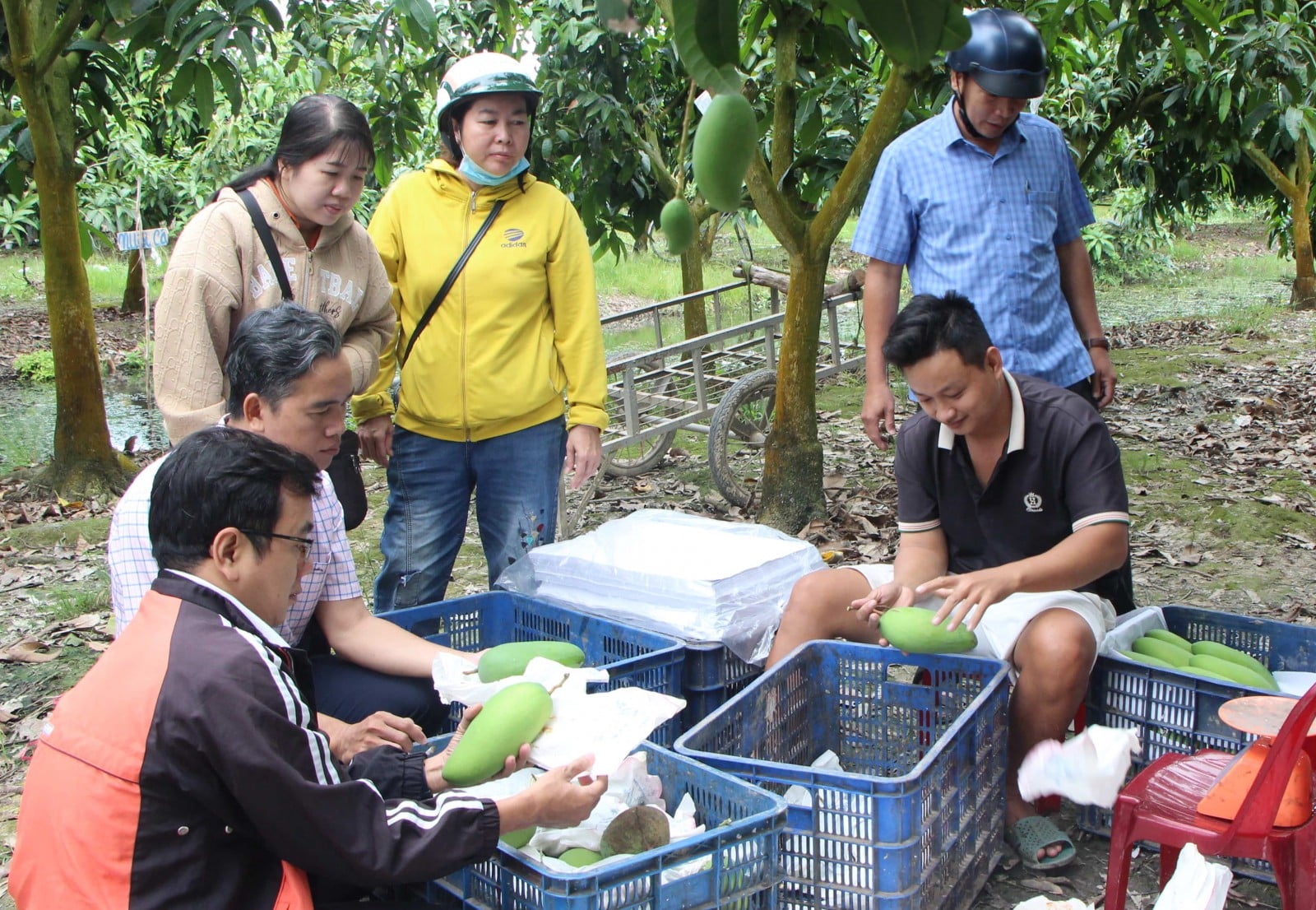
Farmers in Cu Lao Gieng harvest mangoes. Photo: HANH CHAU
One of the pioneer mango farmers, Mr. Pham Van Cham, residing in Tan Hung hamlet, grows 500 mango trees on 1 hectare of land. Mr. Cham said: “Harvesting 2 crops/year yields more than 20 tons of mangoes. If the price is 10,000 VND/kg, the income is 200 million VND. After deducting about 70 million VND in expenses, the net profit is 130 million VND. There was a time when yellow-fruited mangoes of grade 1 cost 60,000 - 75,000 VND/kg, green mangoes cost 35,000 VND/kg, making a huge profit. Farmers who grow according to VietGAP export standards are more assured of their output and do not depend on the market.”
Party Secretary, Chairman of the People's Council of Cu Lao Gieng Commune Vo Minh Nang informed: "To serve domestic consumption and official export to foreign markets, in recent times the locality has focused on propagating to farmers to understand the benefits of cultivating according to good agricultural production practices (VietGAP, GlobalGAP...), with the consensus of the majority of farmers. Up to now, the whole commune has been granted 35 fruit growing area codes, with a total area of 2,974 hectares, VietGAP certification area of 735.9 hectares, GlobalGAP area of 49.9 hectares".
To increase the value of mangoes, Cu Lao Gieng GAP Cooperative was supported to invest in a solar-powered mango dryer, a cold dryer, and a mango juice pressing line, opening up a new production direction: High-tech agriculture - eco -tourism - deep processing. 3 products of green-skinned elephant mango, small-seeded cat mango, and three-color mango of Cu Lao Gieng GAP Cooperative and Cho Moi GAP Fruit Cooperative have been OCOP certified.
The development of fruit trees in Cu Lao Gieng in recent times has brought great economic benefits to farmers, contributing to changing the face of the countryside. Thanks to mango trees, houses are built close together, and flat asphalt roads run across the fields. On the road, trucks, three-wheeled vehicles carrying mangoes, new motorbikes, and even cars are everywhere, gradually changing the appearance of the countryside.
Mango growing cooperatives in the area are determined to continue standardizing raw material areas according to GlobalGAP and organic standards; building a bright spot in the collective economy, linking businesses to bring Cu Lao Gieng mangoes to the world market, contributing to the development of An Giang's agriculture.
HANH CHAU
Source: https://baoangiang.com.vn/tham-vung-cu-lao-xoai-xuat-khau-a469207.html


![[Photo] Cat Ba - Green island paradise](/_next/image?url=https%3A%2F%2Fvphoto.vietnam.vn%2Fthumb%2F1200x675%2Fvietnam%2Fresource%2FIMAGE%2F2025%2F12%2F04%2F1764821844074_ndo_br_1-dcbthienduongxanh638-jpg.webp&w=3840&q=75)

































![[VIMC 40 days of lightning speed] Da Nang Port: Unity - Lightning speed - Breakthrough to the finish line](https://vphoto.vietnam.vn/thumb/402x226/vietnam/resource/IMAGE/2025/12/04/1764833540882_cdn_4-12-25.jpeg)





































Comment (0)