

GIA LAI - Driven by a passion for clean agriculture , literature teacher Bui Van Duong has achieved success with his organic biological products for orchards.
Searching for bold ideas
Despite earning two university degrees simultaneously – one in literature education and the other in economics – both seemingly unrelated to agriculture, Bui Van Duong (37 years old, residing in Ngo 3 village, Ia Ka commune, Chu Pah district, Gia Lai province) is achieving success with his orchards in the region.
"After graduating, being young, I was assigned to teach at a school far from home. The salary was low, not enough to cover gas and transportation costs, so I decided to quit the profession. At first, I was very sad, but what could I do?" Duong shared.

Mr. Duong uses native microorganisms to produce microbial organic fertilizer. Photo: Dang Lam.
Having a small garden plot, Duong decided to invest in coffee cultivation like many others in the area. Initially, he followed traditional garden care methods, using only chemical fertilizers and pesticides. According to Duong, the plants seemed to grow and develop well at first. This was also the time when coffee prices were at their peak, so farmers increased the use of inorganic fertilizers. However, after a while, due to consuming too many chemicals, the plants began to decline.
“Determined to commit to the long-term future of my orchards, I had to find a way to save the coffee and durian plantations that were being poisoned, and the only way was to change farming practices, from inorganic to organic,” Mr. Duong said. Driven by a passion for sustainable agriculture, since 2019 he has been researching and learning, leading him to decide to build an orchard model that says “no” to chemicals.
Currently, Mr. Duong has mastered the technology of using biological preparations to produce organic microbial fertilizers. According to Mr. Duong, the process of producing organic microbial fertilizers is not difficult; even anyone can do it. The initial capital required is not much, just enough to buy raw materials such as fish protein, soybean protein, egg protein, organic potassium, organic phosphorus, etc. Then, after composting in large drums for a certain period, the fertilizer can be used.
"This type of organic fertilizer can be applied, sprayed, or used as irrigation for crops, or as fish feed. For crops, the fertilizer is added to a water-saving irrigation system; wherever the water goes, the fertilizer follows, saving a lot of time and effort," Mr. Duong said.
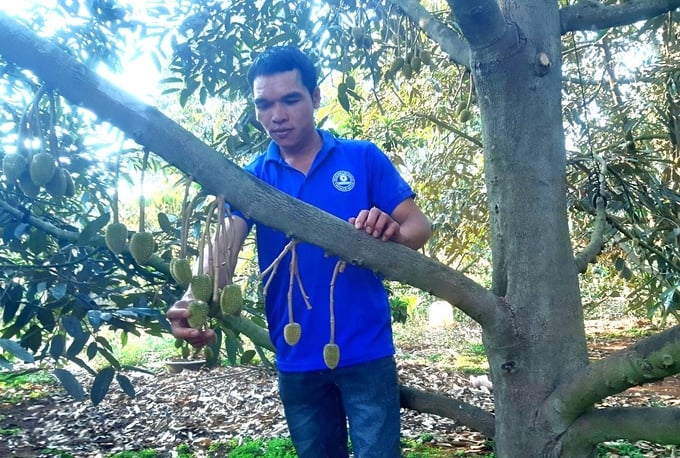
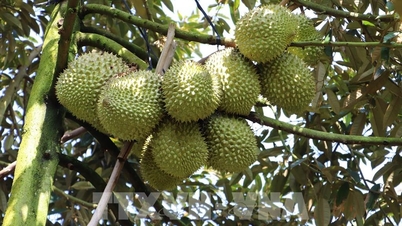
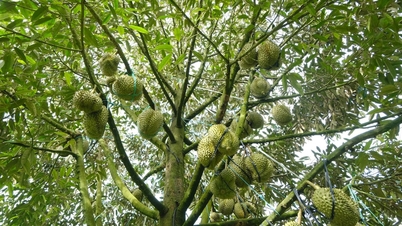
The durian orchard of Mr. Duong's family says "no" to chemicals. Photo: Dang Lam.
According to calculations, producing and using this type of organic microbial fertilizer saves 30-50% of costs compared to using chemical fertilizers and pesticides. Especially during periods when chemical fertilizer prices are high, the savings will be even greater.
In addition, using organic microbial fertilizers also contributes to improving the soil and water environment, creating conditions for the development of beneficial microorganisms, thereby controlling diseases in orchards... "As for the effect on the orchards, you just need to visit the orchards, and you'll see," Duong said.
Spread it to the community.
“Once successful, I wanted to replicate the model to other farmers in the area. However, the difficulty was that it was impossible to change the traditional farming practices of the local people all at once. Initially, some households even applied the model incorrectly, leading to low efficiency and causing a loss of confidence among the farmers. However, now the farmers have widely adopted the model's methods,” Mr. Duong said.
Currently, the movement to use Mr. Duong's organic microbial fertilizer products is no longer unfamiliar to people in the commune, and has even spread to many areas in the district. According to Mr. Duong, it is difficult to give exact figures, but there are at least 1,000 farming households in the district who have successfully applied the production technology and used this line of organic microbial fertilizers.
Mr. Duong took me to the house of Mr. Nguyen Van Truong in Hamlet 1, Ia Ka Commune. Mr. Truong's family owns 2.5 hectares of coffee plantations that were planted many years ago. Like other coffee plantations in the area, Mr. Truong's plantation used chemical fertilizers from the beginning. And then, the trees gradually deteriorated due to chemical fertilizer poisoning.

Mr. Truong's coffee garden consistently adheres to organic farming practices. Photo: Dang Lam.
"I've known about Mr. Duong's organic microbial fertilizer product for a long time. After monitoring its effectiveness, I officially applied this technology to my family's orchard three years ago," Mr. Truong said.
According to Mr. Truong, using organic microbial fertilizers saves costs and labor, is environmentally friendly, and is highly effective. If using chemical fertilizers, it requires fertilizing four times a year and pruning four times a year. In contrast, using organic fertilizers only requires fertilizing five times a year (once in the dry season and four times in the rainy season) and pruning only twice a year, saving half the time spent on pruning.
Mr. Truong further explained: "Chemical fertilizers must be applied during the rainy season, when the fertilizer dissolves immediately, and the roots absorb a large amount of nitrogen, causing lateral shoots to grow quickly. Therefore, pruning is necessary after each fertilization. With organic fertilizers, the plants 'absorb' the fertilizer and grow branches slowly; almost every branch that grows bears fruit, so there's less effort spent on pruning, and the yield doesn't decrease. There's no phenomenon of having a good harvest one year and a poor harvest the next, as is the case with chemical fertilizers."
Taking us to his family's coffee plantation, Mr. Truong showed us the trees, which were lush and green even in the peak of the dry season in the Central Highlands: "Using organic fertilizer helps the trees stay green all year round, without any loss of branches or canopy, so we maintain productivity and yield every year. Especially, the coffee beans are large, juicy, and guaranteed to be clean."
Visiting the durian orchard of Mr. Duong's family, every tree is laden with fruit. Besides coffee, the Duong family also has nearly 500 durian trees and nearly 500 longan trees, all of which have turned their backs on chemical fertilizers and are fertilized entirely with organic microbial fertilizers. This season, the durian trees are producing so many young fruits that they have to prune and remove some of them to ensure the quantity and quality of fruit per tree.
Mr. Duong shared: "Now the local people can produce their own organic microbial fertilizers. During the process, if they don't understand something, they come to me or Mr. Thien to ask for help and support."
The Mr. Thien that Duong just mentioned is Mr. Nguyen Van Thien from Hamlet 1, Ia Ka Commune. “In the field of organic microbial fertilizer production, Mr. Thien is my ‘master,’ my first teacher. From the knowledge he imparted, I have diligently learned more to create the perfected product we have today,” Duong shared.
From the passion for clean agriculture of a literature teacher, the coffee and fruit orchards of Ia Ka commune, Chư Păh district, are now bearing abundant fruit and are very environmentally friendly. Almost every coffee, pepper, or fruit orchard has large drums containing organic microbial fertilizers. Smaller orchards have fewer drums, while those with many large drums and plastic containers are larger. For farmers here, the application of biotechnology to produce organic fertilizers has become a movement.
Mr. Nay Kien, Chairman of the People's Committee of Chu Pah District, said: "The district has long had a policy on developing organic agriculture through sustainable agriculture and high-tech agriculture projects. Accordingly, criteria have been set such as traceability, environmental protection, water-saving irrigation, and the use of natural enemies to control pests and diseases on crops. For fruit trees, the district encourages farmers to use environmentally friendly organic microbial fertilizers, ensuring clean agriculture."
Source















![Passion fruit 'capital' faces sustainability challenge: [Part 3] Building supply chain linkages](https://vphoto.vietnam.vn/thumb/402x226/vietnam/resource/IMAGE/2025/12/12/1765517075835_1232-akk00534-130606_948.jpeg)


![[Photo] Prime Minister Pham Minh Chinh holds a phone call with the CEO of Russia's Rosatom Corporation.](/_next/image?url=https%3A%2F%2Fvphoto.vietnam.vn%2Fthumb%2F1200x675%2Fvietnam%2Fresource%2FIMAGE%2F2025%2F12%2F11%2F1765464552365_dsc-5295-jpg.webp&w=3840&q=75)












































Comment (0)