

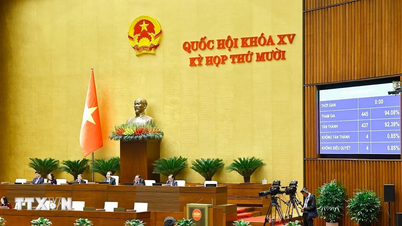
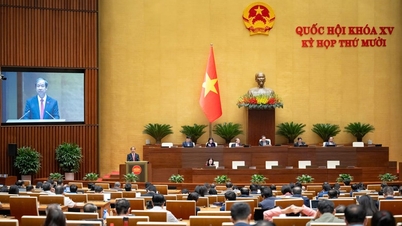
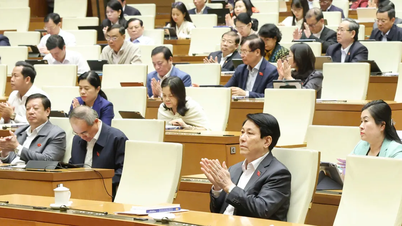
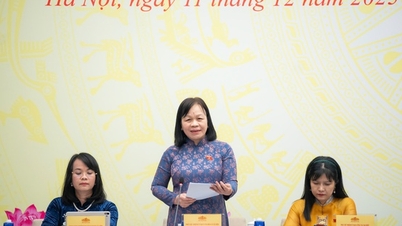
On the morning of December 10th, under the chairmanship of Vice Chairwoman of the National Assembly Nguyen Thi Thanh, with a large majority of National Assembly deputies voting in favor, the National Assembly passed the Law amending and supplementing a number of articles of the Law on Education .
The government has incorporated the opinions of the reviewers and National Assembly deputies to revise the draft, stipulating that the Minister of Education and Training shall decide on a set of general education textbooks for unified national use. This ensures that the Ministry of Education and Training can choose to compile a new set of textbooks or select and revise existing ones, depending on the practical situation and the decision of the competent authority.
Furthermore, the draft continues to entrust the Government with the authority to regulate the free provision of textbooks for students; at the same time, it removes the provision "entrusting the Government with the authority to regulate the details of the socialization of textbooks." In the current context, it is not yet possible to immediately legalize the option of a unified set of textbooks directly compiled by the State or implemented through a socialization mechanism, as the specific plan is still under consideration by the competent authorities.
Furthermore, the open-ended nature of the regulations in the draft helps ensure the stability of the Law, avoiding rigid constraints while the policy is still under research and impact assessment. Regarding the socialization of education, including the donation of textbooks by organizations and individuals, this will continue to be implemented according to Article 16 of the current Education Law and other relevant legal provisions.
The government has also directed a review and revision to standardize the regulation on not issuing junior high school diplomas, replacing it with the phrase "completion of junior high school program or equivalent" throughout the entire draft Law. At the same time, the draft stipulates that diplomas and certificates will be issued in paper or digital form, aiming to promote the implementation of digital transformation policies in education.
Furthermore, the draft standardizes the term "diploma of specialized training programs in certain specific fields" instead of "equivalent diploma," accurately reflecting the nature of degrees such as those of doctors, pharmacists, engineers, and architects; ensuring consistency with the draft Law on Higher Education (amended) and aligning with international practices. The draft also clearly stipulates that the Minister of Education and Training manages diplomas and certificates of the national education system to ensure flexibility and timely adjustments according to practical requirements, while maintaining the uniformity, interconnectedness, and transparency of the system.
For postgraduate advanced training programs in the health sector leading to degrees such as residency and specialist doctor programs, the guidance on organization, implementation, and management will be carried out by the Ministry of Health in accordance with the provisions of the draft Law on Higher Education (amended).
The draft Law has revised and clarified the legal status of "vocational secondary schools" within vocational education, stating that "Vocational education includes elementary, vocational secondary, intermediate, college-level, and other vocational training programs" (point c, clause 2 and clause 3, Article 6); it clearly defines "vocational secondary education at the same level as general secondary education," contributing to improved student streaming, increased articulation between general secondary education and vocational training, and clarifies the legal value of vocational secondary school diplomas and the right to pursue higher education through the amendment and supplementation of clause 1, Article 38, "University-level training for learners who have graduated from general secondary school, vocational secondary school, or equivalent or higher."
The draft amendment to Clause 2, Article 9 on streaming clearly demonstrates the creation of conditions for students, after completing lower secondary education, upper secondary education, vocational education, and equivalent programs, to continue their studies at higher levels or participate in labor suitable to their abilities, aptitudes, talents, personal circumstances, and the needs of society. At the same time, the Government has directed the Ministry of Education and Training, based on its assigned authority, to research and develop a plan to ensure the legitimate rights of learners and guarantee the quality of education in the Minister's Circular detailing streaming and articulation, as well as regulations on admissions.
Source: https://giaoducthoidai.vn/thong-nhat-bo-sach-giao-khoa-dung-chung-tren-toan-quoc-post759992.html

![[Photo] Closing Ceremony of the 10th Session of the 15th National Assembly](/_next/image?url=https%3A%2F%2Fvphoto.vietnam.vn%2Fthumb%2F1200x675%2Fvietnam%2Fresource%2FIMAGE%2F2025%2F12%2F11%2F1765448959967_image-1437-jpg.webp&w=3840&q=75)


![[Photo] Prime Minister Pham Minh Chinh holds a phone call with the CEO of Russia's Rosatom Corporation.](/_next/image?url=https%3A%2F%2Fvphoto.vietnam.vn%2Fthumb%2F1200x675%2Fvietnam%2Fresource%2FIMAGE%2F2025%2F12%2F11%2F1765464552365_dsc-5295-jpg.webp&w=3840&q=75)





































![[OFFICIAL] MISA GROUP ANNOUNCES ITS PIONEERING BRAND POSITIONING IN BUILDING AGENTIC AI FOR BUSINESSES, HOUSEHOLDS, AND THE GOVERNMENT](https://vphoto.vietnam.vn/thumb/402x226/vietnam/resource/IMAGE/2025/12/11/1765444754256_agentic-ai_postfb-scaled.png)







































Comment (0)