

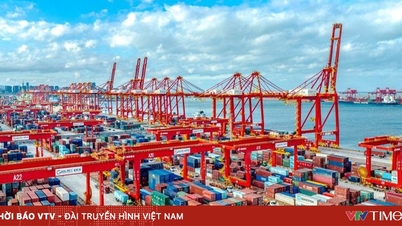
This was the statement made by Deputy Minister of Agriculture and Rural Development Hoang Trung when speaking with Thanh Nien newspaper on the evening of September 10th, regarding information that some businesses had reported they were "unexpectedly" notified to temporarily suspend the export of durian, dragon fruit, and other fruit shipments to the Chinese market.
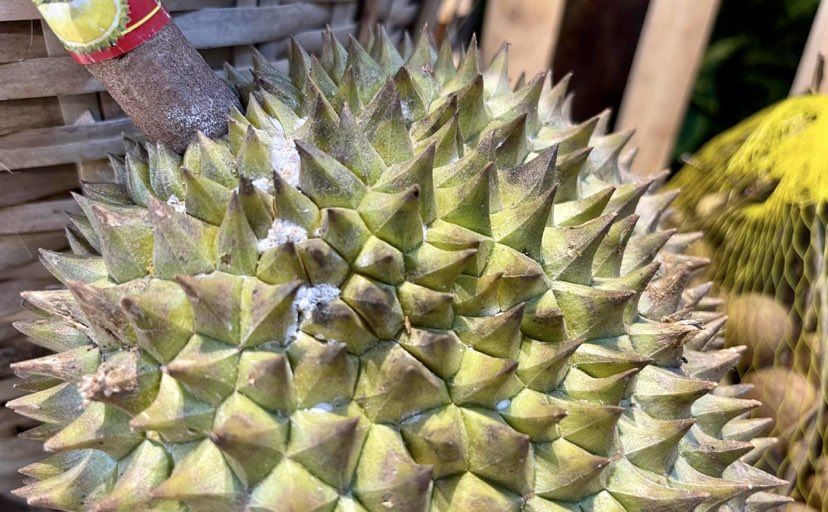
Many shipments of durian exported to China have been found to contain aphids, a pest subject to Chinese quarantine regulations.
Mr. Hoang Trung asserted that the claim by businesses that they were "surprised" to receive a notice from the plant quarantine agency requiring them to temporarily suspend the exploitation of planting area codes and packaging facilities for export to China is incorrect and biased.
On August 24th, in Lang Son , the Ministry of Agriculture and Rural Development chaired a conference on managing planting area codes and agricultural product packaging facilities for export. The conference was attended by representatives from the leadership and Departments of Agriculture and Rural Development of southern provinces, as well as many businesses exporting to China.
At this conference, the leaders of the Ministry of Agriculture and Rural Development clearly stated that they would propose a temporary suspension of exports for certain growing areas and packaging facilities that violate plant quarantine regulations, as notified by the General Administration of Customs of China.
According to Deputy Minister Hoang Trung, the temporary suspension of these codes is to allow businesses and local authorities to clarify the causes and solutions to rectify the problems. Once these issues are resolved, exports will resume.
Recently, the Plant Protection Department sent an official written notice to local authorities and businesses for their information and strict compliance.
"We are proactively implementing this measure to tighten quality control of agricultural products entering the Chinese market, as it is a large and very important market. If China continues to detect more shipments imported from Vietnam with violations as in the past, there is a very high risk that they will apply measures to temporarily suspend or ban imports, which will greatly affect many agricultural products currently exported to China," Mr. Trung said.
According to information from the Plant Protection Department, the unit recently issued a notice to localities requesting a temporary suspension of exports for 74 registered growing areas and the revocation of 47 registered packaging facilities that violated plant quarantine regulations, as notified by the General Administration of Customs of China.
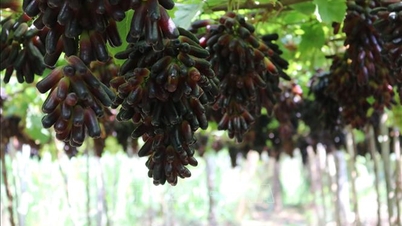
The Plant Protection Department has requested that units holding violation codes take measures to clarify the causes and solutions to rectify the violations and prevent their recurrence. Among these are many codes for durian, dragon fruit, and banana growing areas, all of which are key export fruits from Vietnam to the Chinese market.
According to statistics from the Plant Protection Department, in the first seven months of the year, importing countries of Vietnamese agricultural products detected and warned about 370 shipments (bananas, mangoes, dragon fruit, jackfruit, durian, etc.) in 13 provinces and cities in the southern region that violated plant quarantine regulations. The majority of these violations were reported by the General Administration of Customs of China regarding numerous shipments of durian, dragon fruit, bananas, etc., found to contain harmful microorganisms that are subject to quarantine regulations in China.
Speaking to Thanh Nien newspaper , Mr. Hoang Khanh Duy, Deputy Head of the Management Board of Dong Dang - Lang Son Economic Zone (Lang Son province), confirmed that during recent inspections, when cases of harmful organisms were detected on goods, the Chinese side imposed very severe penalties.
"Typically, they would require the entire shipment to be returned to Vietnam, and might even decide to halt imports of this item for an extended period, as happened with Vietnamese chili peppers," Mr. Duy said.
Source link


![[Photo] Prime Minister Pham Minh Chinh holds a phone call with the CEO of Russia's Rosatom Corporation.](/_next/image?url=https%3A%2F%2Fvphoto.vietnam.vn%2Fthumb%2F1200x675%2Fvietnam%2Fresource%2FIMAGE%2F2025%2F12%2F11%2F1765464552365_dsc-5295-jpg.webp&w=3840&q=75)


![[Photo] Closing Ceremony of the 10th Session of the 15th National Assembly](/_next/image?url=https%3A%2F%2Fvphoto.vietnam.vn%2Fthumb%2F1200x675%2Fvietnam%2Fresource%2FIMAGE%2F2025%2F12%2F11%2F1765448959967_image-1437-jpg.webp&w=3840&q=75)





































![[OFFICIAL] MISA GROUP ANNOUNCES ITS PIONEERING BRAND POSITIONING IN BUILDING AGENTIC AI FOR BUSINESSES, HOUSEHOLDS, AND THE GOVERNMENT](https://vphoto.vietnam.vn/thumb/402x226/vietnam/resource/IMAGE/2025/12/11/1765444754256_agentic-ai_postfb-scaled.png)







































Comment (0)