

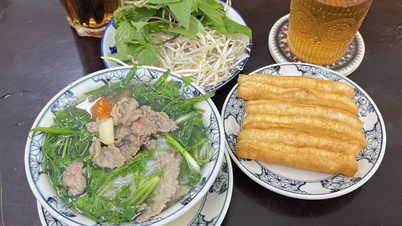
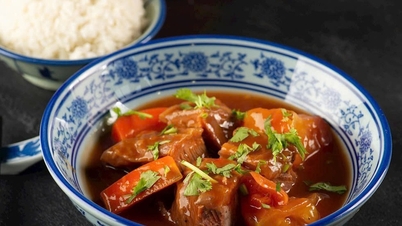
Experts believe that cuisine is the reason foreign tourists keep returning to Vietnam and is a prominent competitive advantage of Vietnamese tourism on the international stage.
"Food is the shortest way to understand the culture of a destination," said Harvey Koi, a tourist in Dubai.
Harvey first came to Vietnam in 2017, visiting Ho Chi Minh City and being captivated by the city's diverse cuisine. He returned after the Covid-19 pandemic ended in 2022 because he craved Vietnamese food. Since then, Harvey has flown to Hanoi and Ho Chi Minh City every year, staying for a month each time to explore local markets and delicacies, while also producing content suggesting culinary experiences for foreigners in Vietnam's two major cities.
Harvey is not alone; many foreign tourists visiting Vietnam prioritize experiencing the local cuisine alongside sightseeing and exploration activities.

"If you ask 10 tourists, 9 of them will fall in love with Vietnamese food after each food tour," said Mr. Nguyen Huy Hoang, CEO of Klook Vietnam, adding that cuisine is a prominent competitive advantage of Vietnamese tourism compared to other markets in the region and around the world. Vietnamese cuisine is diverse, spanning all three regions, each with its own unique flavors, and offers a wide range of experiences from street food to high-end restaurants.
According to Klook representatives, food-related services will be the company's flagship product for breakthrough growth in 2024. Revenue from food tours, food experiences, and fine dining experiences is projected to increase by 70% year-on-year in 2024 and is expected to continue booming next year.
Culinary products are available in all three regions of Vietnam, concentrated in major cities such as Hanoi, Ha Long, Da Nang, Hoi An, Ho Chi Minh City, and Can Tho. Popular options include walking tours, cyclo tours, and motorbike tours to enjoy street food; culinary tours on cruise ships; buffet tickets at restaurants and hotels; and cooking classes. Costs range from one million VND.
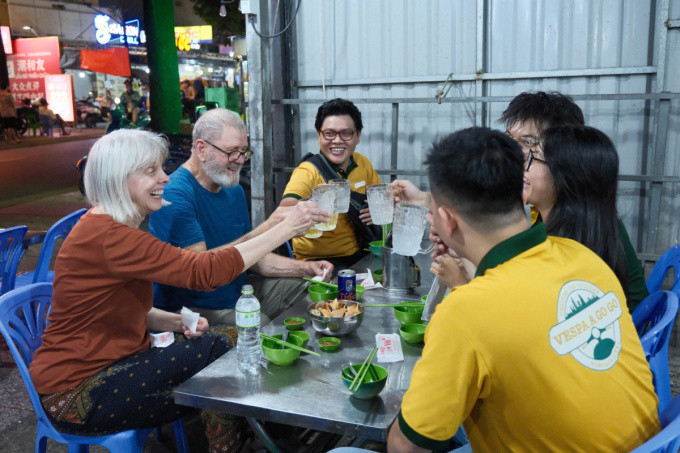
A company specializing in food tours using Vespa scooters in Ho Chi Minh City said that since the pandemic, the company has seen a continuous increase in tour bookings each year. Tour packages start at a minimum price of two million VND per person. In 2025, tours were fully booked until the end of the first quarter. Customers mainly come from Europe, America, and Australia, and have little experience with motorbike transportation.
Besides regular food tours, cooking classes are also popular with foreign tourists. Mr. Nguyen Huy Hoang said that this type of activity appeared around 2019 but only flourished after the pandemic.
Nguyen Dinh Le Hoa, founder of MOM Cooking Class, a cooking class for foreign tourists in Ho Chi Minh City, said that tourists often attend cooking classes on the last day of their trip, after enjoying Vietnamese food at restaurants and eateries. The cost of the class ranges from 30-35 USD during the off-peak season (June-September) and 40-45 USD during the peak season (October-May). During the off-peak season, Hoa's class welcomes about 10 guests per day, while during peak season the number increases two to three times.
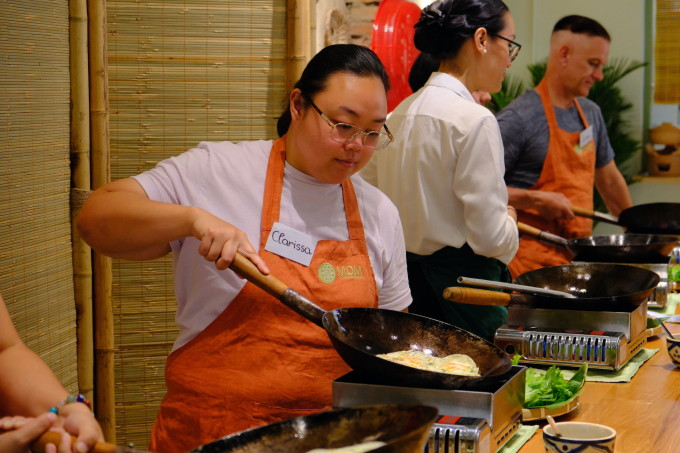
Clarissa, a Filipino tourist who visited Ho Chi Minh City in July, said she spent four days exploring the city and attending a Vietnamese cooking class before returning home. She makes an effort to find cooking classes on every trip to different countries.
"I apply what I've learned to cooking these dishes when I get home," Clarissa said, noting that Vietnamese food is low in oil, has harmonious flavors, uses plenty of vegetables, and is easy to incorporate into everyday meals. Through the class, Clarissa's understanding of Vietnamese cuisine was broadened to include more than just banh mi or pho.
According to Nguyen Trung Khanh, Director of the Vietnam National Tourism Administration, the Vietnam tourism development strategy until 2030 identifies cuisine as a key cultural element and one of the important products contributing to enhancing the competitiveness and brand of national tourism.
Many localities are also promoting food tours to attract tourists. Hai Phong pioneered this trend by launching the "Hai Phong Food Tour Map: Wandering Around and Checking In" in 2022, which became a booming trend on social media platforms.
In December, Da Nang kicks off. food menu With 10,000 culinary "passports" given to tourists to experience signature dishes such as Quang noodles, spring rolls, and banh mi at 50 restaurants suggested by the Department of Tourism, this is the first campaign the city has launched related to cuisine, hoping to provide an enjoyable experience for tourists and contribute to promoting local and regional cuisine.
Vietnamese cuisine further solidified its position on the world map with the appearance of Michelin-starred restaurants in Hanoi and Ho Chi Minh City in 2023. A year later, the culinary guide expanded to Da Nang. Experts believe that high-end cuisine is enabling Vietnam to compete internationally. Ha Quach (Vincent), a lecturer in Tourism and Hospitality Management at RMIT University, stated that the exceptional growth of the F&B industry in 2024 is partly due to the "Michelin effect" and the increasing reputation of Vietnamese cuisine. Mr. Ha cited a report from iPOS.vn, which indicates that the F&B industry is on a positive trajectory, with its market value projected to increase by nearly 11% in 2024 compared to 2023, reaching over 655 trillion VND.
The Michelin effect has had a positive impact on suppliers, staff, and the community. "The restaurants featured in the guide report increased revenue and bookings, contributing to the overall growth of the industry," said an RMIT lecturer.
Despite being considered a shining star driving tourism growth, Vietnamese cuisine still faces several challenges. Dr. Jackie Ong, Senior Head of Tourism and Hospitality Management at RMIT, stated that a major long-standing challenge has been maintaining high standards across all establishments, from street food stalls to upscale restaurants. This involves ensuring food safety and hygiene, especially in casual dining establishments.
"The F&B industry must simultaneously strike a balance between modernization and preserving its identity. It needs to innovate to meet international expectations without losing the essence of traditional Vietnamese cuisine," commented Jackie Ong.
Experts believe that Vietnamese cuisine has much potential and will continue to grow next year, especially with the emergence of foreign luxury travel companies offering culinary tours in Vietnam. Abercrombie & Kent (A&K), a luxury travel company in the US, announced on its website that it has chosen Vietnam as the first destination for its culinary experience tour series. The journey exploring Vietnamese cuisine is expected to launch in 2025, with tour prices starting from $6,995 (178 million VND) per person, limited to 18 guests per tour. After Vietnam, the company plans to expand the tour to countries such as Italy, France, Japan, and China.
The CEO of Klook Vietnam believes that Vietnamese cuisine is in a more competitive position than other countries in the region that have a strong food tour industry, such as Thailand and Singapore. Thailand is gradually becoming too familiar a destination, while Singapore is twice as expensive as Vietnam.
"Vietnam is an emerging culinary destination for Southeast Asian tourists, attracting many visitors from Indonesia, Malaysia, and the Philippines, forecasting positive results for 2025," said Mr. Nguyen Huy Hoang.
Source















![[Photo] Prime Minister Pham Minh Chinh holds a phone call with the CEO of Russia's Rosatom Corporation.](/_next/image?url=https%3A%2F%2Fvphoto.vietnam.vn%2Fthumb%2F1200x675%2Fvietnam%2Fresource%2FIMAGE%2F2025%2F12%2F11%2F1765464552365_dsc-5295-jpg.webp&w=3840&q=75)















































Comment (0)