

Reporter: In the atmosphere of excitement across the country as we look forward to the 79th anniversary of the August Revolution, could you share some of the glorious history of Gia Vien district in the 1945 uprising to seize power?
Comrade Ngo Hung Khanh: Gia Vien is a land of outstanding people and rich history, with a long-standing cultural tradition and a strategically important position in the struggles against invading enemies. Turning the pages of the history of the Gia Vien District Party Committee reveals the unwavering courage and heroism of our forefathers in the resistance wars to win independence and freedom for the nation, liberating our homeland.
Accordingly, on August 17, 1945, the order for the uprising reached the revolutionary base in Quynh Luu. After analyzing and assessing the specific situation of the revolutionary movement throughout the province, the Provincial Party Committee decided to choose Gia Vien as the starting point for the uprising and directed that victory be achieved in the very first battle. Implementing the Provincial Party Committee's resolution, the Gia Vien District Viet Minh directed the Party branches and Viet Minh groups in the communes to gather forces for the uprising. At that time, the villages and communes in the district were filled with unprecedented revolutionary fervor; the self-defense forces and mass national salvation groups eagerly prepared weapons and gathered, ready to launch the uprising simultaneously. The villages and communes of Loi Son, Ngoc Dong, Le Xa, Tri Hoi, Bich Son, Diem Giang, and Diem Xa eagerly awaited the hour of the uprising.
The Bich Son commune self-defense platoon received the order to revolt early. On August 18, 1945, they gathered their forces and marched to Me Street, joining forces with the self-defense forces and the people of Me Street to persuade the district chief to hand over power. On the night of August 18, 1945, District Chief La Xuan Mai fled the district capital. That same night, in the Quynh Luu revolutionary base area, and in the communes of Van Trinh, Le Xa, Tri Hoi, etc., revolutionary forces were busily preparing for the uprising.
On the morning of August 19, 1945, the armed forces liberated the Quynh Luu revolutionary base, the national salvation self-defense forces, and revolutionary masses from the villages and communes of Loi Son, Ngoc Dong, Sinh Duoc, Lac Khoai, Ngo Dong, Tri Hoi, Diem Giang, and Bich Son marched to the district town in groups of 5 to 7, blending into the crowds going to Me market, quickly surrounding the district town. The Viet Minh used loudspeakers to call on the people to rise up and participate in the uprising to overthrow the puppet government of the Japanese. Soldiers surrendered, and the revolutionary forces took control of the district town. Immediately after the successful uprising and seizure of power, the Viet Minh representatives of the district declared the abolition of the imperialist-feudal government of Gia Vien district and the establishment of a revolutionary government.
Following the great victory, on the afternoon of August 19, 1945, a number of patriotic young people from Gia Vien district marched to Nho Quan district to join the people and revolutionary forces of Nho Quan district in persuading soldiers to surrender, confiscating weapons and bringing them back to the revolutionary base in Quynh Luu.
Nearly 79 years have passed, but generations of people in the heroic Gia Vien homeland today remain proud and grateful to their ancestors for making great strides in the history of revolutionary struggle, winning independence and freedom for the nation, and liberating their homeland.
PV: Building upon that glorious tradition, the Party Committee, Government, and people of Gia Vien district have united and strived to build a homeland that is constantly improving. Could you share some of the outstanding achievements of the district in recent years?
Comrade Ngo Hung Khanh: Proudly inheriting the revolutionary traditions of our ancestors, the cadres, Party members, and people of Gia Vien, in each period, have always carried within themselves high aspirations and a strong sense of responsibility, constantly striving to learn, compete in labor and production, develop socio -economic aspects, and build their homeland.
One of the most noticeable changes is economic development. From a purely agricultural district, prone to natural disasters and floods, and among the poorest districts, Gia Vien has risen to become a developed district of the province. The district's economic growth rate has been high and sustainable for many years (averaging over 25% per year), with an economic scale exceeding 40,000 billion VND. The district's economic structure has shifted towards increasing the proportion of industry, construction, and trade-service sectors (currently reaching 97%).
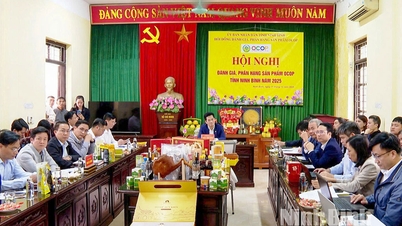
Agricultural production has developed relatively comprehensively towards organic and high-quality agriculture; strengthening linkages along the value chain. Policies and guidelines supporting agricultural production at the provincial and district levels have proven effective. The district has also actively developed OCOP products in its localities; to date, there are 10 provincial-level OCOP products with 3-4 stars in the district. Many integrated farm models generate incomes of 200-500 million VND per year.
Implementing the National Target Program for building new rural areas, the infrastructure system has been invested in comprehensively to meet development requirements, and the quality of life of the people has been improved. To date, the district has Gia Thanh commune achieving the model new rural area standard in the field of education , 10 communes achieving the advanced new rural area standard, and 90 villages and hamlets achieving the model new rural village/hamlet standard according to the criteria set for the 2021-2025 period.
The district has also focused on improving compensation and land clearance, infrastructure development, and attracting investment. Currently, the district has one industrial park (Gian Khau) and three industrial clusters (Gia Van, Gia Phu, Gia Lap) that are operational, attracting 56 businesses to invest in production and business, contributing significantly to the provincial budget. In addition, the number of businesses and production facilities outside the industrial parks and clusters has increased and are operating effectively, with 1,880 production and business establishments in the industrial and handicraft sectors, creating jobs for tens of thousands of workers, promoting economic development, and increasing income for workers in the district.
Trade, services, and tourism have developed comprehensively, with an average annual growth rate of 9.7%, 3.8 times higher than in 2020. Transportation infrastructure has received significant and synchronized investment, and many projects serving people's lives have been constructed, contributing to an increasingly civilized and modern rural landscape.
Along with focusing on economic development, the socio-cultural sector has also been given attention and promoted, the lives of the people have been increasingly improved and enhanced, and social security has been ensured. The quality of comprehensive education has been maintained and strengthened; the quality of specialized education has been improved. The work of protecting and caring for the people's health has been given attention and implemented comprehensively.

PV: Continuing the revolutionary traditions of our homeland, what will Gia Viễn district focus on in the coming period, Comrade?
Comrade Ngo Hung Khanh: In the coming time, the Party Committee and people of Gia Vien will continue to unite, strive, and be determined to achieve the targets set out in the Resolution of the 20th District Party Congress. This includes focusing on directing the implementation of planning work towards increasing the urbanization rate; continuing to implement the Gia Vien District Regional Construction Planning, Ninh Binh Province, until 2030, with a vision to 2050, approved by the Provincial People's Committee in Decision No. 697/QD-UBND dated June 1, 2020; completing the urban planning of Gian Khau and Van Long, aiming to build the district into a type 4 urban area by 2030.
Along with implementing the planning, the district is focusing on arranging and implementing the reorganization of commune-level and village-level administrative units in Gia Viễn district during the 2023-2025 period; arranging, reorganizing, and streamlining when merging commune-level administrative units according to the central government's policy and the province's guidance.
Actively attract investment resources for the development of industry and handicrafts. In particular, encourage and create favorable conditions for businesses and projects applying high technology, clean technology, and environmentally friendly technologies, as well as supporting industries and industries serving agriculture and rural areas, to operate and conduct business in the locality. Develop industry in a modern direction based on maximizing the existing capacity of factories, linked to restructuring the industrial sector, increasing product value and contributing significantly to the budget; promptly address difficulties and obstacles and provide effective support for businesses to recover and develop.
Effectively exploit existing tourism potential and develop additional tourism spaces. This includes focusing on connecting with regional tourism areas and destinations in Hanoi and Ha Nam. Develop agricultural economy towards circular agriculture, safe agriculture, organic farming, high-tech applications, and advanced production methods; focus on developing key products, specialty products, and OCOP products. Continue building advanced and model new rural areas. By 2024, Gia Vien aims to build 3 more communes meeting model new rural area standards, 2 communes meeting advanced new rural area standards, and 31 model new rural villages/hamlets.
Looking back at the proud past of our homeland to look towards the future with new achievements is what the Party Committee, Government, and people of Gia Vien are striving for. Although many difficulties and challenges still lie ahead, with the decisive leadership of the entire political system and the unity of the people, we believe that Gia Vien will increasingly develop and prosper, steadily progressing on the path of innovation, aiming to build the district into an advanced new rural area by 2025 and a type 4 urban area by 2030. This will contribute to the successful achievement of the province's overall goals: By 2030, Gia Vien will be a relatively prosperous province, a growth pole of the southern provinces of the Red River Delta, basically meeting the criteria to become a centrally-governed city with the characteristics of a Millennium Heritage City and a creative city. By 2035, it will become a centrally-governed city with the characteristics of a Millennium Heritage City and a creative city.
PV: Thank you, comrade!
Hong Giang ( performed )
Source: https://baoninhbinh.org.vn/viet-tiep-truyen-thong-cach-vang-xay-dung-que-huong-gia-vien/d20240816084336447.htm
![[Photo] Closing Ceremony of the 10th Session of the 15th National Assembly](/_next/image?url=https%3A%2F%2Fvphoto.vietnam.vn%2Fthumb%2F1200x675%2Fvietnam%2Fresource%2FIMAGE%2F2025%2F12%2F11%2F1765448959967_image-1437-jpg.webp&w=3840&q=75)
![[Photo] Prime Minister Pham Minh Chinh holds a phone call with the CEO of Russia's Rosatom Corporation.](/_next/image?url=https%3A%2F%2Fvphoto.vietnam.vn%2Fthumb%2F1200x675%2Fvietnam%2Fresource%2FIMAGE%2F2025%2F12%2F11%2F1765464552365_dsc-5295-jpg.webp&w=3840&q=75)


























![[OFFICIAL] MISA GROUP ANNOUNCES ITS PIONEERING BRAND POSITIONING IN BUILDING AGENTIC AI FOR BUSINESSES, HOUSEHOLDS, AND THE GOVERNMENT](https://vphoto.vietnam.vn/thumb/402x226/vietnam/resource/IMAGE/2025/12/11/1765444754256_agentic-ai_postfb-scaled.png)






























Comment (0)