

THANH HOA - Since breeding yellow ants, Mr. Mao's pomelo orchard has been free of pests, eliminating the need for pesticides, resulting in increased pomelo yield, and beautiful, delicious fruit.
THANH HOA - Since breeding yellow ants, Mr. Mao's pomelo orchard has been free of pests, eliminating the need for pesticides, resulting in increased pomelo yield, and beautiful, delicious fruit.
In today's market, there is a growing demand for delicious and safe organically grown fruit. This poses a significant challenge for farmers in implementing effective pest and disease control measures without compromising plant health and the quality of the harvested product.
One of the measures being adopted by many farmers in Thanh Hoa to protect crops and improve product yield and quality is raising yellow ants to control certain insect pests.
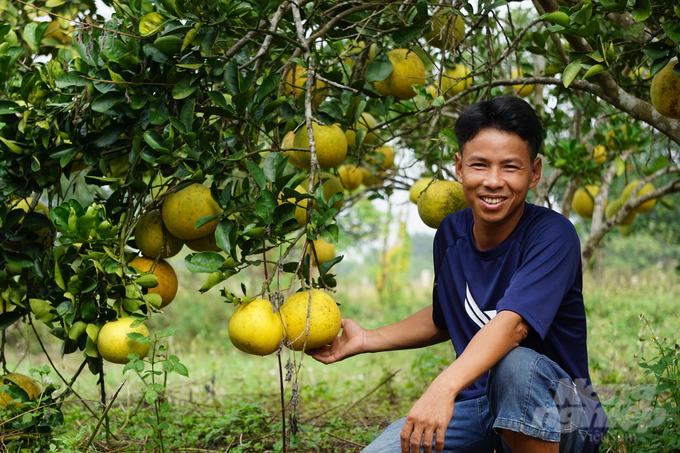
Mr. Mão's pomelo orchard is laden with fruit thanks to the "bodyguards" of yellow ants. Photo: Quốc Toản.
Mr. Trinh Dinh Mao (born in 1987 in Trinh Xa 1 village, Yen Ninh commune, Yen Dinh district, Thanh Hoa province) is still quite young but is considered one of the largest landowners in Thanh Hoa. Besides 10 hectares of rice paddies, Mr. Mao also owns a 1.5-hectare Dien pomelo orchard that is currently in its harvesting period.
Like many farmers in the commune, Mr. Mao previously used mainly chemical fertilizers to fertilize his crops. Mr. Mao calculated: “Every year, my family spends about 30 million VND on fertilizers and other inputs to care for our pomelo orchard. Furthermore, the use of harmful chemicals also poses risks to human health, the environment, and product quality.”
In early 2024, Mr. Mão collaborated with the Regional Plant Protection Center IV (Department of Plant Protection) and the Agricultural Service Center of Yên Định District (Thanh Hóa) to implement a model for breeding and using yellow ants to control pests on pomelo trees. According to the orchard owner, this model is not new, but to achieve effectiveness, farmers must follow the correct procedures and techniques for caring for the ants to ensure the population size in the orchard.
After a period of breeding, Mr. Mão's pomelo orchard now has hundreds of yellow ant nests, estimated to contain millions of ants. The pomelo trees are connected by thin plastic wires to facilitate the ants' movement. In the orchard, Mr. Mão uses many plastic containers filled with food (chicken intestines, fish heads, etc.) placed on the tree trunks for the ants to supplement their nutrition. In particular, for fallen pomelos, Mr. Mão cuts off the outer peel and leaves it at the base of the tree for the ants to drink when needed; the rest he composts to make organic fertilizer for his plants.
"Yellow ants are very easy to raise, requiring little time, effort, or cost for care, but breeders must understand their habits. For example, you shouldn't overfeed them, to avoid them becoming full and lazy to hunt. Or, if you don't provide enough food, the ants will leave, and breeders will waste time repopulating," Mr. Mão noted.
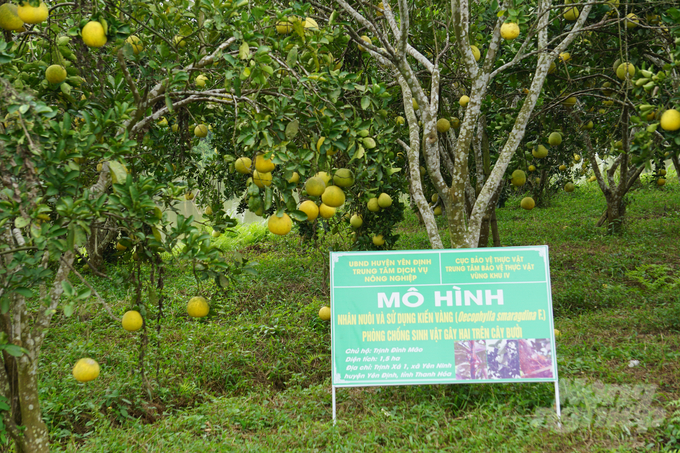
The model of breeding and using yellow ants to control pests on pomelo trees is showing clear effectiveness, contributing to increased productivity and quality of fruit trees.
After experimenting with raising yellow ants in his pomelo orchard, Mr. Mão realized that this beneficial natural predator could eliminate many harmful organisms such as stink bugs, aphids, leaf miners, mealybugs, and stink ants… Therefore, pomelo trees where yellow ants live are almost free of harmful insects.
Furthermore, when raising yellow ants, farmers do not need to use pesticides or spend time spraying them. This helps balance the ecosystem, protect the environment, and reduce investment costs.
“Previously, our family's pomelo orchard was often damaged by insects, causing premature fruit drop or stunted fruit growth. After implementing this method, the orchard experiences less fruit drop because the yellow ants control and eliminate the harmful insects. In addition, the yellow ants help farmers warn of water shortages in their crops, allowing for timely water replenishment,” Mr. Mão explained.
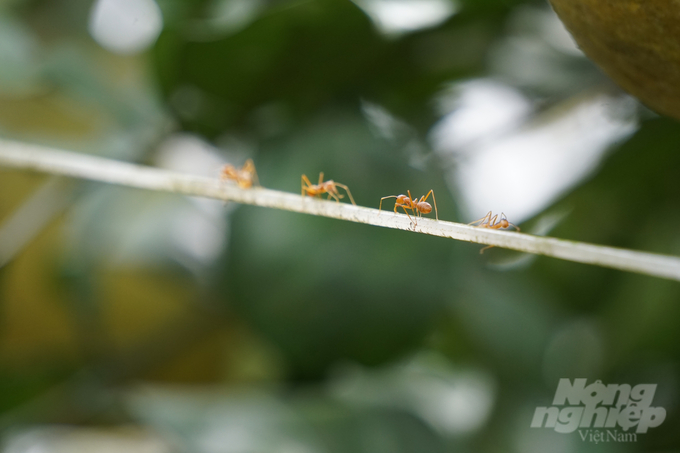
Yellow ants have become important "guardians" for citrus fruit trees. Photo: Quoc Toan.
Mr. Mão noted that during the implementation of the model, farmers absolutely must not use chemicals or pesticides to avoid depleting the ant population and affecting the health of the yellow ants.
According to Mr. Mao, the only drawback of raising yellow ants in the garden is that harvesting is a bit difficult because if you're not careful, you'll get bitten. "If you don't wear protective clothing, you'll get bitten very painfully. Therefore, before harvesting, you need to water the ant nest with enough water to prevent them from coming out."
Thanks to the systematic implementation of raising yellow ants in his pomelo orchard, the model has now brought double benefits: it helps increase the sweetness of the fruit by preventing insect attacks, and it also helps the trees grow well. This year, Mr. Mão expects to harvest about 10 tons of pomelos, a yield 20% higher than in 2023. With a 1.5-hectare pomelo orchard and 10 hectares of rice paddies, Mr. Mão's family earns approximately 300 million VND annually after deducting expenses.
Source: https://nongsanviet.nongnghiep.vn/vuon-buoi-tang-20-san-luong-qua-dep-ngot-ngon-chi-phi-giam-nho-kien-vang-d409391.html



















![Passion fruit 'capital' faces sustainability challenge: [Part 3] Building supply chain linkages](https://vphoto.vietnam.vn/thumb/402x226/vietnam/resource/IMAGE/2025/12/12/1765517075835_1232-akk00534-130606_948.jpeg)


![[Photo] Prime Minister Pham Minh Chinh holds a phone call with the CEO of Russia's Rosatom Corporation.](/_next/image?url=https%3A%2F%2Fvphoto.vietnam.vn%2Fthumb%2F1200x675%2Fvietnam%2Fresource%2FIMAGE%2F2025%2F12%2F11%2F1765464552365_dsc-5295-jpg.webp&w=3840&q=75)














































Comment (0)